
 Universal High Income
 Axis Robotics
 Pudgy Penguins
 Pearl
 MESSIER
 Orbio.so
 Aerodrome Finance


Ethereum staking reached an all-time high of 43.8 million ETH during the third quarter of 2026, according to Bitwise. The amount represented 35.9% of the network’s supply as institutional participation continued expanding.
However, Bitwise’s October 20 staking report identified a divergence between growing deposits and declining validator returns. Ethereum’s annualized gross staking yield fell to 2.63%, compared with 2.81% in the previous quarter.
Solana experienced a similar trend, with 69% of its supply staked as yields declined. The findings highlight changing economics across major proof-of-stake networks.
Ethereum Staking Demand Rise in 2026 with BitMine Driving Growth
In the first nine months of 2026, Ethereum recorded a net inflow of 7.96 million ETH staked. This is six times higher than the 1.31 million ETH staked in the same period last year.
A major contributor to this surge is the interest in staking among institutional investors, particularly Bitwise. The Ethereum treasury company has staked 5.07 million as of September 27, a sizable jump from 0.41 million ETH in December 2025.
Beyond BitMine driving staking growth, technical upgrades to the Ethereum network have also contributed to it. The Pectra upgrade in May 2025 allows validators to stake their consensus rewards automatically.
While execution rewards do not automatically get restaked, the compounding of consensus rewards means that more ETH gets restaked, increasing the overall staking volume.
The Pectra upgrade also enables the consolidation of several validators. The Bitwise report noted that this has reduced infrastructure costs while also reducing the number of validators from 1.1 million to 881,000.
Meanwhile, Ethereum is not the only network that has experienced a surge in staking volume. Solana also saw increased staking volume.
69% of the Solana supply is now staked, up from 68% in the previous quarter, with 440.5 million SOL. However, the amount of HYPE actively staked on Hyperliquid dropped from 437.29 million to 436.47 million while the average NEAR staked remains the same.
Staking Yield is Dropping as Volume Rises
Interestingly, the rise in the volume staked in ETH and SOL has also been matched by a corresponding decline in staking yield. Annualized staking yield on Ethereum is now down to 2.63% from 2.81% in Q2.
The decline in revenue contributed to the fall in yields. Ethereum generated only 18,210 ETH in revenue in Q3, averaging 198 ETH per day.
This happened despite the high transaction volume in Q3, at around 199.32 million. In Q2, it averaged 331 ETH in daily revenue despite processing only slightly more transactions.
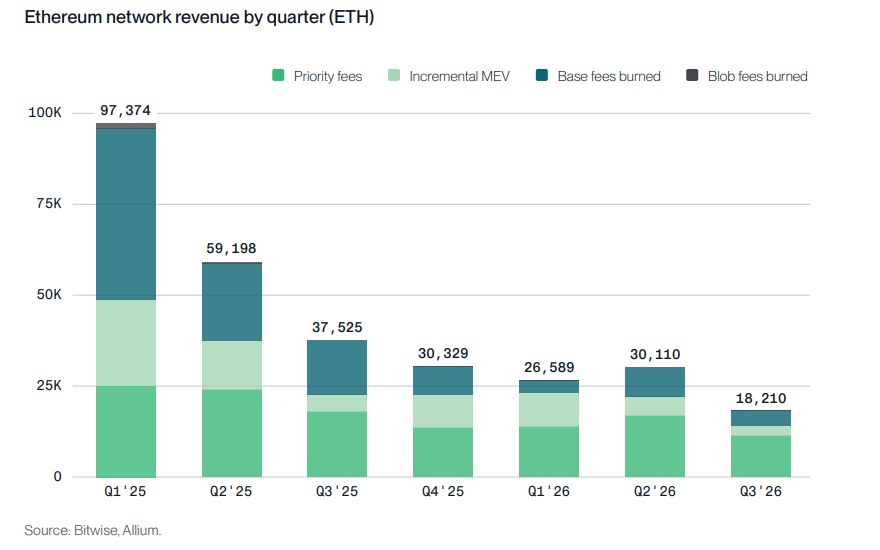
The drop in Ethereum revenue is mostly due to lower transaction costs on the network. With the network capacity increasing, it was able to easily process the larger volume without any major impact on blockspace.
Solana’s annualized yield has also been declining over the past year, falling to a new low of 5.99%. It was around 9.07% in Q2 of 2025 and 6.38% in Q2 of 2026.
With Solana stakeholders approving a faster disinflation schedule a few months ago, the network could see a further drop in staking yield once the proposal is activated.
This article is for informational purposes only and does not constitute financial or investment advice. Cryptocurrency staking involves price volatility, operational risks, potential penalties, and variable returns. Investors should conduct independent research and consult a qualified financial adviser before making investment decisions.