
 Universal High Income
 Axis Robotics
 Pearl
 Aerodrome Finance
 Pudgy Penguins
 Zcash
 Quantus


Ethereum news this week centers on the Glamsterdam network upgrade as developers prepare for another major testnet activation. The Ethereum Foundation confirmed that Hoodi will undergo the upgrade on October 26, following Sepolia’s October 6 activation.
The announcement comes as Ethereum price remains under pressure, trading near $2,384 on October 20. Technical analysts continue monitoring lower support levels after ETH struggled to sustain its recent recovery.
Glamsterdam aims to improve Ethereum’s block production and transaction processing capabilities. However, the upcoming activation applies only to Hoodi, with no confirmed mainnet date.
Ethereum News Confirms October 26 for Glamsterdam Upgrade on Hoodi Testnet
The Ethereum Foundation has scheduled Glamsterdam for the Hoodi testnet on October 26, 2026, at 17:42:48 UTC. Hoodi is the second public testnet to run the fork after Sepolia.
A clean run on both usually clears the way for developers to pick a mainnet date, though none has been announced yet.

Glamsterdam combines two upgrades. Amsterdam covers the execution layer and Gloas covers the consensus layer.
The goal is to make Ethereum’s base layer process transactions more efficiently without giving up security or decentralization.
The gas limit is getting a lot of attention in Ethereum news coverage. Hoodi will raise it to 200 million at activation.
How Glamsterdam’s ePBS and Block-Level Access Lists Could Improve Ethereum Throughput
The headline feature is enshrined proposer-builder separation (ePBS), defined in EIP-7732. In theory, this reduces reliance on trusted third-party relays and gives validators more time to check execution payloads.
The second big piece is block-level access lists, defined in EIP-7928. Every block will carry a required list of the accounts and storage slots it touches, along with the resulting state changes.
With that list, Ethereum clients can tell which transactions depend on each other and run disk reads, validation and state-root work in parallel. Parallel processing is what would make larger blocks practical later on.
Glamsterdam also changes gas prices for creating new state, accessing existing state, calldata and access lists. The aim is to charge closer to what each action actually costs the network.
Smart contracts that rely on fixed gas assumptions may need updates. The fork also adds ETH transfer logs, a slot-number opcode and a larger maximum contract size.
Anyone hoping this Ethereum news means cheaper fees should keep expectations in check. Fees will still move with demand and transaction complexity.
Can Ethereum Hold Above $2,200? Ethereum News Points to Heavy Selling Pressure
Upgrade headlines have filled the Ethereum news cycle, but they haven’t helped the price much. On the 1-hour chart, ETH trades at about $2,384.55 after a series of lower highs.
The price has been moving sideways in a tight $2,380–$2,400 range, with little buying interest. RSI readings sit between 31 and 43, and the fastest one is nearing oversold territory.
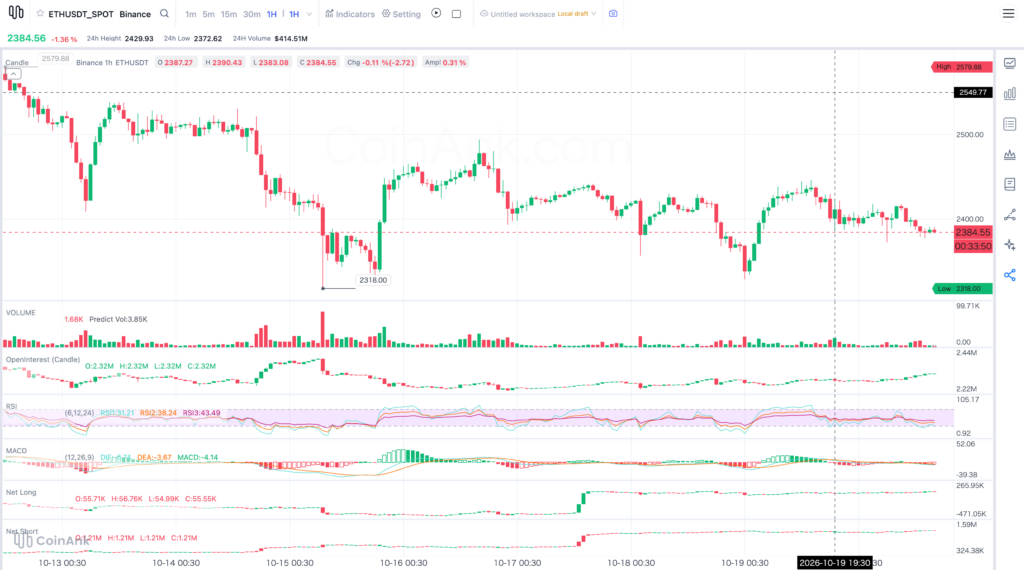
The MACD histogram is slightly negative, so bears still have a small edge. Open interest is rising while the price stays weak. That means new positions are opening, but the chart alone can’t show whether traders are betting long or short.
Immediate support is at $2,370–$2,380, with the bigger swing low near $2,318. On the way up, ETH needs to clear $2,400–$2,420 first, then $2,450–$2,480.
Trader Ted summed up the mood on X. “Buyers are disappearing, and any small pump is getting sold,” he wrote.
Ethereum Price Prediction: Could ETH Revisit the $2,150–$2,200 Zone?
Ted expects Ethereum to revisit the $2,150–$2,200 zone before it turns around. From current levels, that would be another drop of roughly 8% to 10%.
The short-term chart supports caution. A break below $2,370 would bring $2,350 into view, followed by a retest of $2,318.
If that swing low gives way, Ted’s target zone comes into play. For the picture to improve, ETH needs to recover above $2,420 and push cleanly through $2,450. If neither happens, sideways trading between $2,370 and $2,400 looks most likely.
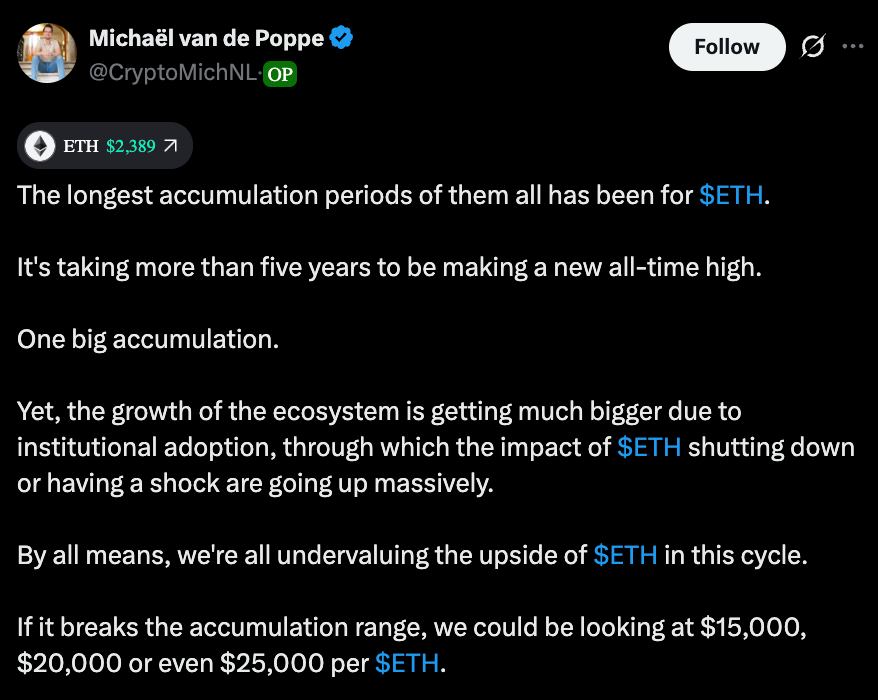
Longer-term views are much more optimistic. Analyst Michaël van de Poppe described ETH’s multi-year range as “one big accumulation,” noting it has taken more than five years to reach a new all-time high.
He believes “we’re all undervaluing the upside of $ETH in this cycle” and says a breakout from the range could send it to “$15,000, $20,000 or even $25,000.”
This week’s Ethereum news gives bulls a strong technical story, while the chart favors bears. Glamsterdam’s Hoodi launch on October 26 is the next date on the calendar, and a smooth testnet run could bring a mainnet schedule closer.