
 Hyperliquid
 Beam
 Bitcoin
 Lighter
 Aave
 BNB
 Pepe


MSFT stock attracted attention after Microsoft launched a $25 billion bond offering and Wells Fargo raised its price target to $750. The financing follows quarterly earnings showing accelerating Azure growth and substantial AI infrastructure spending.
The offering reportedly attracted $115 billion in investor orders at its peak. Meanwhile, analysts continued assessing whether Microsoft’s expanding AI business could justify higher valuations.
MSFT Stock Gets $750 Wells Fargo Price Target
Wells Fargo analyst Michael Turrin raised Microsoft’s price target from $725 to $750 on October 29. The bank maintained its Overweight rating following the company’s fiscal first-quarter earnings.
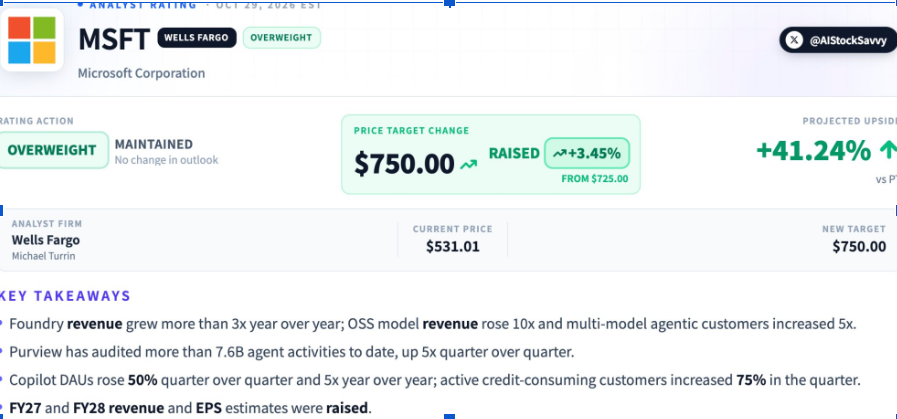
The revised target represents approximately 41.2% upside from Microsoft’s October 28 closing price of $531.01. However, the estimate reflects the analyst’s outlook rather than a guaranteed return.
Turrin highlighted demand for Microsoft’s cloud, security and artificial intelligence services. His assessment identified stronger enterprise adoption across several AI-related products.
Microsoft Foundry revenue more than tripled from a year earlier, according to the analyst. Open-source model revenue increased tenfold, while customers using multiple AI models rose fivefold.
Copilot daily active users also increased 50% quarter over quarter. Meanwhile, Microsoft’s Purview security platform audited more than 7.6 billion AI agent activities.
Wells Fargo increased its fiscal 2027 revenue forecast from $394 billion to $398.5 billion. Its earnings estimate also rose from $19.59 to $19.83 per share.
Separately, Stifel raised its Microsoft target from $575 to $650 while maintaining a Buy rating. The revisions reflected optimism surrounding Azure and enterprise AI demand.
For MSFT stock, stronger analyst expectations offer a positive signal. Nevertheless, future returns depend on earnings execution and the company’s valuation.
Microsoft Prepares First US Bond Sale Since 2017
Bloomberg reported that Microsoft was seeking at least $25 billion across as many as 10 bond tranches. The proposed maturities range from two to 40 years, with the longest notes due in 2066. Pricing discussions placed those notes as much as 1.35 percentage points above comparable U.S. Treasuries.
JPMorgan Chase, UBS, and Wells Fargo are leading the offering, which follows Microsoft’s $17 billion debt sale in 2017. Microsoft’s preliminary securities filing describes eight fixed-rate series and two floating-rate series. The final amount remains subject to investor demand, and the company has not announced completed pricing.
Proceeds may support capital spending, working capital, acquisitions, share repurchases and debt repayment, according to the filing. Microsoft joins technology companies seeking outside financing as infrastructure costs rise across the AI industry. The spending also supports chip demand, which featured in recent coverage of Nvidia’s AI partnerships.
Azure Growth Accompanies Rising Infrastructure Spending
Microsoft reported fiscal first-quarter revenue of $92.3 billion on October 28, representing 19% annual growth. Adjusted earnings reached $4.89 per share, while Azure revenue grew 48%, and Microsoft Cloud revenue reached $63.9 billion. These results preceded the bond announcement and the latest increases in analyst price targets.
Quarterly capital expenditures reached $45.2 billion, including finance leases, while cash spending on property and equipment totalled $39.4 billion. The company generated $18.6 billion in free cash flow, and its cash and short-term investments stood at $64.5 billion. Management expects capital spending to exceed $50 billion in the December quarter.
Microsoft has also developed its own AI chips, including the Maia 300 processor, alongside its purchases of external computing equipment. Chief Financial Officer Amy Hood said, “Microsoft would seek funding when we believe it is attractive to do so.”
Microsoft expects December-quarter revenue between $96 billion and $97.1 billion as cloud demand continues to grow.
This article is for informational purposes only and does not constitute financial advice. Equity and bond investments involve market risks and potential losses. Analyst price targets are forecasts, not guaranteed outcomes.