 WASTED
 Official Trump
 Pearl
 Lucia
 Pudgy Penguins
 Sky
 EVAA Protocol

Ethereum’s Pectra upgrade, activated on May 7, 2025, changed what an existing account can do without requiring it to move to another address. One of its components, EIP-7702, allows a conventional account controlled by a private key to use smart contract code. Functions such as grouping operations into a batch can therefore be made available through an existing account. The address can stay familiar while the account gains programmable behavior.
The distinction appears in the Ethereum Foundation’s May 2026 explanation of how EIP-7702 changes the account model. It describes a mechanism for connecting an account to deployed code while preserving its address and original key authority. Understanding that mechanism means separating the account recorded on Ethereum from the wallet software used to interact with it. A network upgrade establishes what the protocol permits; software determines how that capability reaches users.
An address is separate from the wallet interface
An Ethereum address identifies an account, while a wallet supplies the interface for interacting with it. Account upgrades discussed in the latest blockchain headlines can add functions at an address already in use. The wallet presents the controls for those functions, while the account’s configuration determines which code it executes. An interface update and a change to the account’s execution capabilities are distinct developments, even when they arrive as part of the same release.
Ethereum has distinguished externally owned accounts, controlled by a private key, from contract accounts, which execute deployed code. EIP-7702 allows an existing key-controlled account to use contract logic without replacing it with a separate contract account. The interface through which the owner sees those functions remains a different piece of software.
An account page can display the account and implementation addresses. Etherscan’s June 2025 guide to EIP-7702 accounts describes a delegated-address field alongside the account’s details. The account address identifies the user’s account, while that field identifies its code implementation. Displaying both addresses records a relationship between them; it does not mean the owner has migrated from one account to another.
Delegated code supplies account functions
For an externally owned account (EOA), delegation begins with an authorization signed with its private key. That authorization specifies a delegation target: the address of code already deployed on Ethereum. The network records a pointer to that code in the existing account. When the code runs through this delegation, it operates as that account. Its deployment address identifies the implementation; the user keeps the account address through which the functions operate.
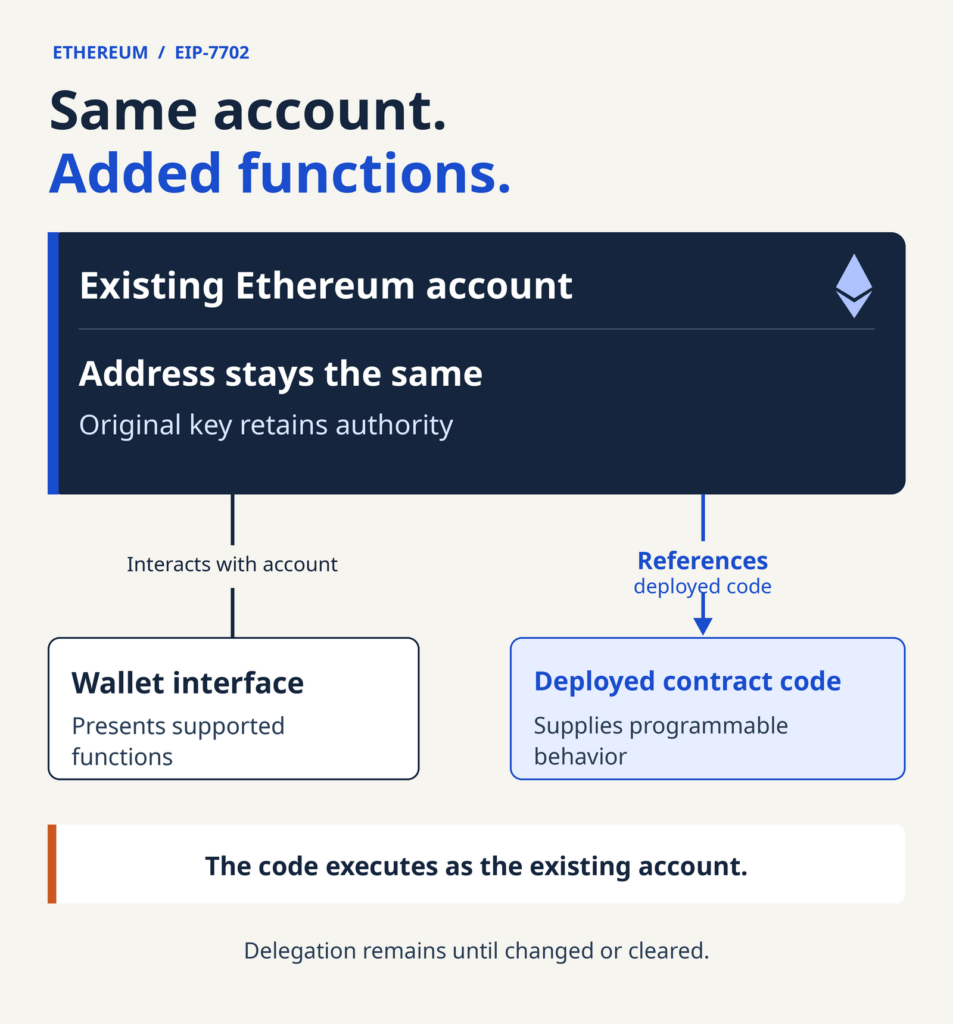
Delegation remains active until changed or reverted. It is not a temporary setting that disappears when the transaction establishing it finishes. That persistence makes delegation part of the account’s ongoing configuration, distinct from the individual operations subsequently performed through it.
Batching shows what programmable behavior contributes. Multiple operations can be organized for execution within one transaction, with the delegated implementation providing the logic. In an atomic batch, every operation succeeds, or none does. The network’s delegation mechanism and the code’s batching function perform different jobs: one establishes which code to execute, while the other determines the supported behavior.
The Etherscan guide above documents Ambire’s batching implementation and explains that its batched actions appear under one transaction hash in the explorer. Individual actions remain visible within that record. A single transaction can therefore contain several operations; counting transactions and counting actions describe different things. Batching changes how work is grouped without requiring a new account address.
The account can have only one delegation target at a time. A later delegation replaces the earlier one, including when the same address is used across supporting wallets. Opening the account through another wallet does not give that application an independent delegation slot.
Wallet software determines which functions appear
Protocol support does not specify an entire wallet product. Developers supply the delegated implementation, connect supported functions to the interface, and determine how applications request them. The same underlying standard can support different experiences without changing the basic account model.
The Foundation’s guide identifies ERC-5792 as an interface for applications to request a batch of calls from a wallet. Calls are requests to execute code. The wallet decides which account system handles the request, which can include EIP-7702. An application can therefore request a function without prescribing how the wallet implements it.
EIP-7702 creates room for programmable account functions; the particular code and surrounding software establish which functions are actually available. Recovery options, alternative authentication, and other account features each require their own implementation. They do not appear automatically because the network recognizes delegation.
In its June 2025 description, Etherscan recorded a separate account-update step in MetaMask and automatic delegation triggered by activity in Ambire. Both used EIP-7702, but their activation flows differed. The difference appeared in how software arranged access to the capability, without changing the underlying requirement for an account authorization.
The original key retains control
The original private key retains ultimate authority over the EOA, including the ability to authorize a replacement delegation or clear it. Delegated code can still define how its supported operations are authorized. An additional authentication method belongs to that implementation; it does not erase the original key or make its control irrelevant.
The power to change the delegation is separate from the rules governing individual operations. A wallet can expose a new way to authorize an action while the original key still controls which implementation the account uses. The visible experience can change substantially without requiring the owner to establish another address.