 WASTED
 Lucia
 Pearl
 Official Trump
 Sky
 EVAA Protocol
 Solana

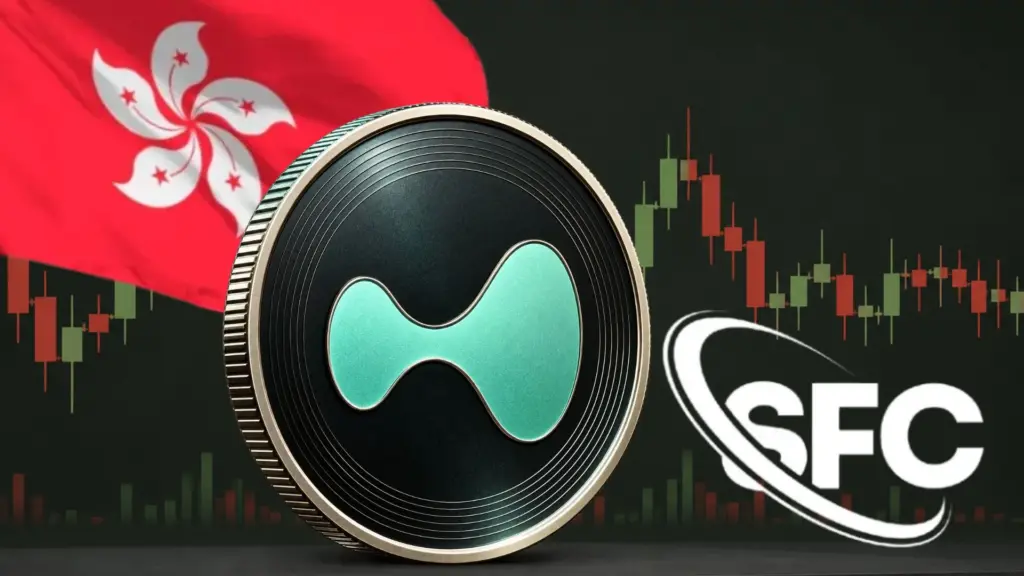
The HYPE price stayed relatively calm on November 19 after Hong Kong’s Securities and Futures Commission placed Hyperliquid on its list of suspicious virtual asset trading platforms.
The token traded in the mid-to-high $60s, moving largely in step with a softer crypto market instead of breaking down on the news.
Hong Kong SFC Flags Hyperliquid as Suspicious Platform
According to the SFC’s official website, the regulator added “Hyperliquid / Hyperliquid Hong Kong” to its “Suspicious Virtual Asset Trading Platforms” alert list on November 18, 2026.
The entry names the platform’s trading interface, app.hyperliquid.xyz/trade, and states plainly that the entity is not licensed by the commission.
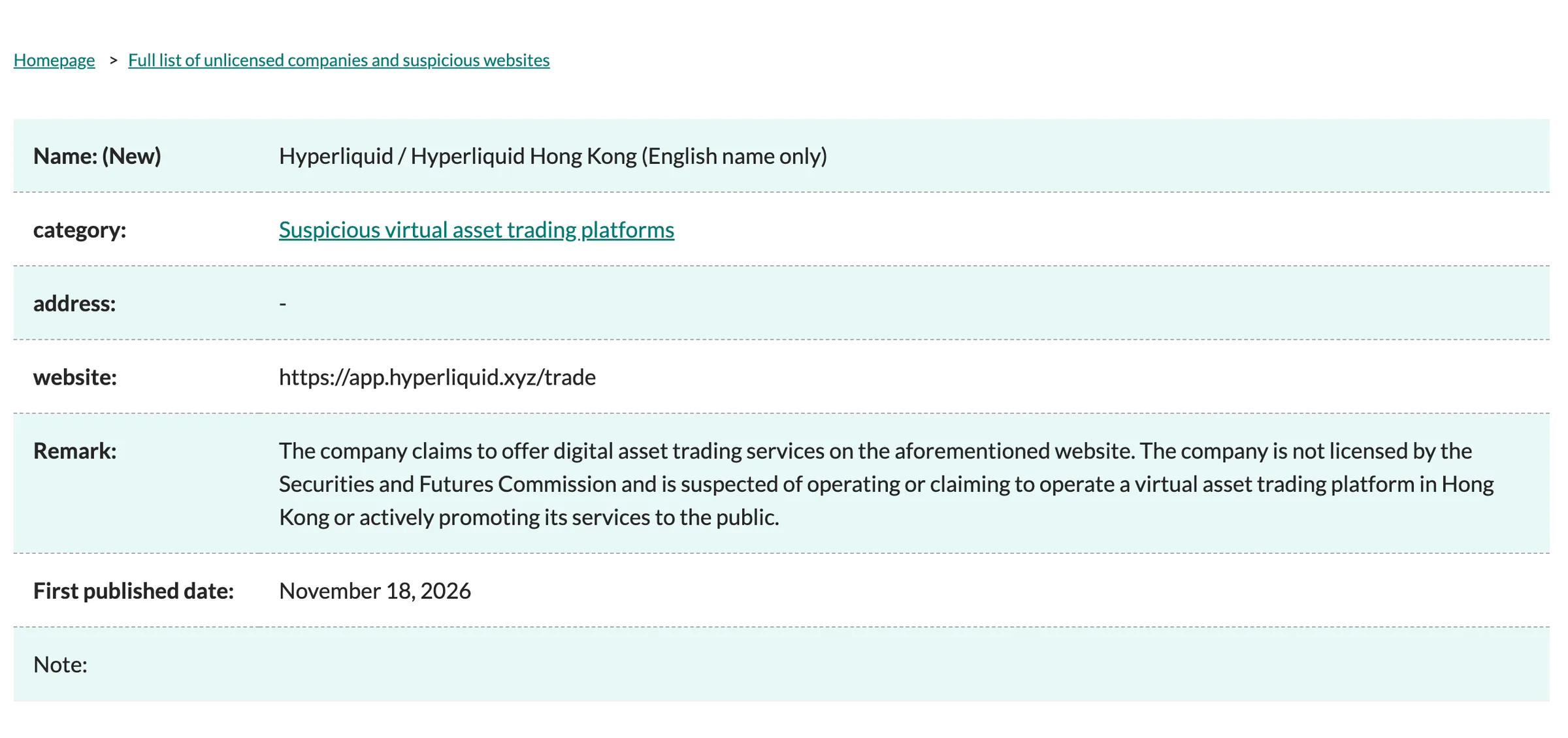
The SFC suspects Hyperliquid of operating, or holding itself out as operating, a virtual asset trading platform in Hong Kong, or actively marketing its services to the Hong Kong public.
It does not accuse Hyperliquid of fraud, and it does not order the platform to shut down. That distinction matters for anyone tracking the HYPE price.
Why Hong Kong Added Hyperliquid to Its Alert List
Hong Kong requires any virtual asset trading platform serving local investors to hold an SFC license. The alert list warns the public about platforms the regulator believes are reaching local users without one.
The size of the platform makes this listing stand out. Castle Labs data from November 19 showed Hyperliquid processing about $10.1 billion in perpetual futures volume over 24 hours, roughly 51% of the on-chain perp DEX volume the firm tracks.
The platform also generated about $72.6 million in revenue over the previous 30 days. That scale is why the warning carries weight for the HYPE price.
Hong Kong is not the first regulator to raise concerns. The UK Financial Conduct Authority issued a warning about Hyperliquid in May 2026, saying it may be offering financial services there without authorization.
Singapore’s Monetary Authority added Hyperliquid to its Investor Alert List on June 26, 2026. These warnings do not amount to a global ban, since each regulator works under its own rules.
What the SFC Warning Means for Hyperliquid Users and HYPE Price
For users in Hong Kong, the main issue is protection. The SFC warns that anyone dealing with an unlicensed platform does not have the safeguards provided by SFC supervision.
If such a platform fails, gets hacked, collapses or misappropriates funds, users could lose their assets, and legal recourse may be hard to obtain where the platform has no Hong Kong presence.
Hyperliquid’s website has not been blocked, trading has not been suspended and no tokens have been frozen.
On November 19, 1inch announced that Hyperliquid-powered perpetual futures were now live through its dApp and Android wallet in eligible regions, so the platform’s infrastructure is still growing.
HYPE Price Analysis: Can the Token Hold Support?
The immediate HYPE price reaction looked muted. On the 1-hour chart, the HYPE price sits around $69.13 after recovering from a sharp drop.
The token fell from a $75.35 high to about $60.03, a decline of roughly 20%, before buyers stepped in. It has since printed higher lows, bouncing from the $66 to $67 area.
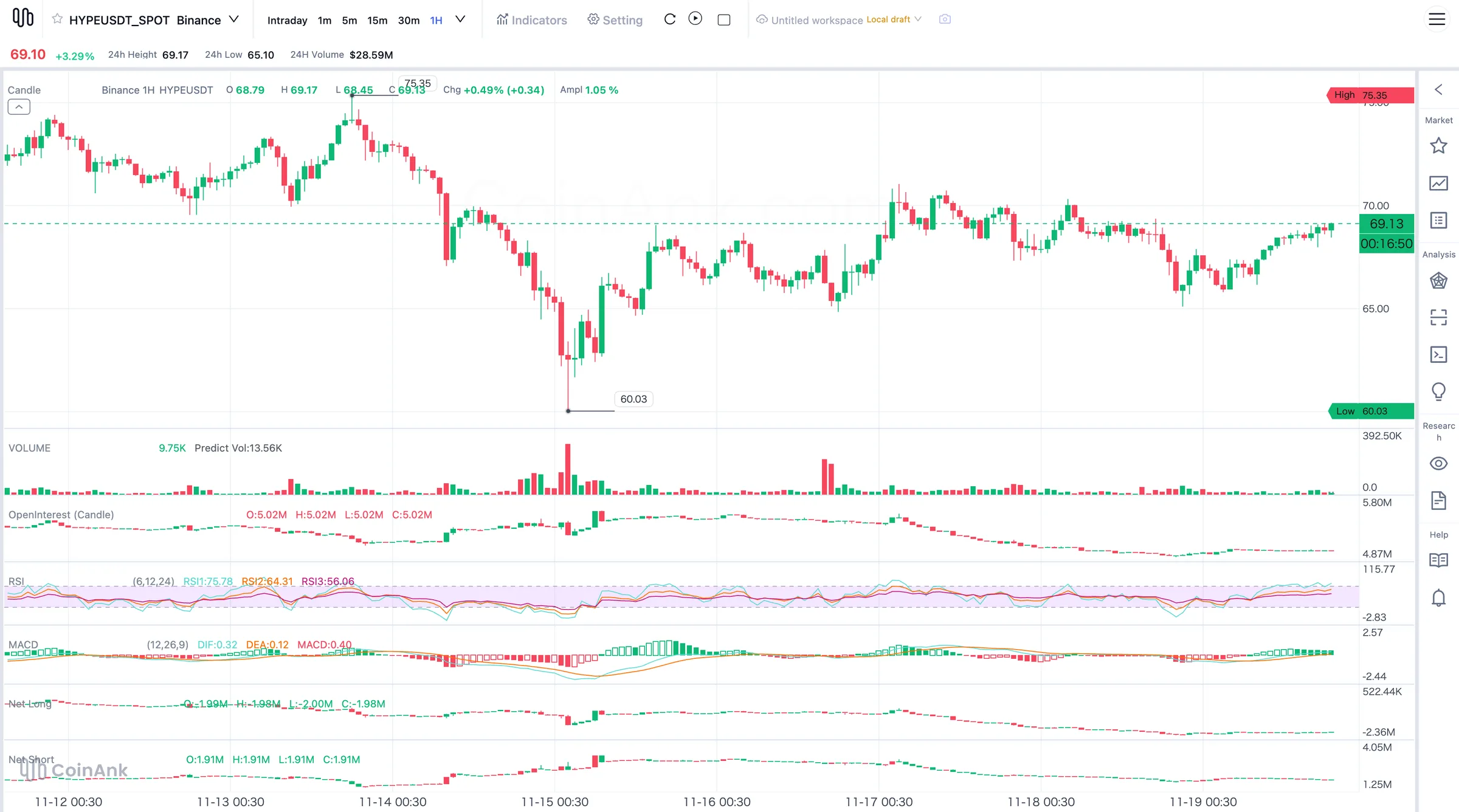
The $70 to $70.50 zone is the immediate test. Sellers have appeared there repeatedly, and a clean hourly close above $70 would improve the setup. Above that, $72 to $73 is the next resistance, followed by the $75.35 swing high.
On the downside, $68 is the first short-term support, with $66 to $67 below it. A loss of $65 would weaken the recovery and put the $60 to $61 region back in play.
Chart readings lean bullish but stretched. The fast RSI sits near 75.8, in overbought territory, while slower readings at 64.3 and 56.1 have more room to run. MACD has turned positive, with a growing histogram.
If HYPE breaks $70 with rising volume and open interest, a move toward $72 to $73 and then $75.35 becomes realistic. A rejection at $70 followed by a drop below $66 would hand control back to sellers.
This article provides cryptocurrency market and regulatory information, not investment advice. Regulatory alerts do not necessarily establish misconduct. Cryptocurrency and leveraged trading carry substantial risks, and technical levels do not guarantee future prices.