 Derive
 Cool Dog
 Pepe Intelligence
 Bitcoin
 Pudgy Penguins
 Pearl
 Hyperliquid

BitMine bought another 7,819 ETH last week, lifting its treasury to 6,085,564 ETH. That stack equals about 4.98% of Ethereum’s 122.2 million token supply. It leaves the company a hair short of the 5% goal it has chased for 17 months.
The company shared the update on November 23. It values its crypto, cash, marketable securities and "moonshot" stakes at $11.1 billion, with ETH priced at $1,713 as of November 22.
The timing is rough for BitMine stock, which has lost nearly half its value since its October 21 peak. Ethereum also fell as low as $1,538 over the weekend before bouncing.
BitMine Adds 7,819 ETH as Holdings Surpass 6.08M
The new purchase keeps a long buying streak alive. BitMine has added ETH every single week since it moved to an Ethereum treasury strategy on June 30, 2025.
"Bitmine’s track record of consistent buying of crypto is unmatched by any public company in the world," said Executive Chairman Tom Lee.
Beyond ETH, the balance sheet holds 216 BTC, a $180 million stake in Beast Industries, a $54 million position in Eightco Holdings (ORBS) and $50 million in other moonshots at cost. Cash and marketable securities come to $384 million.
Lee also pointed to Vitalik Buterin’s recent comment that ETH works as a store of value. He said ETH supply has grown 0.90% a year since BitMine’s pivot, close to Bitcoin‘s 0.82%.
By his numbers, Solana‘s supply grew 7.6% a year over the same stretch, XRP‘s 5.4% and Cardano‘s 2.9%. Lee argues that ETH and BTC both count as hard money on that measure, while the other large tokens are far more inflationary.
BitMine’s ETH Staking Revenue Could Reach $286M
BitMine now stakes 5,227,037 ETH. That is about 86% of its holdings, worth roughly $9 billion at $1,713 per token. The company says it has staked more ETH than any other entity in the world.
At the current 2.74% seven-day yield, the staked balance earns about $245 million a year in rewards. If all 6.09 million ETH were staked, the company estimates that figure would climb to $286 million a year.
Much of the staking runs through MAVAN, the Made in America Validator Network that BitMine launched earlier in 2026. It started as infrastructure for the company’s own treasury and now also serves institutional investors, custodians and ecosystem partners.
Can Ethereum Hold Key Support? ETH Price Analysis
The hourly ETH chart on Binance shows a sharp drop on November 21. The Ethereum price fell from around $1,720 to $1,538 on the heaviest selling volume of the week.
ETH got back above $1,700 on November 22 and spent most of November 23 grinding between $1,700 and $1,750. Then a strong hourly candle pushed it to about $1,823, up 6.75% on the day.
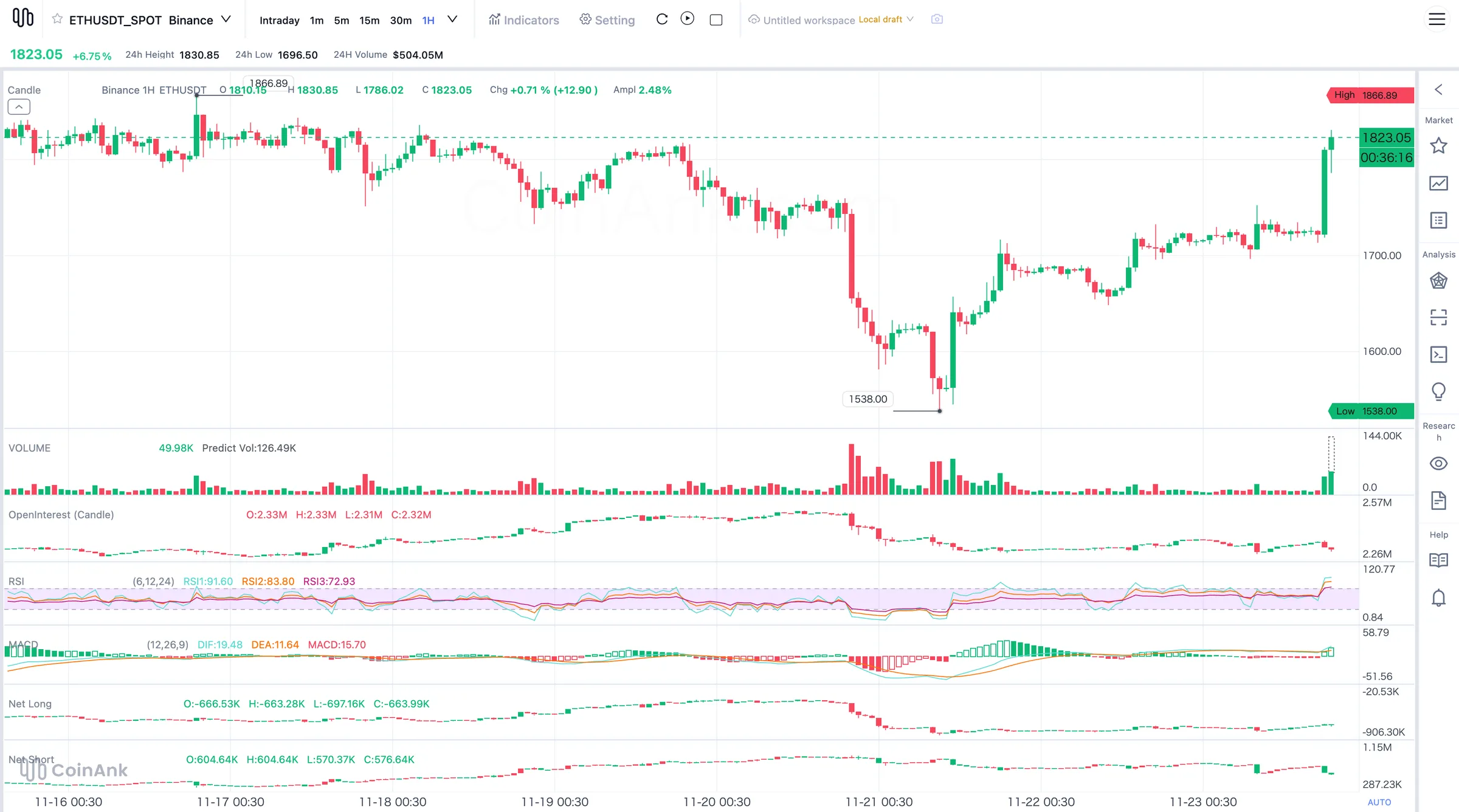
Resistance sits at $1,866.89, the high from November 17. A clean hourly close above it would push it to $1,900.
On the downside, $1,700 is the first support to watch, followed by the $1,538 weekend low. Losing $1,700 would put Ethereum back under the $1,713 price BitMine used to value its holdings.
BMNR Stock Chart Shows Deeply Oversold Readings
BitMine stock closed Friday at $12.96 on the NYSE, down 2.19% in the final hour. The hourly chart shows a steady run of lower highs since the October 21 peak near $24.50. The steepest drop came on November 20, after shares fell through the $15 level.
Both oscillators on the chart are pinned low. The Ultimate Oscillator reads 25.49, its weakest level in more than six weeks, and Stochastic RSI sits at 0.00 on both lines.
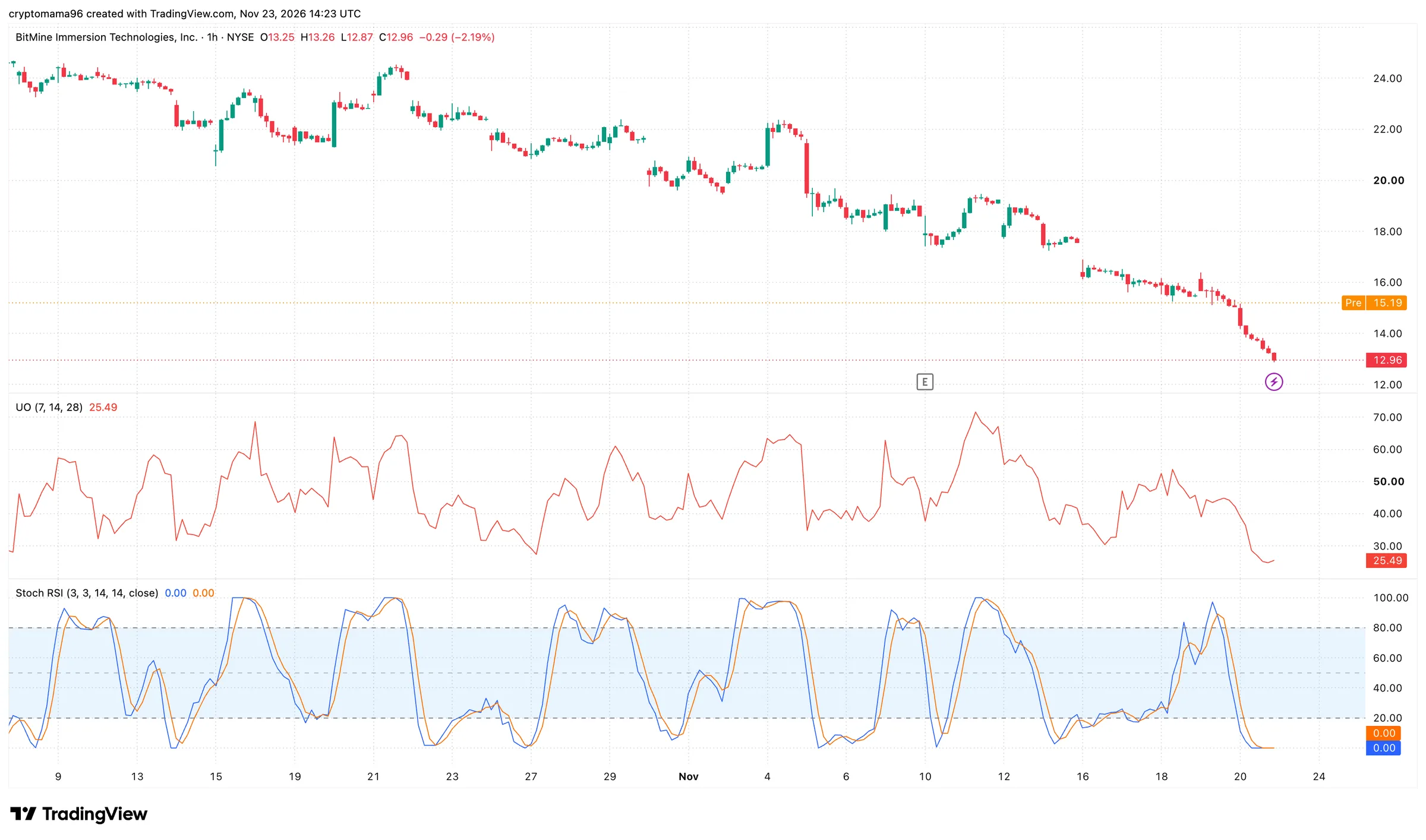
Readings this low often come before a relief bounce, though they can stay low for a while in a strong downtrend.
Pre-market trading looks stronger. BMNR was quoted at $15.19 before Monday’s open, roughly 17% above Friday’s close, as ETH rallied. If that gap holds, $16 is the first resistance, then $18. If the gap fails, $12 is the nearest support.
BMNR has moved in step with ETH through this sell-off. The stock’s next few sessions will likely depend on whether Ethereum can stay above $1,700 and push through $1,866.
This article provides general financial information, not investment advice. Cryptocurrency and stock prices fluctuate, while staking yields and technical indicators cannot guarantee future returns. Investors should conduct independent research before making financial decisions