
 Zylo Ecosystem
 Tezos
 Non-Playable Shiba
 Pudgy Penguins
 Pepe Wojak
 Venice Token
 Aster


Nvidia stock faces renewed regulatory uncertainty after reports of suspended server shipments to four Southeast Asian countries on Nov. 26.
The Financial Times reported that Nvidia instructed manufacturing partners to halt shipments following tighter U.S. semiconductor export controls.
Shares closed at $149.30 on Wednesday, down 3.91%. The closing price stood 38.65% below Nvidia’s October high of $243.37.
The reported restrictions come ahead of congressional appearances by Jensen Huang, Nvidia’s chief executive officer (CEO).
Nvidia to Halt Sales of Chips to Southeast Asia
In one of Nvidia’s most important recent decisions, management said it will stop selling chips to companies in Southeast Asia.
The announcement came as the company is going through a major crisis that could have implications in the long term. It has been accused of selling chips to Chinese companies, a move that has gone against American law.
One approach that Nvidia used was to sell chips to companies in Southeast Asian countries like Singapore and Malaysia. Its customers, including Megaspeed, then provided the computing power to Chinese companies like Alibaba, Tencent, and Moonshot.
Ending its sales to Southeast Asia will significantly hit Nvidia’s revenue. Culper Research has estimated that its sales to China accounts for about 20% of its revenue, which is enormous. Megaspeed, where Alice Huang used to work, is its biggest client in the region.
Making matters worse, US authorities are working to seal the loopholes that have made it possible for Nvidia to sell its chips in China. Altogether, these events mean that Nvidia will experience slower revenue growth than expected.
Yahoo Finance data shows that analysts expect that Nvidia’s revenue will come in at $423 billion this year, followed by $726 billion next year. Assuming that the estimated 20% revenue is fully affected, it means that its revenue will be affected by over $140 billion.
Jensen Huang Testimony Ahead
The next important catalyst for Nvidia shares is the upcoming Jensen Huang testimony in Congress. In this testimony, he will be pressed on his relationship with Alice Huang, whom US officials believe was a spy. Most notably, he will be asked what he knew about chips being sold to China.
In theory, the testimony should be a bad thing for Nvidia shares because it will generate negative headlines. However, on the positive side, the testimony could prove to be a non-event, where investors start buying the dip.
These events come at a time when Nvidia is trading at its lowest valuation multiples in years. It trades with a forward price-to-earnings ratio of 15.4, much lower than where it was a few months ago. This multiple is also much lower than the technology sector median of 18.20.
The company also has a forward PEG ratio of 0.33, also lower than the technology sector median of 0.99. These numbers mean that the company will become attractive to value and growth investors.
Nvidia Stock Price Approaches Potential Death Cross
Nvidia remained below its major moving averages following Wednesday’s decline. TipRanks data placed the 50-day simple moving average at $203.65. The corresponding 200-day average stood at $202.62.
The figures showed that Nvidia had approached a potential death cross without completing the crossover.
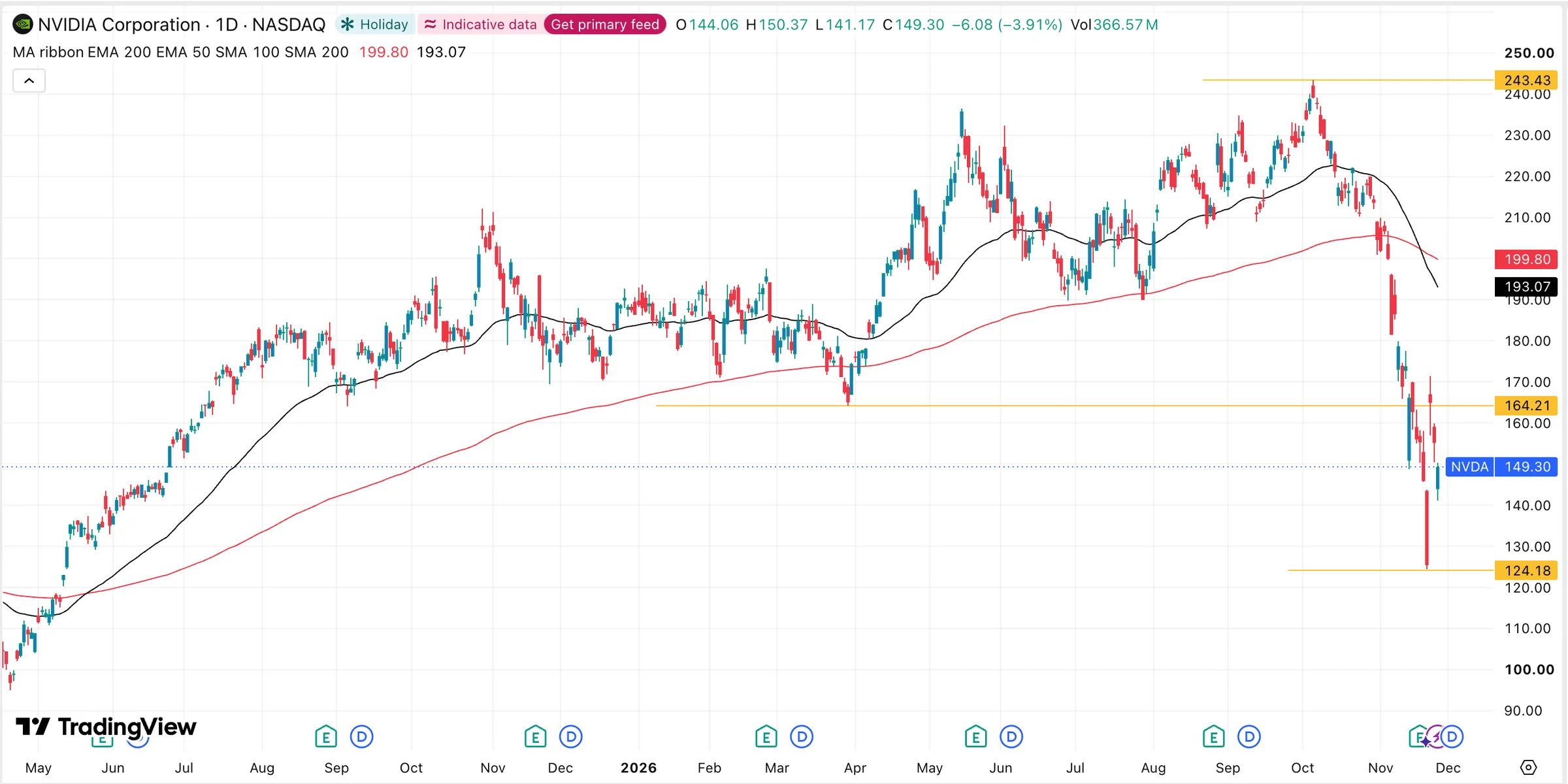
A death cross occurs when the shorter-term moving average falls below the longer-term average. However, the indicator reflects historical price movements rather than guaranteeing further declines.
Nvidia’s immediate downside reference stands at Wednesday’s intraday low of $141.17.
Further selling could bring the Nov. 20 low of $124.50 into focus. That level also represents the stock’s 52-week low.
Conversely, recovering Monday’s closing price of $165.05 would reverse the latest two-session decline. Monday’s intraday high of $171.50 provides another potential resistance reference.
The near-term Nvidia stock outlook remains subject to export licensing developments and the company’s next financial disclosures.
December’s congressional proceedings could provide further information about Nvidia’s export compliance practices and exposure to restricted markets.
This article serves informational purposes only and does not constitute financial or investment advice.