
 Venice Token
 Bitcoin
 Pudgy Penguins
 Hyperliquid
 NEAR Protocol
 Solana
 Pearl


Bitcoin price recovered above $60,000 on Nov. 26 after Wednesday’s decline following new U.S. tariff proposals and economic data.
Bitcoin (BTC) traded at $60,525 at 07:30 UTC, up 2.6% over 24 hours, according to The Block. The cryptocurrency had fallen near $57,300 during the previous session.
Meanwhile, traders continued pricing in a December Federal Reserve rate increase. Separate fund data showed that monthly U.S. spot Bitcoin exchange-traded fund (ETF) withdrawals exceeded $5 billion.
Donald Trump Proposes New Tariffs as Bitcoin Price Falls
The Office of the United States Trade Representative (USTR) released its tariff proposals on November 25 after investigating manufacturing practices across 16 economies.
The proposed duties reach 35% for Vietnam and 25% for India. Chinese imports could face tariffs of up to 20% under the investigation, while proposed rates for Japan, South Korea and the European Union reach 15%, subject to existing trade arrangements and exemptions.
However, the new duties are not yet in effect. The USTR has set January 5, 2027, as the deadline for written comments, with public hearings beginning on January 25.
Inflation was already picking up in the US before Wednesday’s announcement. Higher tariffs could increase import costs, complicating the Fed’s efforts to bring inflation under control.
Figures released by the Bureau of Economic Analysis on Wednesday showed that annual PCE inflation increased to 3.8% in October from 3.6% in September. Core inflation also rose from 3.1% to 3.3%.
Meanwhile, the government revised third-quarter economic growth from 3.4% to an annualized 4.3%.
Both readings strengthened expectations of a December rate increase. For Bitcoin investors, higher interest rates mean greater competition from assets that generate income.
Bitcoin ETF Outflows Reach a Monthly Record
Bitcoin’s problems, however, began well before Wednesday’s tariff announcement. As we reported, the US spot Bitcoin ETFs lost another $231.4 million on Tuesday, a day after investors withdrew approximately $570 million from the funds.
November withdrawals have now reached $4.94 billion, exceeding the previous monthly record of $4.51 billion in June. BlackRock’s iShares Bitcoin Trust accounted for 84% of the total.
There was a modest improvement on Tuesday, when daily withdrawals fell below $300 million for the first time since November 17. Nevertheless, the funds continued to lose capital.
The distinction matters because slower withdrawals do not necessarily mean buyers have returned. Bitcoin briefly recovered to $64,673 on Monday, but the rally failed to hold as selling resumed.
Bitcoin Price Prediction: Can BTC Defend $55,500?
In a November 25 market report, Bitfinex analysts placed Bitcoin’s near-term trading range between $56,300 and $61,400.
Their immediate concern is the November 21 low of $55,501. If Bitcoin breaks below that level, analysts see its realized price of approximately $53,100 as the next area of interest.
Bitfinex also noted that futures traders had increased their exposure while Bitcoin’s price declined. The return of leveraged long positions, without comparable spot buying, leaves the market exposed to further liquidations.
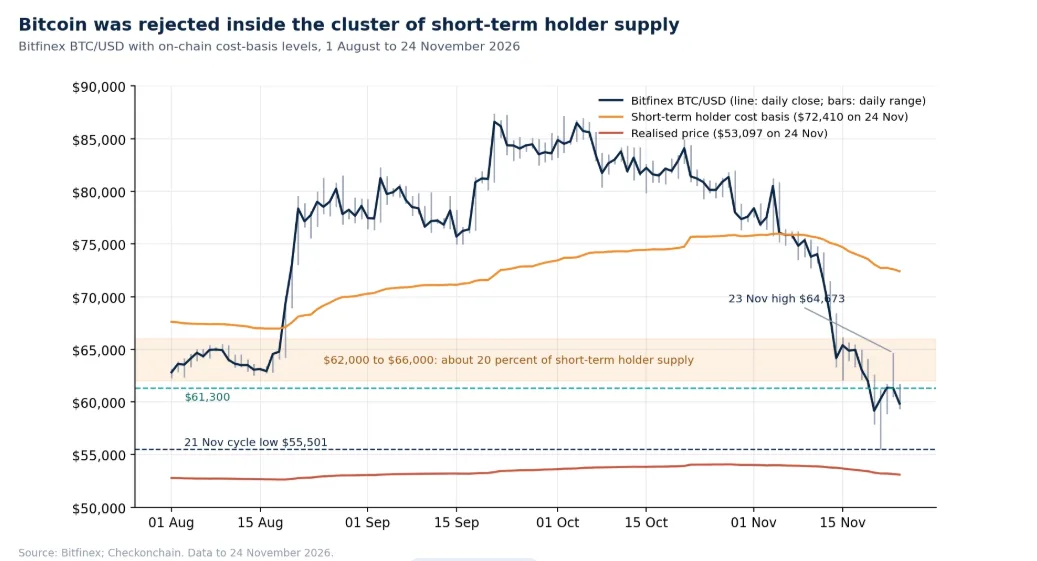
A recovery above $61,300, alongside three consecutive sessions of ETF inflows, would give analysts grounds to reconsider their bearish outlook.
CryptoQuant analyst XWIN Japan also identified a return of spot buyers and consistent ETF inflows as necessary conditions for a Bitcoin price recovery.
Traders are now looking ahead to Friday’s $6.6 billion Bitcoin options expiration, less than two weeks before the Federal Reserve’s December 8–9 policy meeting.
This article serves informational purposes only and does not constitute financial or investment advice.