
 FOCO
 Pepe Wojak
 Pudgy Penguins
 Zylo Ecosystem
 Non-Playable Shiba
 Monad
 Bitcoin


Ethereum co-founder Vitalik Buterin called for greater transparency in semiconductor design on Nov. 26, citing security risks affecting cryptocurrency hardware wallets.
In his latest blog post, Buterin argued that reviewing software cannot establish whether the underlying hardware operates securely.
He advocated publishing detailed chip layouts and expanding independent physical inspections to identify unauthorized hardware modifications.
Vitalik Buterin Warns of Security Risks in Hardware Wallets
In a November 26 blog post, Vitalik Buterin discussed cases where criminals tampered with hardware wallets before they reached customers. Users had little reason to suspect a problem because the devices appeared genuine. However, the unauthorized modifications allowed criminals to obtain sensitive recovery information.
Vitalik Buterin said future attacks could involve changes to the chips themselves. Detecting such modifications could prove difficult, particularly when the replacement components look identical to the original hardware.
The Ethereum co-founder questioned whether users can fully trust their private keys without knowing how their devices operate. While open-source wallet software allows developers to review its code, proprietary chips leave another part of the system beyond public inspection.
Vitalik Buterin wants hardware manufacturers to provide researchers with enough information to examine the components inside these devices.
Open-Source Chip Designs Could Support Security Audits
Vitalik Buterin explained that publishing a chip’s source code alone is not enough to verify its physical structure. Engineers use programming languages such as Verilog to describe how electronic circuits operate. Design software then converts the code into physical layouts for chip production.
Vitalik Buterin called on manufacturers to make Graphic Design System (GDS) files publicly available. These files show the exact location and arrangement of electronic components within each layer of a chip.
Access to these files would allow independent researchers to compare manufactured chips with their original designs. Auditors could then check for unauthorized modifications that may compromise hardware security.
However, access to manufacturing specifications remains a challenge. Semiconductor companies often restrict access to process design kits through confidentiality agreements.
Vitalik Buterin Outlines Plans for Open-Source Semiconductor
Vitalik Buterin cited several manufacturers that already provide publicly accessible chip development resources. They include GlobalFoundries in Singapore, SkyWater in Minnesota and IHP in Germany.
He also mentioned China’s ICsprout and its 55-nanometer manufacturing process. The company has released part of its design kit, although the technology currently serves research and prototype development.
Buterin placed a realistic target for open-source manufacturing at around 25 nanometers. He noted that chips at this level could handle most everyday computing requirements. Advanced artificial intelligence applications, however, would require more powerful hardware.
The Ethereum co-founder also discussed infrared imaging as a possible method for inspecting chips. He recommended designing circuits that allow independent auditors to examine individual sections.
Vitalik Buterin expects performance and security requirements could eventually create separate markets within the semiconductor industry. Security-focused chips could run less efficiently while still meeting everyday computing needs.
Ethereum Price Prediction as ETH Attempts Recovery
Meanwhile, Ethereum price recovered from $1,600 to approximately $1,705 on Thursday, according to Traders Union. The recovery came amid continued withdrawals from Ethereum ETFs and selling activity among early ETH holders.
Ethereum price prediction identified $1,850 as the resistance level ETH crypto needs to reclaim. A move above this level could bring the 200-day simple moving average near $2,111 into focus.
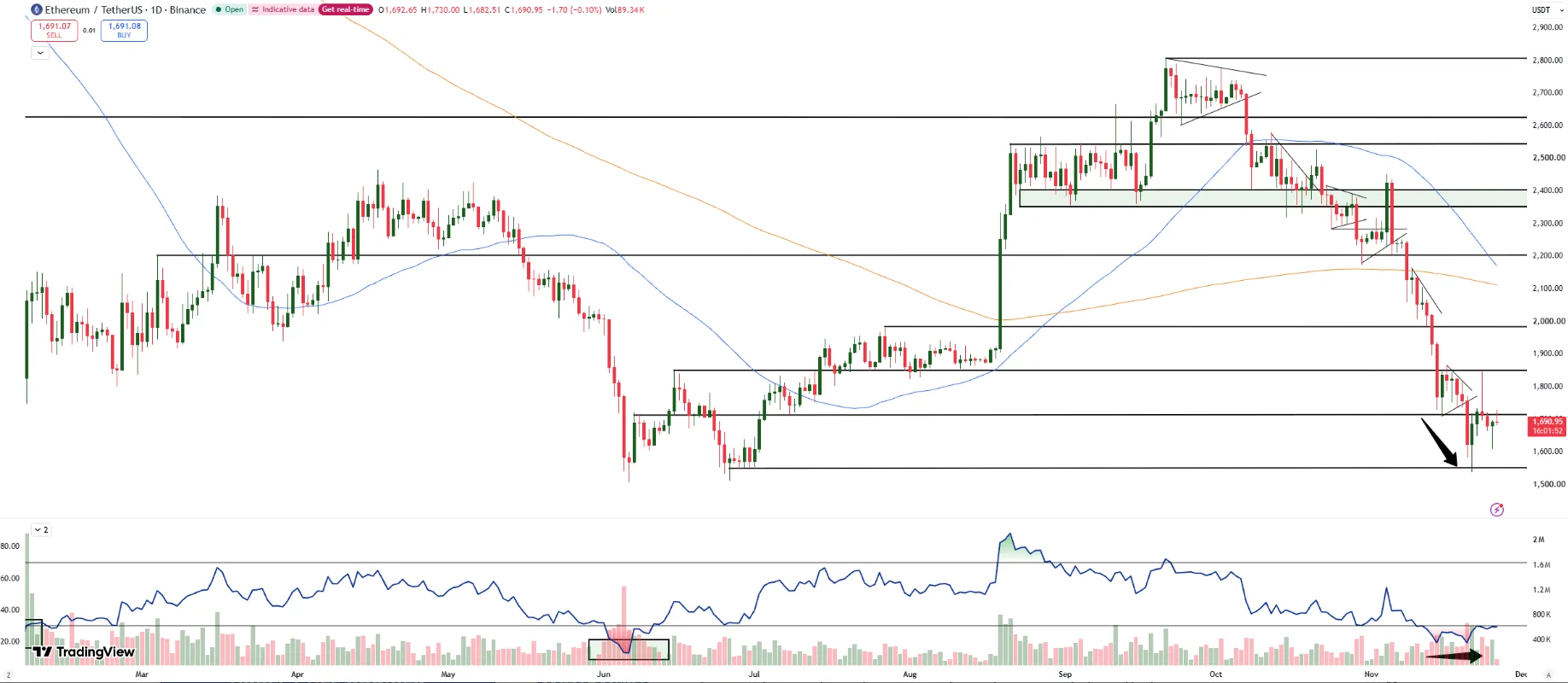
Data from SoSoValue showed that US spot Ethereum ETFs recorded $68.5 million in net outflows on November 25. The withdrawals marked eight consecutive sessions of negative flows.
Separately, Arkham tracked an Ethereum ICO participant who sold 32,010 ETH worth $53.3 million within nine hours on November 26.