Zylo Ecosystem
 Pearl
Pearl Walrus
 Derive
 Quantus
 Aerodrome Finance
 Sui
Sui

Key Highlights:
- Bitcoin ETFs added 27,849 BTC in 7 days—BlackRock led with over 25K BTC inflow.
- Ethereum ETFs posted a net inflow of 128,419 ETH, led mainly by Fidelity’s FETH.
- Global crypto capital inflows jumped from $1.45B to $15.15B in 10 days.
ETFs drive momentum in the crypto market, with Bitcoin and Ethereum funds witnessing strong weekly inflows. Stablecoins signal fresh buying power, reinforcing confidence in the broader crypto market.
Global liquidity continues to rise, indicating sustained institutional accumulation. This trend suggests ongoing confidence from large investors in the market’s long-term growth.
Institutional Demand for Bitcoin and Ethereum ETFs in the Crypto Market Continues to Rise
Over the past week, inflows into Bitcoin ETFs in the U.S. have been strong. According to Lookonchain data, 10 Bitcoin ETFs gained 27,849 BTC over the past 7 days. At the current BTC price, this influx is worth $3.45 Billion.
The most significant weekly inflow was seen by the iShares Bitcoin Trust (IBIT), managed by BlackRock. The crypto market saw an addition of 25,430 BTC, valued at $2.37 Billion.
IBIT now holds 601,209 BTC, making it the largest spot Bitcoin ETF as of April 29. The current Bitcoin holdings are worth roughly $57.04 Billion, with an additional $80,425 in USD cash.
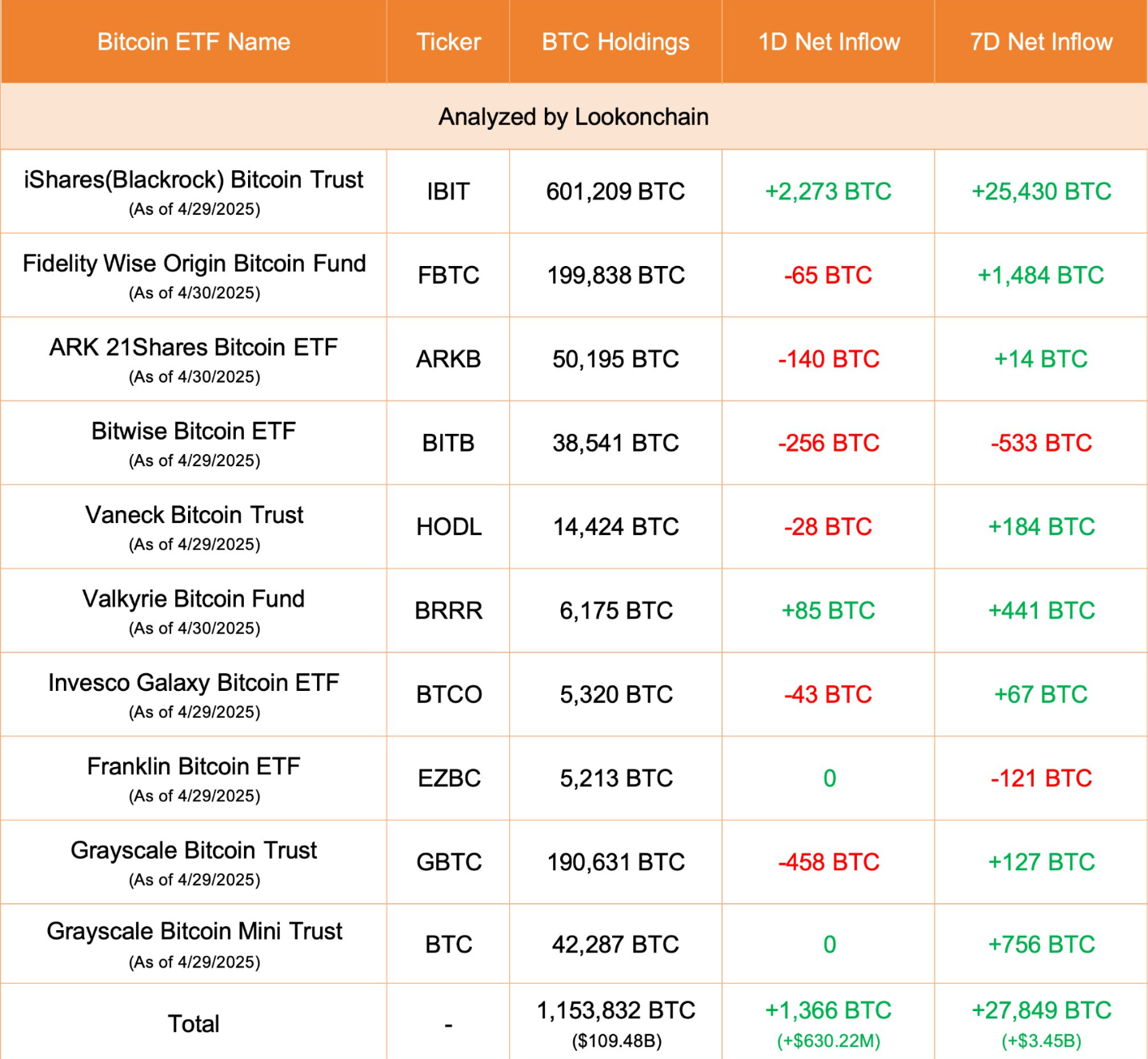
On April 29 alone, total net inflows into Bitcoin ETFs amounted to 1,366 BTC, translating to about $630.22 Million. These data points to increased institutional interest in Bitcoin, primarily through ETF channels.
Some funds, including Fidelity’s FBTC and ARK’s ARKB, saw daily outflows of 65 BTC and 140 BTC. Despite this, the crypto market remains positive with continued investor interest.
Bitcoin ETFs led inflows, but Ethereum ETFs also had positive net flows. In the last seven days, they have combined inflow of 128,419 ETH, worth $224.73 Million.
This activity mainly was from Fidelity’s Ethereum Fund (FETH), which added 33,972 ETH during this period. The fund raised 13,988 ETH, or approximately $24.48 Million, on April 29 alone.
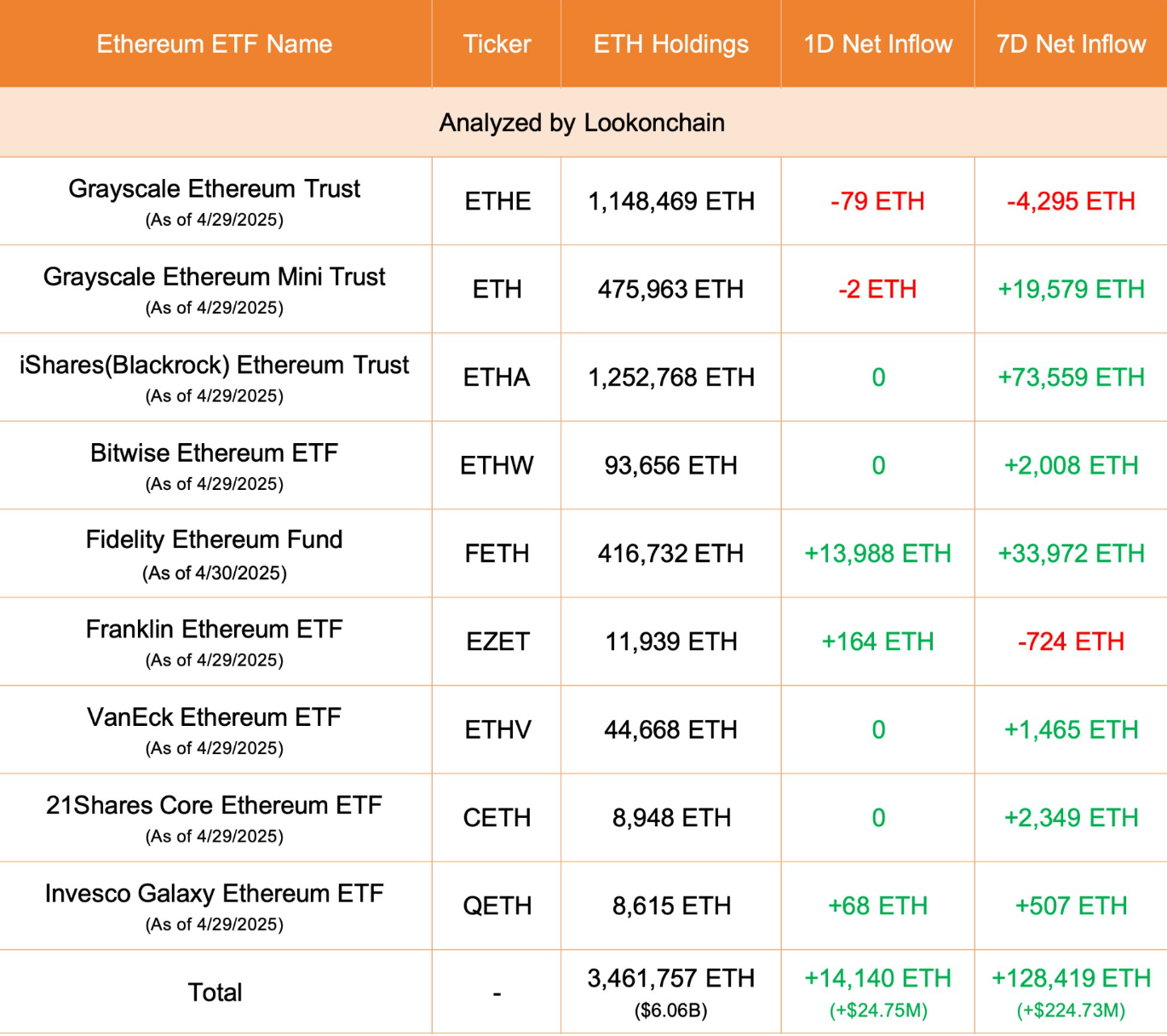
iShares Ethereum Trust (ETHA) also added positively with 1,252,768 ETH in its possession, with no daily outflows reported.
ETFs showed mixed behavior, with some experiencing shifts between providers. Grayscale’s Ethereum Trust (ETHE) saw a weekly outflow of 4,295 ETH, possibly due to investor rebalancing.
Investors are steadily increasing allocations to Bitcoin and Ethereum ETFs, reflecting a preference for regulated financial products. This trend highlights the growing demand for crypto exposure within traditional investment structures.
Capital Inflows into Crypto Market Reach $15 Billion
As a result, the total 30-day capital inflows into the crypto market increased from $1.45 Billion on April 20 to $15.15 Billion on April 29.
This is a tenfold increase from just 10 days ago. During this time, BTC price rose from $85,165 to $94,298, with inflows strongly correlated with price action.
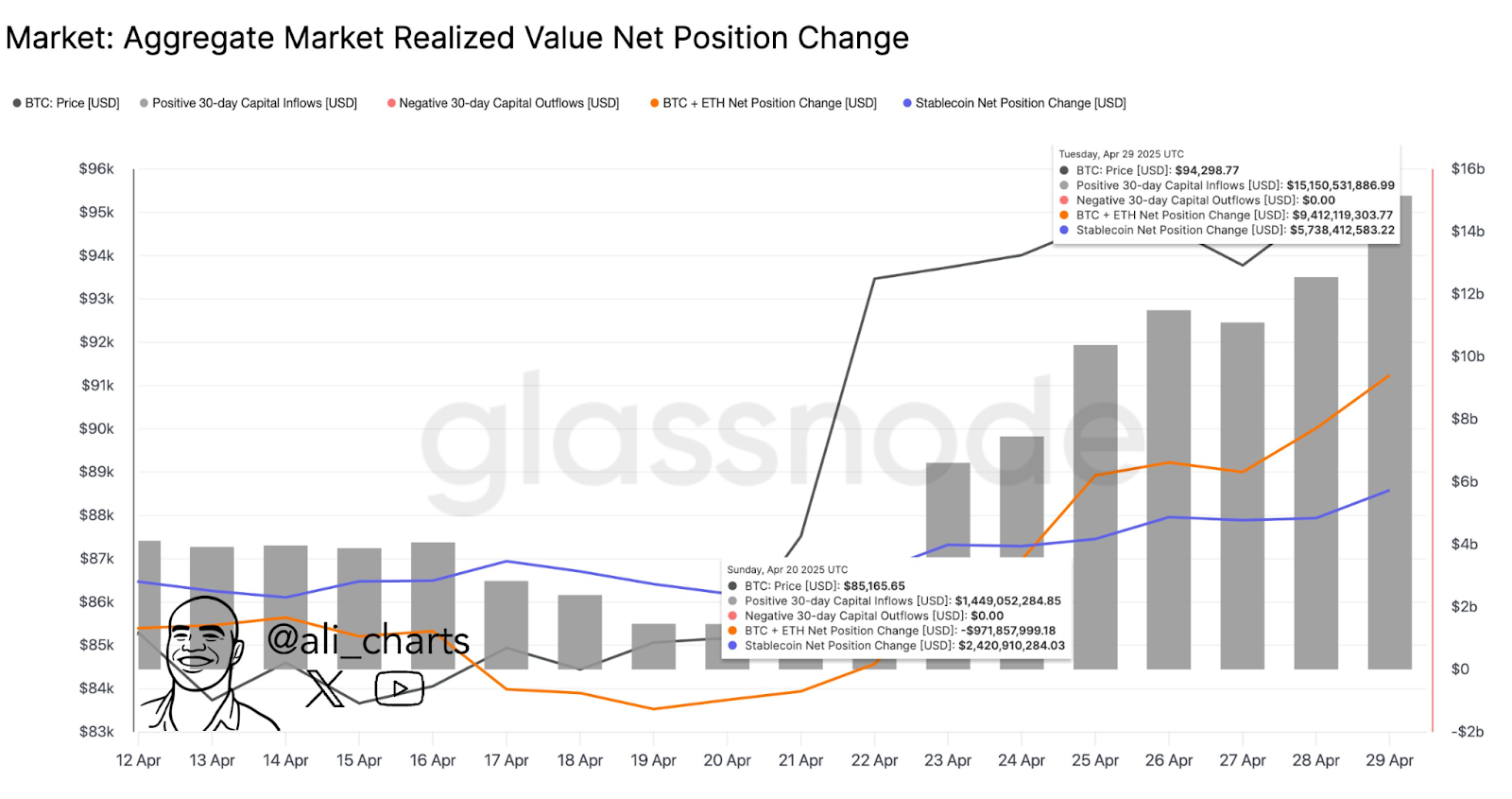
Also, the changes in BTC and ETH net position showed strong investor positioning. BTC and ETH had combined net inflows of $9.41 Billion.
At the same time, stablecoin net inflows were $5.73 Billion. This shows that liquidity is being deployed across the broader crypto ecosystem.
The growth of stablecoin is essential, as it often signals buying power entering the market. This increase in stablecoins and ETF allocations indicates coordinated buying pressure and institutional participation.
Bitcoin Price Lags as Global Liquidity Expands
The global M2 money supply continues to expand, reinforcing market liquidity. This growth signals strong financial momentum and potential economic shifts.
The M2 Global Supply has now risen above $108 Trillion. Historically, this rising liquidity has been followed by increases in Bitcoin prices.
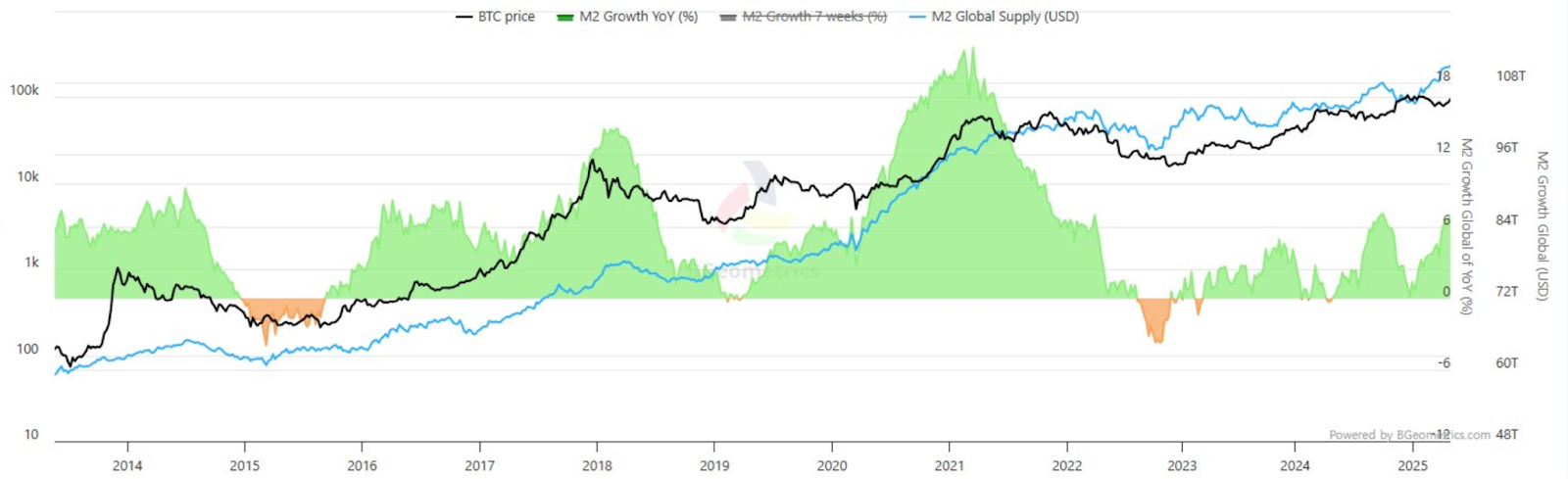
Yet, Bitcoin price has not thoroughly followed this trend. Analysts at CW believe that institutional investors might still be accumulating BTC before larger moves.
‘Liquidity is increasing, which is decreasing the currency’s value,’ he noted. ‘Assets that are limited in quantity have no other option but to increase in value.’”
On the long-term chart, the periods of rising M2 growth have historically correlated with BTC rallies. Bitcoin has traditionally lagged behind macro liquidity shifts, showing delayed reactions. The current divergence in the crypto market may signal another similar lag.
Disclaimer
In this article, the views, and opinions stated by the author, or any people named are for informational purposes only, and they don’t establish the investment, financial, or any other advice. Trading or investing in cryptocurrency assets comes with a risk of financial loss.