streamoors
 Injective
 Pudgy Penguins
 Celestia
 Pearl
Pearl Sui
Sui Bitcoin

Key Insights:
- TIA climbs over 13% in 7 days, outperforming Bitcoin in short-term strength.
- Technical indicators hint at slowing bearish momentum but no apparent trend reversal.
- Concerns persist over token unlocks, weak TVL, and investor exit activity.
Celestial (TIA) has gained over 13% in the last seven days. This shows a strong recovery after weeks of bearish pressure. The surge comes as market sentiment leans into “greed.”
It was further supported by growing speculation around its upcoming Lotus upgrade. However, several on-chain and technical metrics raise caution despite the price movement.
Lotus Upgrade Boosts Narrative, but History Tempers Expectations for Celestia
The recent buzz stems from the v4 upgrade of Celestia, Lotus. It went live on Mocha testnet after earlier deployments on Arabica. The upgrade introduces Hyperlane interoperability, enabling TIA to connect with rollups and networks like Ethereum, Base, and Arbitrum.
Meanwhile, CIP-29 decreases inflation by 33%, CIP-30 removes auto-claiming of rewards, and CIP-31 links staking rewards to vesting logic. This will help to correct the tokenomics.
Collectively, these enhancements hold out hope of cross-chain utility and long-term economic equilibrium. The breakout of TIA from its downtrend channel followed these updates, with the market cap crossing $1.1 Billion.
However, the daily fees on the network are not impressive, averaging at approximately $200. Also, total value locked (TVL) has dropped by 95% since its peak.
Technical Charts Show Some Relief, but Trends Still Unclear
Technically, the RSI(14) is 46, and the short-term RSI(7) is 53, which is neutral. Money Flow Index (MFI) has also increased to 54 compared to 33 last week, which implies that buyers’ interest is improving. In addition, the Fear & Greed Index has reached 73, indicating market optimism.
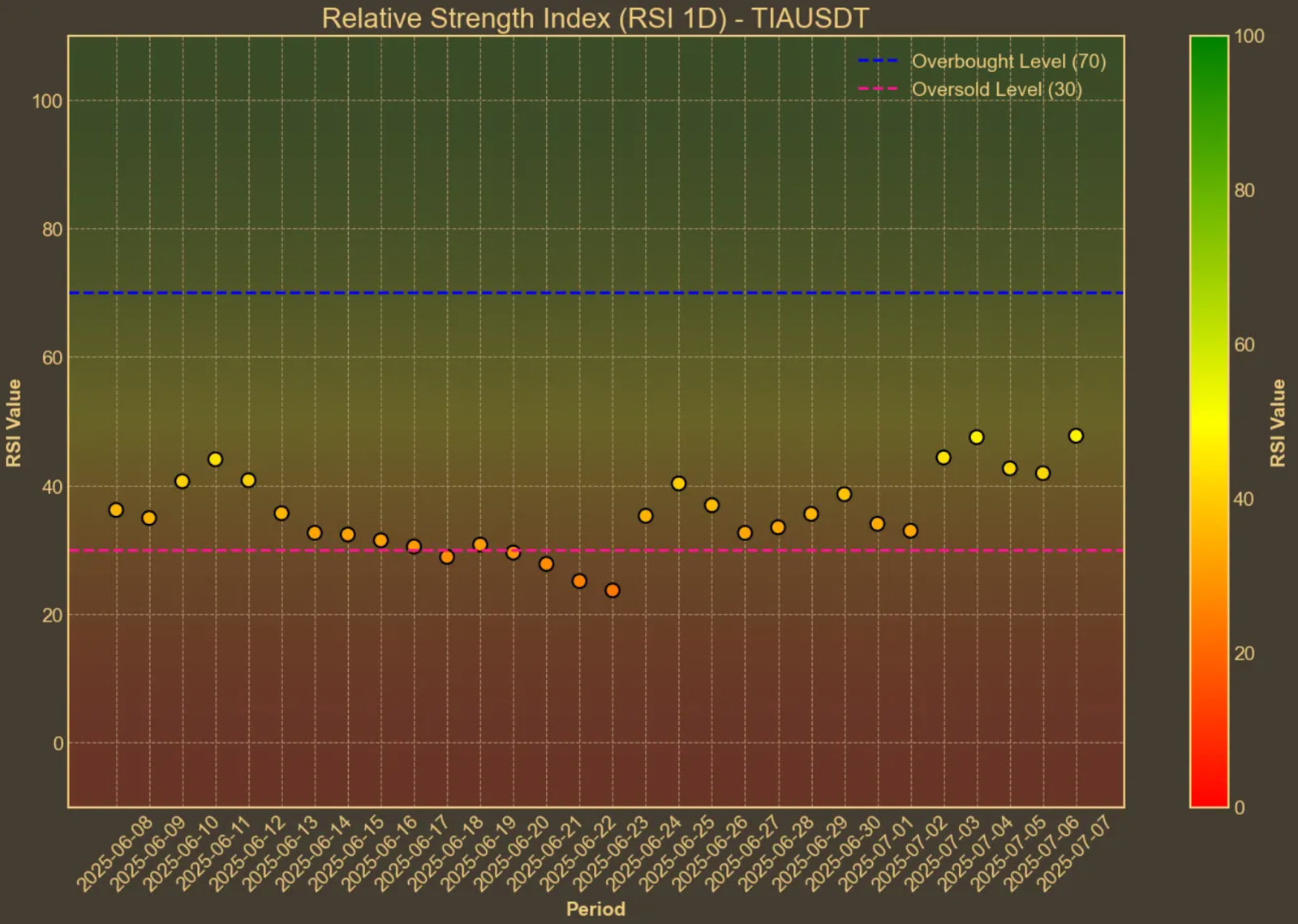
Nevertheless, the moving averages are still indicating a bearish stance. The SMA(9) is 1.52, and the EMA(9) is 1.55. These are lower than the longer-term SMA(26) and EMA(26) at 1.59 and 1.66, respectively.
Bollinger Bands indicate increased volatility with the widened ranges between 1.34 and 1.73. However, the current price of Celestia is in the middle of the band without a breakout.
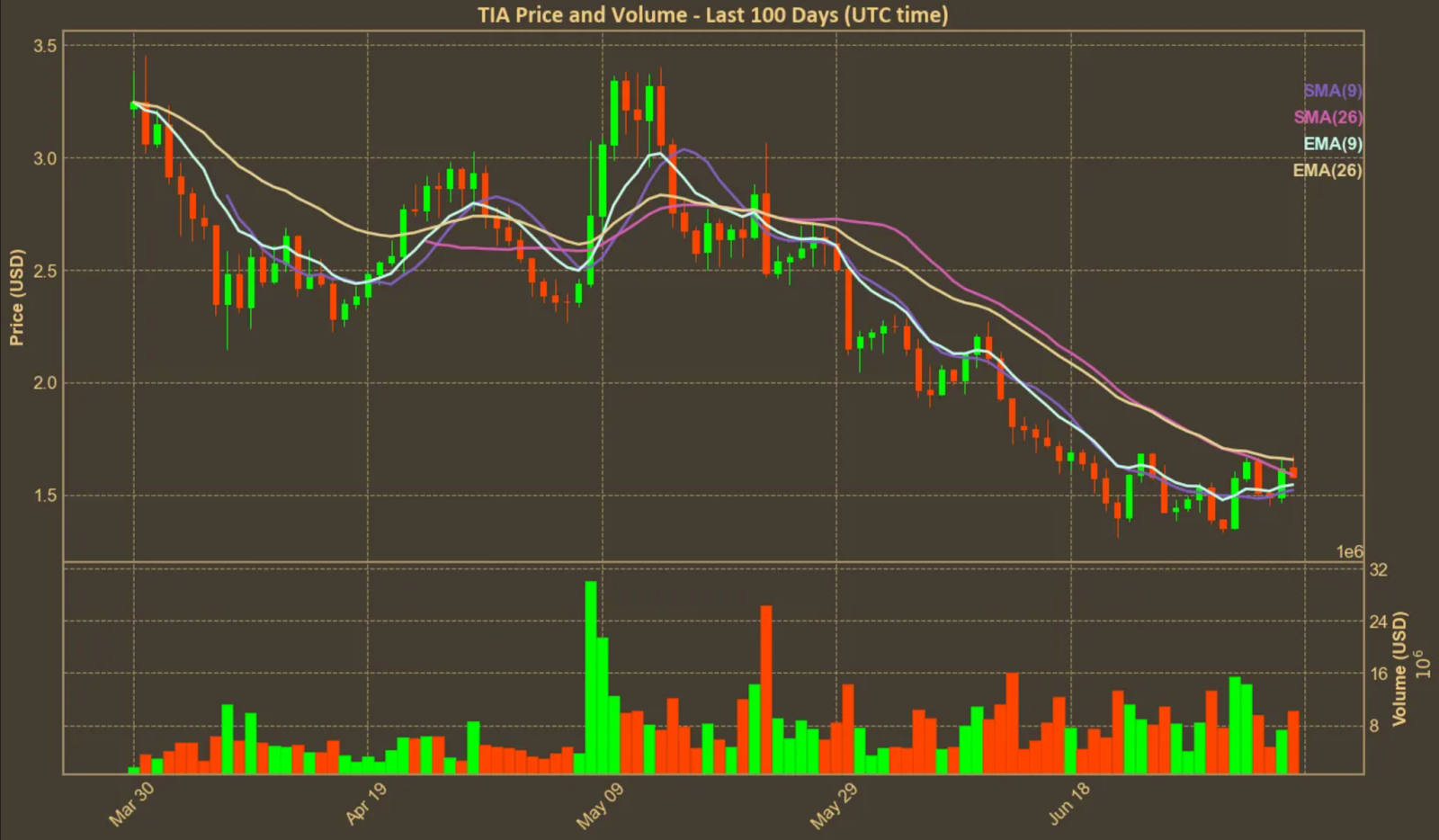
The volume has grown by more than 77% in the past 24 hours. Also, the open interest has grown by a small margin of 0.63%. Funding rate is a bit negative, which shows that there is caution in the derivatives.
Binance and OKX traders are leaning heavily toward long positions, with ratios at 2.3 and 1.8. This suggests strong bullish sentiment in the market, as top traders bet on upward price movement.
Celestia Price Structure and Market Data Reflect Mixed Signals
Despite recent gains, the broader structure of TIA remains pressured. It is still 92% below its all-time high, and the 10% surge is impressive. However, it followed a decline to just over $1.32, near all-time lows.
The Awesome Oscillator is now negative at -0.14, but higher than last week’s value. This indicates bearish momentum is easing, hinting at potential reversal strength.
VWAP at 2.29 remains above the current trading price, emphasizing a bearish trend. The ADX has also dropped to 25, down 34. This indicates the trend’s strength is weakening, a common precursor of range-bound movements.
ATR(14) is at 0.15, which means stable and limited volatility. Relative to Bitcoin, Celestia has shown some strength in the past week, recovering around 12.5%. But even in the last 30 days, it has not recovered, with a 23% decline in value.
Network Metrics and Investor Behaviour Raise Longer-Term Doubts
Although technicals are improving in the short run, fundamental factors are weak. The average fees of TIA per user are just $0.0576, far below other L1s like Avalanche or BNB Chain. It is the 12th L1 in this metric with a market share of only 0.7%.
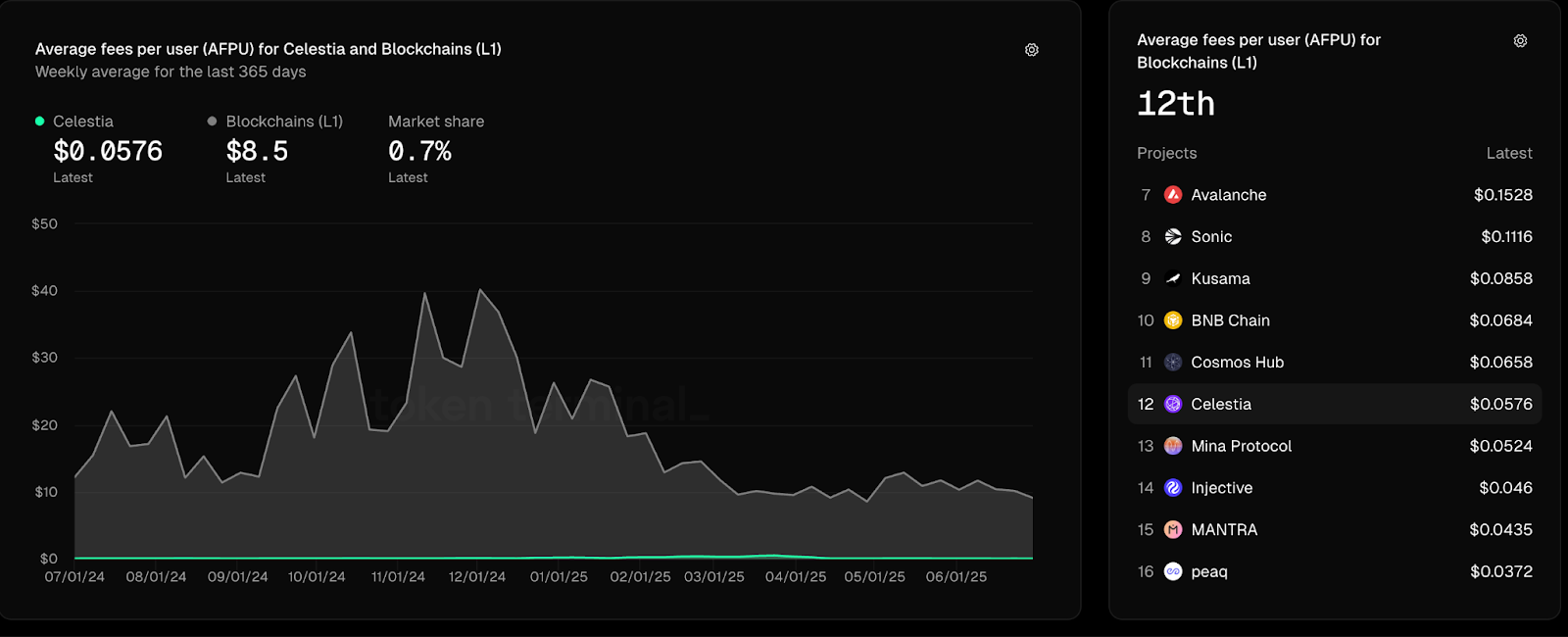
Historical volume charts depict a downtrend in network activity since January, with recent spikes largely due to speculative purchases. Old fears are also still there.
Early investors like Polychain have sold over $240 million worth of Celestia, and community sentiment on social platforms remains muted.
Despite these concerns, some optimism surrounds TIA’s potential. The Lotus update is expected to address the problem of interoperability and economic sustainability. If successful, it could reposition Celestia in the competitive modular blockchain space.
The rally must demonstrate ongoing growth in project utility. Restoring user confidence is key to confirming it’s more than a temporary upswing.
Disclaimer
This article is for informational purposes only and provides no financial, investment, or other advice. The author or any people mentioned in this article are not responsible for any financial loss that may occur from investing in or trading. Please do your research before making any financial decisions.