Walrus
 Quantus
 Pudgy Penguins
 Bitway
 Quant
Quant Sui
Sui Bitcoin

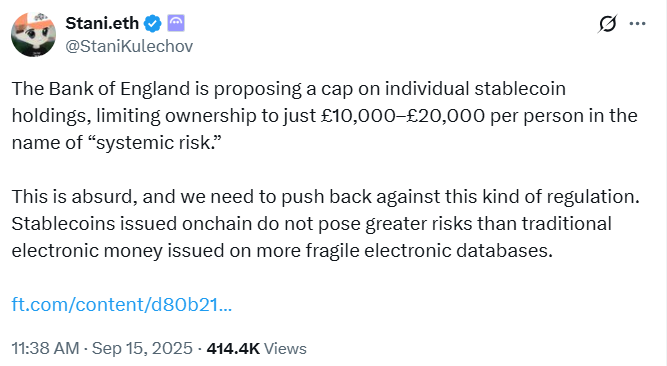
Aave founder Stani Kulechov has criticized the Bank of England’s plan to limit stablecoin holdings to £10,000–£20,000 per person.
The proposal, announced recently, aims to reduce financial risk but could affect digital currency use in the UK.
Bank of England Proposes Limit, Kulechov Responds
It is worth mentioning that the Bank of England proposes capping how much stablecoin an individual can hold.
The limit would be £10,000 to £20,000 per person. Officials say the cap is to reduce systemic risks in the financial system.
Stani Kulechov, founder of Aave, strongly disagrees. He said stablecoins on blockchain are not riskier than traditional digital money.
Kulechov argues that blockchain is transparent and secure. He warned that the cap could slow down the UK’s digital currencies growth.
Stablecoins are digital currencies that are tied to real money like the U.S. dollar. They are used for payments, trading, and sending money abroad.
According to the update, Kulechov says people and businesses benefit from stablecoins because they are fast and reliable.
The Bank of England’s plan is the first major proposal in the UK to limit individual stablecoin ownership.
It reflects growing concerns about digital money but could also make some people cautious about using stablecoins.
GENIUS Act Sets a Different Stablecoin Path in the U.S.
In the United States, stablecoins follow a different approach. The GENIUS Act, signed into law recently, sets clear rules for stablecoin issuers.
Since the introduction of the regulations, companies are now mandated to keep transparent reserves and follow strict regulations.
Unlike the UK proposal, the GENIUS Act does not limit how much a person can hold.
Instead, it aims to make stablecoins safe while allowing them to grow. The law could make people and institutions more willing to use digital money.
This approach could help the U.S. become a global leader in stablecoin use. Clear rules allow businesses to plan and investors to trust the system.
Market observers believe the GENIUS Act balances safety and innovation, encouraging wider adoption.
Tether Launches USA₮ with Bo Hines as CEO
Tether, the largest stablecoin company, announced a new U.S.-regulated token called USA₮ on September 12, 2025.
The U.S. dollar backs the digital asset and follows the GENIUS Act rules. Bo Hines, former Executive Director of the White House Crypto Council, is named CEO of Tether USA₮.
He will lead the company as it offers a regulated digital dollar to businesses and institutions.
Hines brings experience in law, business, and government, which Tether says will help the company meet U.S. regulations.

USA₮ is designed to be transparent and secure. Tether already has more than $169 billion in market value and handles more transactions daily than some major banks.
It is important to add that the company also holds many U.S. Treasury bonds, showing its financial strength.
The launch of USA₮ contrasts with the Bank of England’s plan. In the U.S., companies can issue stablecoins under clear rules.
In the UK, the limit could slow adoption. Tether’s move shows how regulated stablecoins might grow while remaining safe.
The Bank of England’s proposal and the GENIUS Act show different paths for stablecoins.
Kulechov warns limits could slow use in the UK, while Tether and Hines show how regulation can support growth.
More importantly, the future of digital money depends on how countries balance rules and innovation.