Zylo Ecosystem
 Walrus
 Bitcoin
 Sui
Sui Quantus
 Quant
Quant Starknet

Michael Saylor has published a new framework describing the ideological groups shaping Bitcoin’s future. In a paper shared on X, the Strategy executive categorized Bitcoin supporters into four camps: Maximalists, Capitalists, Technologists, and Fundamentalists.
Saylor argued that each group plays an important role in Bitcoin’s development. However, he warned that problems emerge when any single perspective becomes extreme or attempts to dominate the broader ecosystem.
Saylor Maps Out Four Schools of Thought
Saylor opened by saying that Bitcoin has moved past its early stage as a narrow technical experiment. He called it the leading digital monetary network and a global asset that now matters to individuals, companies, banks, capital markets, and governments.
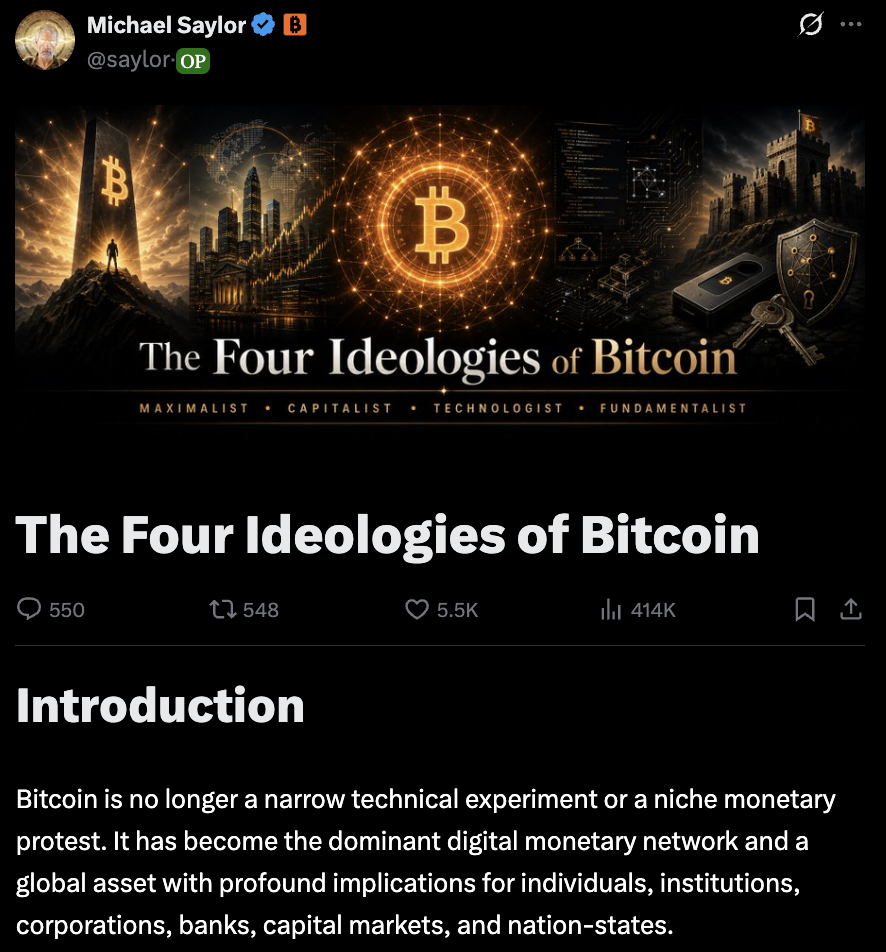
As the network grows, Saylor said, the community has split into distinct groups. Each one shares a belief in the asset’s value but disagrees on how it should grow, integrate, and stay protected.
He stressed that the four camps are not mutually exclusive and that many holders carry traits from more than one. The labels matter, in his view, since they clarify the debates now shaping where the network heads will go next.
The Bitcoin Maximalist and Capitalist Views
The Maximalist treats Bitcoin as the dominant monetary network and the only truly decentralized crypto asset, per Saylor’s description.
This group sees it as incorruptible money that guards savings against inflation, confiscation, and debasement. Saylor wrote that Maximalists give Bitcoin its strongest identity.
The risk he flagged is imprecision: conviction that the asset has won, without a clear answer on how the world actually adopts it.
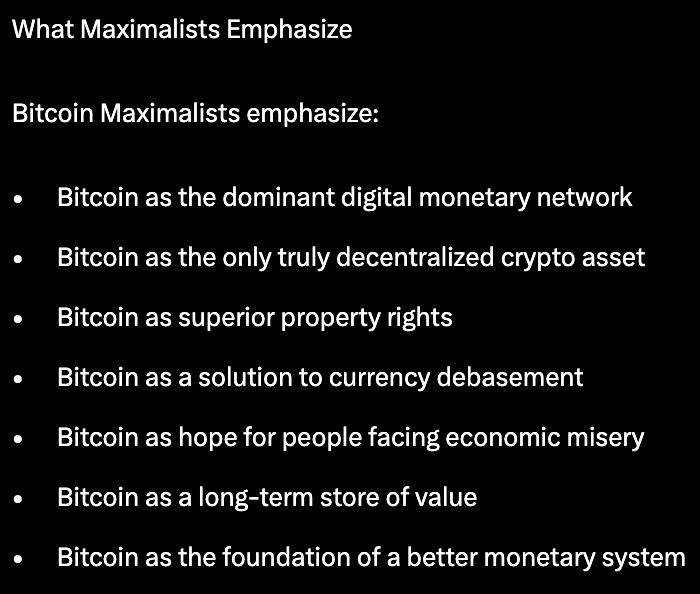
The Capitalist takes a wider position. Saylor said this camp wants Bitcoin woven into the global economy through companies, banks, securities, credit, and capital markets.
To the Capitalist, the asset works as digital capital that gains value once institutions hold it, custody it, and build products around it.
Saylor said this view explains how the network scales into the existing financial system. He cautioned, though, that careless financial engineering could rebuild the fragility Bitcoin was created to remove.
Technologists and Fundamentalists Clash Over Change
The Technologist, in Saylor’s account, sees the protocol as powerful but unfinished. This group pushes for steady base-layer work on privacy, scaling, security, and protection against future threats such as quantum computing.
Saylor framed responsible improvement as stewardship rather than corruption. He warned, at the same time, that base-layer changes carry real danger, comparing a botched upgrade to harm caused by a medical treatment itself.
The Fundamentalist sits at the opposite end. Saylor described this camp as the guardian of self-custody, personal nodes, decentralization, and the use of the asset as money.
Fundamentalists worry that custodial concentration, regulatory capture, and loose protocol experiments could erode the properties that make the network unique.
Saylor credited them with protecting first principles, then named the cost of going too far. A stance that rejects all institutions and all upgrades, he said, could shut billions of people out.
The Risk of Bitcoin Extremism
Saylor tied the four camps together through the question each one asks. The Maximalist asks what Bitcoin has already proven.
The Capitalist asks how it joins the global economy. The Technologist asks how it should improve. The Fundamentalist asks how to defend its core rules. Each question, he wrote, responds to a genuine concern.
The trouble starts when one view turns absolute. Saylor warned that Maximalists can grow dismissive, Capitalists can grow reckless, Technologists can grow interventionist, and Fundamentalists can grow exclusionary.
A healthy network, in his telling, holds conviction, adoption, innovation, and preservation at once.
Saylor closed with a call for disciplined expansion. He said the Bitcoin base layer should be treated as sacred infrastructure, with rare, carefully considered changes backed by broad consensus, while most new development happens at higher layers.
Individuals must keep the ability to hold their own keys, run their own nodes, and verify the network for themselves. His point was that Bitcoin can serve many groups at the same time without belonging to any single one of them.