Walrus
 Quantus
 Pudgy Penguins
 Bitway
 Quant
Quant Sui
Sui Bitcoin
The U.S. Securities and Exchange Commission approved a temporary framework on Sept. 17 for limited onchain trading of tokenized U.S. stocks. The US SEC order gave Tokenized Securities Venues conditional relief from the Exchange Act’s definition of an exchange.
The decision mattered because it created a regulated pathway for tokenized securities without immediately rewriting broader market rules. It also gave the agency live trading data before any longer-term rulemaking.
US SEC Approves Limited Onchain Stock Trading
The SEC said Tokenized Securities Venues may support permissioned trading through automated market makers and liquidity pools. The venues can bring buyers and sellers together through approved pools while setting access standards for participants.
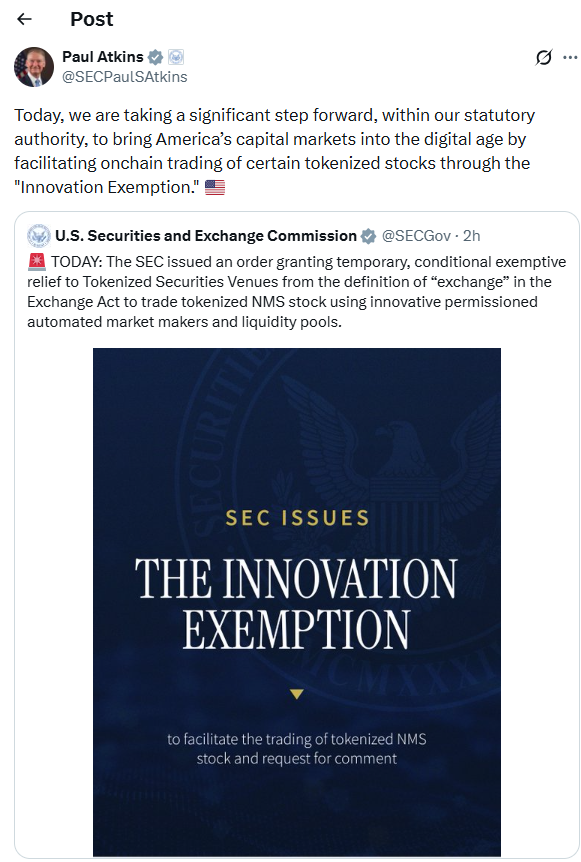
The agency imposed limits on traded symbols and transaction volumes. Each venue must verify that tokenized shares carry the same rights as equivalent National Market System stock.
Those rights include economic and governance rights attached to the underlying security. Chairman Paul Atkins said the framework would allow limited trading while the Commission considers further regulatory action.
The SEC also required issuer protections for third-party tokenization. A venue must notify the underlying issuer before listing tokens created by an unaffiliated third party.
That issuer must receive an opportunity to object. The requirement gives listed companies a direct role when third parties tokenize their shares.
Smart contracts used by a venue must remain auditable and public. The SEC also required deployment on public, permissionless distributed ledgers.
US SEC Uses Existing Exemptive Authority
Atkins said the Commission relied on Section 36(a)(1) of the Securities Exchange Act. That section permits conditional or unconditional exemptions when they serve the public interest and investor protection.
The order created two forms of temporary relief. The first covered venues that could otherwise meet the Exchange Act definition of an exchange.
The second covered certain liquidity providers that use proprietary capital inside approved automated market maker pools. Those firms received conditional relief from the statutory dealer definition.
The SEC did not suspend federal antifraud or antimanipulation rules. Atkins said those provisions continue to apply to securities activity conducted under the exemption.
Commissioner Mark Uyeda said transaction transparency formed a central condition. Venues must publish U.S. dollar-denominated trade data at regular intervals.
Required data includes price, size, time, pool address, end-of-day pool size and daily volume. Uyeda said the disclosures would support monitoring and future policy evaluation.
Tokenized Securities Face Trading Controls
The order also linked tokenized securities trading to traditional market stoppages. A Tokenized Securities Venue must halt trading whenever the primary listing exchange stops the underlying stock.
Venues must publish information covering their operations, trading activity and affiliate activity. The SEC also required books and records, technology safeguards and coordination around trading stoppages.
The framework builds on a policy path Atkins outlined earlier this year. On Feb. 18, he said the agency was considering limited tokenized securities trading through automated market makers.
Atkins later described the proposal as an interim framework while the Commission developed longer-term rules. SEC officials also gathered industry comments through the agency’s Crypto Task Force during 2026.
That process drew competing views. Securities Industry and Financial Markets Association submissions warned that broad exemptions could fragment markets and create regulatory arbitrage.
Other submissions supported limited exemptions with defined caps and disclosures. The final order adopted controls around access, volumes, issuers, data reporting and technology.
US SEC Opens Next Regulatory Phase
The exemption will expire five years after publication, according to the SEC. The Commission also requested public comment on possible modifications and future regulatory steps.
Uyeda asked commenters for data, case studies, incident analyses and operational evidence from live or test environments. That material could shape later rules governing tokenized securities and onchain market infrastructure.
The framework therefore creates a controlled market test rather than a general exemption for all tokenized equities. Its conditions tie tokenized shares to existing issuer rights, primary-market stoppages and federal securities-law protections. The agency can collect new operational evidence.
The next formal milestone will be publication of the order in the Federal Register. Market participants can then track the comment process and any SEC guidance for prospective Tokenized Securities Venues.
This article is for informational purposes only and does not constitute financial, investment or legal advice. Regulatory exemptions and securities rules remain subject to SEC conditions, modification and future rulemaking.