Boomer
 Minter
 Pearl
Pearl Pudgy Penguins
 Sui
Sui Covenant x402
 Pump.fun
- Crypto(dot)om has faced backlash after enforcing the EU’s Travel Rule requirements ahead of its official implementation.
- XRP advocate Edoardo Farina criticized the platform’s refusal to credit a domestic transfer of 12 XRP, highlighting concerns over the early enforcement of the rule.
- The Travel Rule, will officially take effect on December 30, 2024.
On December 27, Edoardo Farina, a prominent XRP supporter, reminded the internet of the long-standing crypto mantra. The mantra is “Not your keys, not your crypto,” in response to Crypto(dot)com’s premature enforcement of the EU’s Travel Rule.
Farina expressed frustration over the platform’s refusal to credit his 12 XRP deposit unless he disclosed the beneficiary’s name and the origin of funds. Sharing his experience on X (formerly Twitter), he stated:
His remarks shed light on the increasing concerns about centralized crypto exchanges’ compliance practices, especially for seemingly straightforward domestic transactions.
In a related instance, another crypto user, Ash Crypto, echoed Farina’s concerns while emphasizing the mantra. Fearing potential risks in 2025, Ash moved his entire 232 Bitcoin holdings from a ledger and shared a post with the photo in it, where he shows the “passphrase” of his wallet.

EU Travel Rule Set to Bring Transparency to Crypto Transfers Amid Concerns Over Premature Enforcement
The EU’s Travel Rule, officially recognized as Regulation (EU) 2023/1113, is set to take effect on December 30, 2024. This regulation is crafted to enhance transparency in cryptocurrency transactions, mandating crypto exchanges to gather detailed information about transfers.
The primary objective is to combat most probable criminal activities like money laundering, terrorist financing, and other illicit activities that exploit the crypto ecosystem.
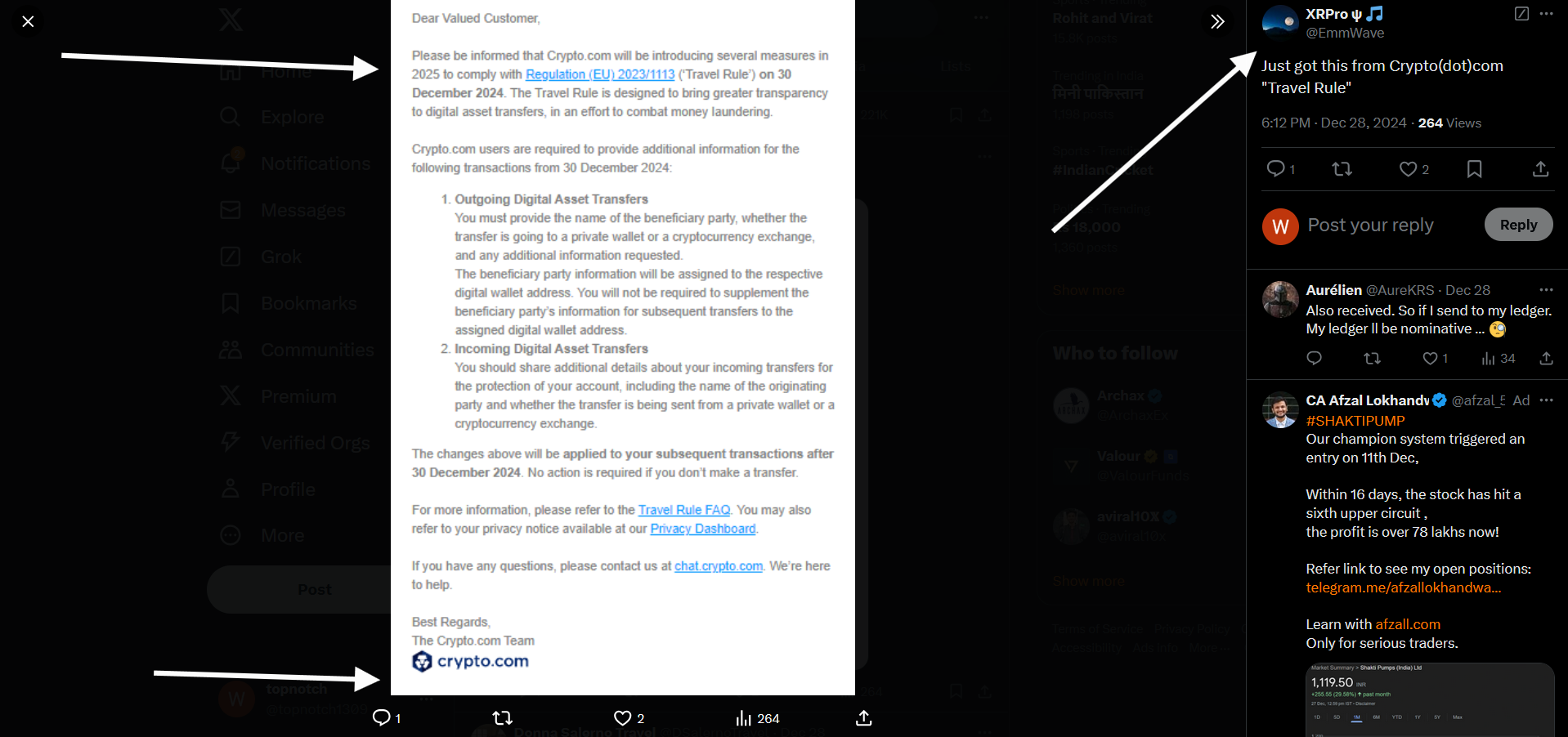
Under the rule, exchanges are required to document key transaction details. For outgoing transfers, this includes the beneficiary’s name, whether the transaction is destined for a private wallet or another crypto exchange.
For incoming transfers, users must disclose the origin of funds, along with clarifications about whether the transfer was initiated via an crypto exchange or wallet. These measures are intended to strengthen protections for user accounts and ensure transparency, particularly in cross-border transactions.
However, the rollout of the Travel Rule has sparked criticism. On December 27, Edoardo Farina accused Crypto(dot)com of premature enforcement of the rule.

Farina recounted his experience on X, where he shared that a deposit of 12 XRP was withheld by the platform until he provided the beneficiary’s name and the origin of the funds. Frustrated, he questioned why such measures were applied to domestic transactions before the regulation’s official implementation date.
Farina’s remarks were echoed by another crypto user, Ash Crypto, who expressed growing concerns over centralized platforms’ compliance practices. Highlighting his discomfort with potential overreach, he disclosed transferring his 232 Bitcoin from his ledger to ensure personal custody of his assets. He shared his decision online with a symbolic image captioned, “Never gonna give you up.”
The Travel Rule represents a significant step toward greater oversight in the cryptocurrency space. However, it also raises important questions about the balance between regulatory compliance and preserving the decentralized ideals that many in the crypto community hold dear.
Farina’s and Ash Crypto’s experiences underscore the complexities of implementing such regulations in a way that respects user autonomy while addressing legitimate security concerns.
Amid Travel Rule Criticism, What Lies Ahead for EU Crypto Users?
As compliance measures tighten, cryptocurrency users increasingly find themselves at a crossroads. As they find themslves torn between adhering to regulation and maintaining the decentralized ideals that originally defined the industry.
The recent experience of Edoardo Farina highlights a key issue. Which is that the centralized crypto exchanges do streamline the user experience but do so at the cost of user autonomy and anonymity.
Crypto(dot)com’s preemptive enforcement of the EU’s Travel Rule is indicative of a broader trend. With the regulation set to take effect soon, the platform’s actions may set a precedent for other exchanges.
However, this approach has sparked debate within the crypto community. While the Travel Rule is specific to the European Union, its ripple effects are felt worldwide.
Global crypto exchanges are under growing pressure to align with regulatory frameworks, even ahead of their official implementation. This dynamic often creates friction, as users grapple with the erosion of privacy and control in favor of compliance.
The tension between centralized platforms and their user bases isn’t new. Coinbase, for example, recently came under fire for account restrictions and slow customer support, amplifying criticism of centralized platforms’ ability to meet user needs.
Disclaimer
In this article, the views, and opinions stated by the author, or any people named are for informational purposes only, and they don’t establish the investment, financial, or any other advice. Trading or investing in cryptocurrency assets comes with a risk of financial loss.