Injective
 Bitcoin
 Quantus
 Sui
Sui Derive
 Pump.fun
 Quant
Quant- Significant inflows influence ETH’s price trends and suppress speculative growth.
- Economist links Ethena crypto’s activity to Ethereum’s market dynamics and potential scarcity effects.
- ETF inflows could counterbalance Ethena crypto’s influence, driving ETH scarcity and long-term price surges.
Renowned crypto economist Ben Lilly has sparked debate in the digital asset space with his assertion that Ethereum (ETH) is being “heavily suppressed” in the market. His claim has drawn attention, particularly due to his comments on the inlows of Ethena crypto, which he believes plays a significant role in shaping Ethereum’s price trajectory.
Ben Lilly’s analysis is grounded in a detailed examination of DeFi metrics and data trends. This includes insights from 2024’s 11 months of trading activity on centralized exchanges (CEXs) such as Binance, ByBit, and OKX.
According to Lilly, these platforms have been pivotal in ETH’s price movements, with Ethena crypto emerging as a key influencer for ups and downs on several occasions.
Ethena crypto, as described by Lilly, represents a mechanism tied to how substantial ETH reserves are held and managed by these CEXs. His data reveals that much of the inflows to these exchanges can be traced back to Ethena crypto’s TVL.
The economist’s findings suggest that the sheer volume of ETH held by CEXs through Ethena crypto exerts downward pressure on the asset’s price. That pressure has been suppressing its potential for organic growth.
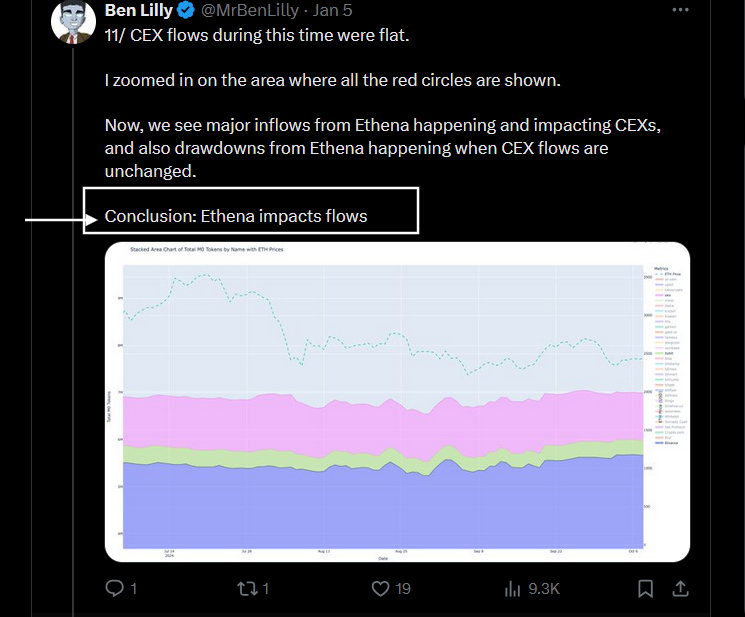
Ben Lilly’s revelations highlight the complexities behind Ethereum’s price behavior. Continue to read to dive deeper into this analysis.
Why Ben Lilly Believes Ethena Crypto is Responsible for ETH’s Suppression
Economist Ben Lilly has brought new perspectives to the debate over Ethereum’s (ETH) market dynamics.
Pointing to data from DeFi Llama, Lilly noted that Ethena boasts a TVL of $5.9 Billion. Moreover, this figure is consistent with Ethena’s transparency dashboard. This alignment of data presented in a table has captured a lot of attention. However, Lilly cautioned that this figure could be easily misunderstood.

In addition, he explained that while the TVL reflects the total value locked in USD terms, flipping this metric into ETH units doesn’t accurately represent ETH’s total market presence or holdings. According to Lilly, these numbers only quantify how much TVL exists when measured in ETH, rather than capturing the actual quantity of ETH locked.
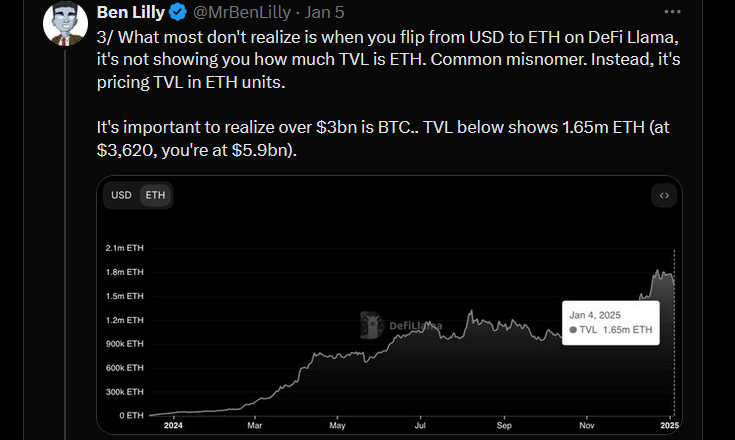
Ben Lilly further emphasized that while he believes DeFiLlama’s method of presenting TVL data isn’t flawed, his analysis provides more insight into the timing of ETH inflows, particularly through Ethena crypto.
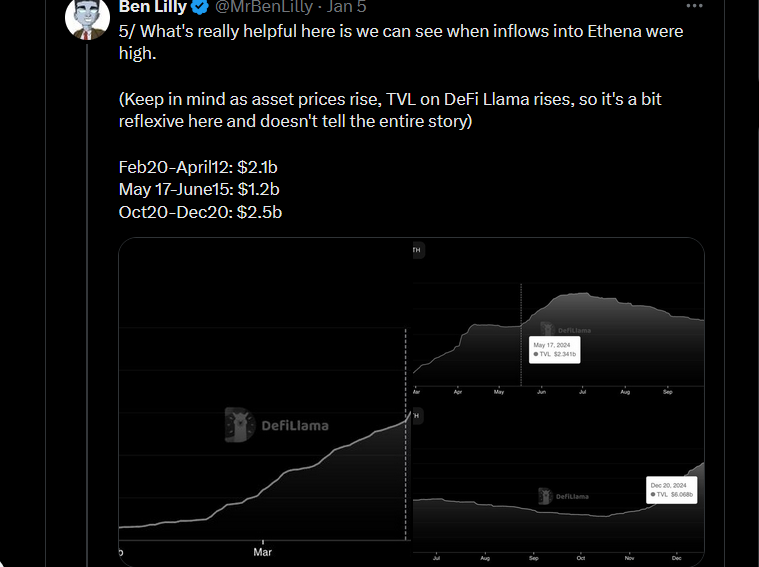
Ben Lilly used various charts to identify three distinct periods in 2024 when Ethena experienced significant inflows. This shedded light on the noteworthy market behavior during these phases.
The first major inflow period spanned from February 20th to April 12th, during which $2.1 Billion flowed into Ethena. The second wave came between May 17th and June 15th, amounting to $1.2 Billion. The third and final surge occurred from October 20th to December 20th, bringing in $2.5 Billion.
Moreover, Ben Lilly’s deep dive into centralized exchange (CEX) data from the top three platforms during the same periods as the inflows of Ethena crypto revealed notable discrepancies. These differences confirmed his earlier suspicion that Ethena plays a significant role in influencing Ethereum’s price dynamics.
By comparing the inflows reported by DeFiLlama and the CEXs, Lilly’s research brought to light how Ethena’s activities might indirectly shape ETH’s price movements.
This meticulous investigation not only underscores the complexity of ETH price behavior but also raises questions about the transparency of how major players contribute to its market trends.
Conclusions Drawn From Ben Lilly’s Chart Of ETH/USD & ETH/BTC
Ben Lilly’s recent analysis sheds light on Ethena crypto’s significant impact on Ethereum’s price behavior. Sharing a detailed chart, he highlighted key areas. In the chart below, red boxes mark periods of major inflows into Ethena, while vertical green lines indicate drops in its total value locked (TVL).
According to Lilly, these inflows often coincided with sharp rises in ETH’s price, shown as a climbing purple line within the red boxes.
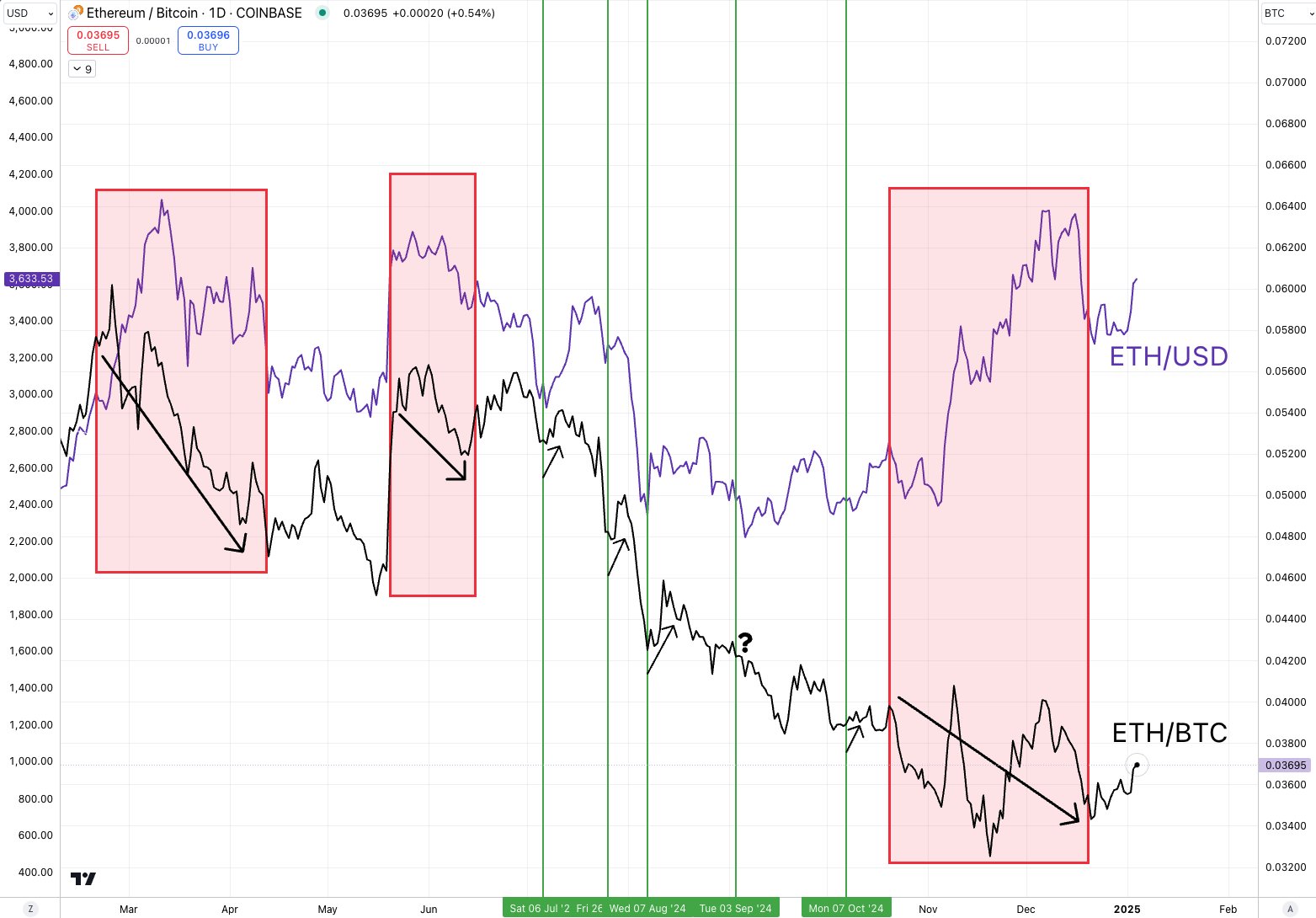
This trend, Lilly explained, aligns with the idea shared by crypto commentator CL207 on X, who suggested that ETH is being suppressed, and Ethena crypto appears to play a pivotal role in this.
Lilly noted that ETH’s current market dynamics suggest a preference for using the asset as collateral in yield-generating strategies rather than for speculative price movements.
Looking ahead, Lilly believes Ethena’s influence will continue to dampen Ethereum’s price upside. However, he also pointed out a contrasting factor, that if Wall Street begins to pour money into Ethereum-focused ETFs, market dynamics could shift dramatically.
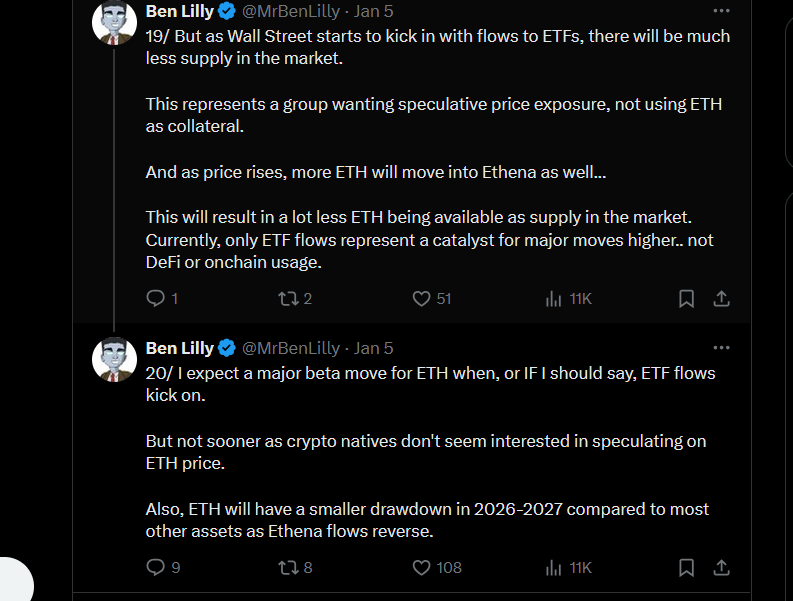
These ETF inflows represent speculative price exposure rather than the collateral-based usage Ethena promotes. Interestingly, Lilly predicted a cyclical effect.
As Ethereum’s price rises due to ETF flows, more of it will likely flow into Ethena crypto, further reducing its available supply in the market. This interplay could create a scarcity effect, amplifying price movements in the long term.
Over the next two to three years, Lilly forecasts that Ethereum will experience smaller drawdowns compared to most other assets, particularly in 2026-2027, as Ethena flows begin to reverse.
On the contrary, for now, ETH’s fate is tied to the balance between ETF-driven speculation and its utility within on-chain ecosystems.
Disclaimer
In this article, the views, and opinions stated by the author, or any people named are for informational purposes only, and they don’t establish the investment, financial, or any other advice. Trading or investing in cryptocurrency assets comes with a risk of financial loss.