
 streamoors
 Sword Inu
 Altai the Tiger
 IGNITION
 no crying in the casino
 NEAR Protocol
 Pudgy Penguins
- Ommer Blocks are two similar blocks, based on Ethereum’s Blockchain
- Several blockchains including Ethereum use the “Merkle Tree” concept to verify the genuinity of the data entered into a block
In the Ethereum Blockchain, it is possible to mine two blocks at the exact same time, when that happens, only one block is allowed to enter the ledger, the block which is left out of the inclusion is called Ommer Block or formerly known as Uncle Block. This change in its name comes from the discussion between the miners and the Ethereum community that the block shouldn’t be called with a gender-specific name.
However, the miners of the Ommer Blocks don’t go home empty-handed, they do get rewarded a certain percentage of the block as well as the transaction fees for mining the block. This is because the coin is based on the Proof-of-Work consensus mechanism. The pay for Ommer Blocks is less as compared to the complete block which is included in the ledger. Moreover, Ommer Blocks are not useless, instead, they help in enabling the network to be more secure and allow for shorter block times.
If a blockchain, say Ethereum, decides to change its consensus mechanism from Proof-of-Work to Proof-of-Stake then this change will directly impact the rewards that a miner gets for the Ommer Blocks. In the case of a Proof-of-Stake consensus mechanism, the miner will not be rewarded the percentage of the block but only the transaction fees.
Understanding the Mechanism of Ommer Blocks.
It’s important to understand, how Ommer Blocks originate.
To understand this, it’s important to know how the data is structured in the Ethereum Blockchain.
Blockchains like Ethereum and Bitcoin which provides an unrestricted access to the public, should have a method that only allows the data verified by a consensus mechanism to enter into a block. To achieve this, many blockchains use a method called “Merkle Tree”.
Merkle Tree is a method of structuring data in a manner that ensures the authenticity of the data stored or transmitted within a blockchain. A Merkle Tree is a tree-shaped data structure that consists of a list of hashes with each hash containing a block of data. These hashes are verified at each level of the Merkle Tree by comparing a hash to the Root Hash, which contains the data of all the hashes, this is done to ensure the authenticity of the data entered into the block.
It’s easier to identify changes in the data as Merkle Tree consists large data sets in the form of hashes and any change in the data will automatically change its hash, enabling it to be detected without any difficulty.
A Merkle Tree structure forms a concept of ancestral relationships, meaning, every new block which is added to the chain has some attributes of the block prior to it. One can understand this by relating it to a parent, sibling, or parent’s sibling relationship, similar to a family tree to an extent.
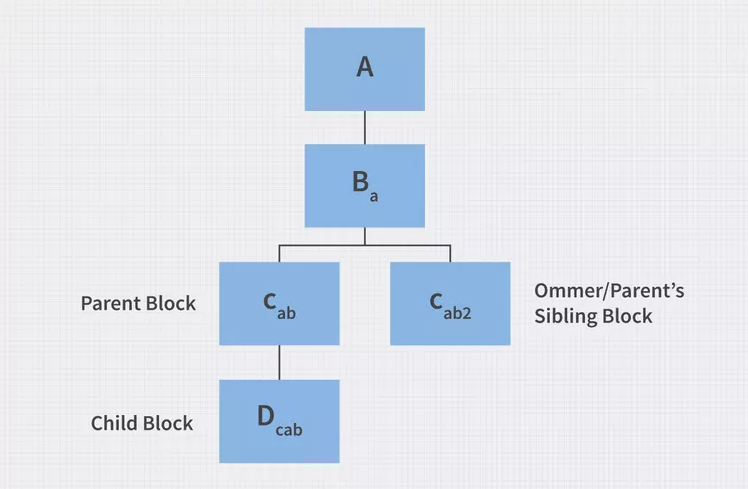
Above is a pictorial representation of, how an Ommer Block is created and identified by the Merkle Tree Method.