Bitcoin
 ZKsync
 Pudgy Penguins
 Pearl
Pearl Quantus
 Starknet
 NEAR Protocol
- Nick White contends that a decentralized committee remains, at its core, a committee.
- Vitalik countered that if Ethereum left its principles of verifiability and adopted committees and centralized mediators for all operations, it would cease to be Ethereum in his eyes.
- Meanwhile, Justin Sun’s team transferred 29,920 ETH, valued at $119.7 million, into HTX following the price surge to $4,000.
In the crypto world, a fresh debate is gaining traction, sparked by Celestia partner Nick White and further illuminated by Ethereum co-founder Vitalik Buterin. Buterin’s response to White’s remarks has brought renewed insight and clarity to the community.
This article sheds light on what the discussion was about and Vitalik’s key principles which are intended for shaping the second-largest blockchain. Keep on reading for a deeper dive into this pivotal discussion and its impact on the ETH price.
Nick White Stressed On The Primary Goal Of a Blockchain
Nick White asserted that the core purpose of blockchain technology lies in achieving verifiability, regardless of the approach used. He also challenged the idea that decentralization, by itself, guarantees the integrity of blockchain systems. Which are particularly in areas like governance and exchanges.
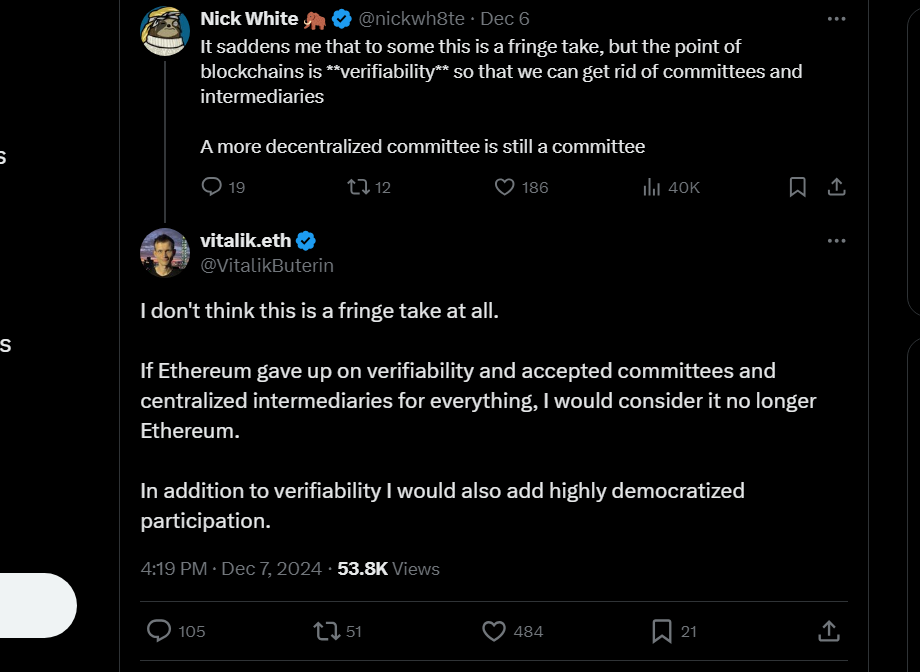
On X, White expressed disappointment, stating, “It saddens me that to some this is a fringe take, but the point of blockchains is verifiability so that we can get rid of committees and intermediaries. A more decentralized committee is still a committee.”
Celestia’s partner, Nick White, emphasized that the ultimate goal is to eliminate reliance on committees and intermediary institutions, regardless of the method. He remarked, “A decentralized committee is still a committee.”
To clarify, White was not advocating for the widespread adoption of committees within blockchain verification. Instead, he argued that committees should only be considered for consensus mechanisms, rejecting their use for state validity.
His comments highlighted a crucial debate about the core of blockchain technology. Its ability to facilitate verifiable and trustless transactions without intermediaries. Those are core principles deeply valued by much of the crypto community.
Vitalik Buterin Focuses on Upholding Blockchain Fundamentals
Ethereum co-founder Vitalik Buterin quickly responded to Nick White’s remarks. He expressed his thoughts on Nick white’s opinion.
Buterin stated, “This perspective is far from fringe. If Ethereum were to abandon verifiability and embrace committees or centralized intermediaries universally, it would no longer be Ethereum to me.”
He further elaborated that alongside verifiability, fostering a highly democratized participation is equally vital. Buterin argued that these foundational principles are essential to avoid replicating centralized systems disguised as innovative technology. Pursuing these principles would ensure Ethereum stays true to its spirit of being “trustless, inclusive, and accessible to all.”
Vitalik Buterin also explored the complexities of incorporating trust into certain layers of Ethereum’s infrastructure. He acknowledged areas where striking a balance might be unavoidable.
Challenging a common belief that users prioritize convenience over verifiability, Buterin argued that a good user experience and robust verifiability are not mutually exclusive. While achieving both is complex, he emphasized that it is essential and may require user patience to ensure progress without sacrificing Ethereum’s foundational principles.
Vitalik Buterins remarks shed light on the developmental hurdles Ethereum faces and reaffirm his dedication to maintaining its decentralized and verifiable framework.
What’s the Impact of This Discussion on the ETH Price?
The discussion highlighted the importance of verifiability and democratized participation within blockchain ecosystems. It resonated strongly with the Ethereum community.
While Ethereum has long championed decentralization, the ecosystem’s growth has brought contentious compromises. For example, the reliance on centralized intermediaries for API nodes and oracles. That’s one of the probable reasons that Nick White’s comments reignited this debate, drawing attention online.
The response from Vitalik Buterin made it clear that Ethereum’s identity hinges on resisting the ****full adoption of centralized solutions or heavy reliance on intermediary committees. Maintaining decentralization remains non-negotiable for the world’s second-largest blockchain by market capitalization, following only Bitcoin.
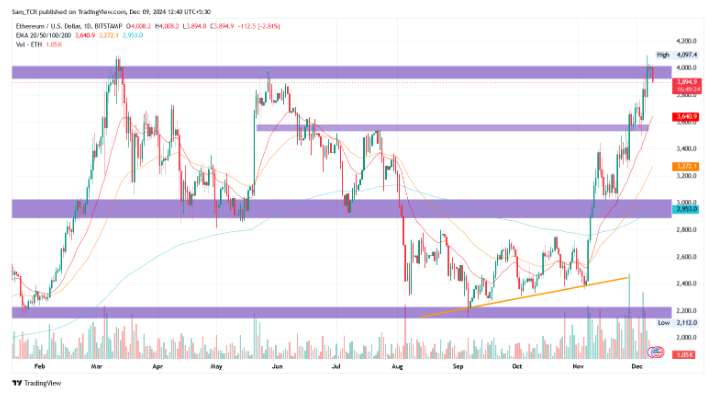
These discussions have also subtly influenced ETH’s price movement. After a strong rally that brought Ethereum close to the $4,000 mark, the price appears to be lacking momentum.
While the recent dip isn’t alarming, it indicates a temporary pause in the bullish momentum. A renewed wave of interest could potentially push ETH past $4,000, testing resistance levels around $4,200.
Community Reactions to Blockchain Governance and Censorship Resistance
The debate around committees in blockchain governance continues to generate strong opinions within the community. Toly (@aeyakovenko) emphasized the importance of real-time censorship resistance. It notes that geographically distributed committees are necessary for event ordering.
Toly’s view aligns with Celestia partner – Nick White’s stance that committees should only be used for consensus. However, it should not be for state validity, as there are no current alternatives.

Further highlighting concerns, Toly argued that committees should also be avoided for double-spend protection. Additionally, Zooko (@zooko) expressed interest in how the combination of Proof-of-Stake and Proof-of-Work might offer solutions, even though PoS relies on committees.
Those discussions underline ongoing concerns and varied approaches to blockchain governance and security.
Strategic Crypto Moves by Justin Sun’s Team
In a strategic move, Justin Sun’s team transferred 29,920 ETH, worth around $119.7 million, into the HTX exchange as the ETH price surged past $4,000.
This deposit is part of a larger acquisition strategy, with Sun’s team purchasing 392,474 ETH between February and August this year at an average price of $3,027 per ETH. It has brought their total investment to nearly $1.19 billion.
The transfer also reflects Sun’s broader efforts to diversify within the crypto market. That includes moving significant amounts of EIGEN and ETHFI staking rewards from Ethereum into the HTX.
The EIGEN deposit alone amounted to $1.44 million. That underscores Sun’s growing involvement across various blockchain projects.

Those deposits highlight Justin Sun’s optimistic outlook on Ethereum’s future and align with a larger trend of increasing capital flows into crypto exchanges. That suggests growing confidence in the digital asset market.
Disclaimer
In this article, the views, and opinions stated by the author, or any people named are for informational purposes only, and they don’t establish the investment, financial, or any other advice. Trading or investing in cryptocurrency assets comes with a risk of financial loss.