 Minter
 Bittensor
 Quack AI
 NEAR Protocol
 Pons
Pons Pearl
Pearl Bitcoin
The XRP Ledger (XRPL) has experienced a notable surge in the total value locked (TVL).
Within the past 7 days, the XRPL DeFi TVL increased by 19%. This growth reflects rising confidence in the XRPL’s DeFi applications and expanding liquidity.
It coincides with the bullish rally in XRP price, which is currently inching towards its all-time high price of $3.8.
XRP News: Details of the XRP Ledger DeFi TVL Boom
According to data from DeFiLlama, XRPL’s TVL currently stands at $89.22 million. This figure marks an 18.5% increase from the $75.25 million TVL recorded on July 18, 2025.
In addition, the XRP Ledger stablecoin market cap stood at $166.05 million, marking a 46.25% increase over the past 7 days. Likewise, the Decentralized Exchanges (DEX) volumes surged to $48,309.
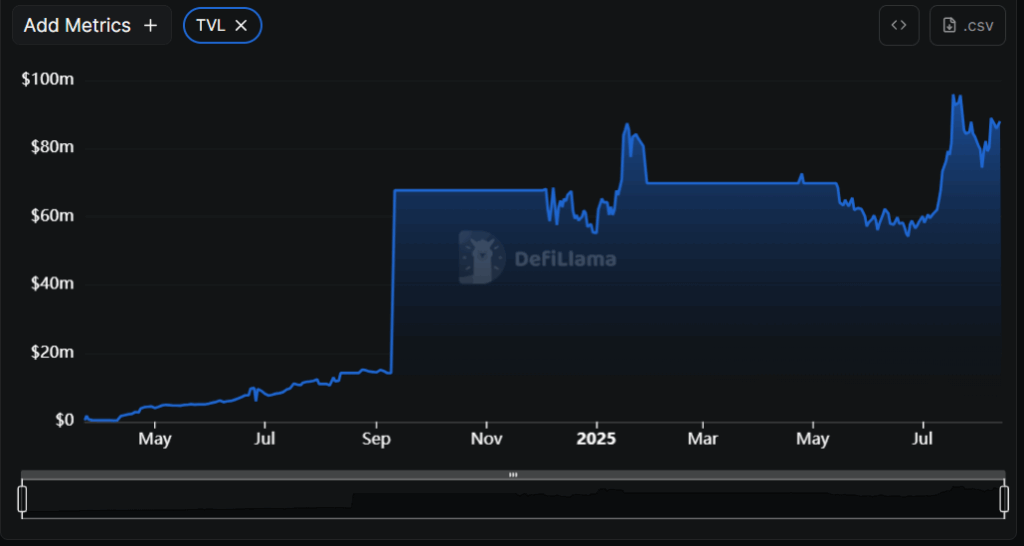
Note that the TVL refers to the total value of an asset staked or locked in a specific protocol. The worth of locked assets can help give investors insight into the entity’s performance.
A higher TVL value usually indicates a successful project compared to others with lower values. Therefore, the recent $89.22 million figure suggests that investors are open to investing in XRP.
This has also shown in the coin’s price performance. At the time of writing, XRP’s price was trading at $3.26, which is up 2.68% in the past 24 hours. Similarly, the trading volume increased by 16% to $9.7 billion.
The emergence of new protocols has also contributed to the expansion of the XRP Ledger DeFi ecosystem. OpenEden has emerged as a major player, overtaking XRPL DEX as the leader in TVL within the network.
XRP News: XRPL Institutional Tokenization Trend
The success of XRPL has largely been attributed to its strong network. This is evident in its more than 170 active validator nodes and over 900 nodes globally.
Ripple, the firm behind the XRPL blockchain, has, over the years, prided itself on its low transaction fees and high transaction speed.
As a result, Ripple plays a key role in real-world asset (RWA) tokenization. The blockchain payment firm leverages the XRP Ledger to enhance financial efficiency and accessibility.
Ripple aims to connect central finance and decentralized systems through blockchain technologies.
However, market analyst SMQKE argued that Ripple and XRP are designed for financial institutions, not retail.
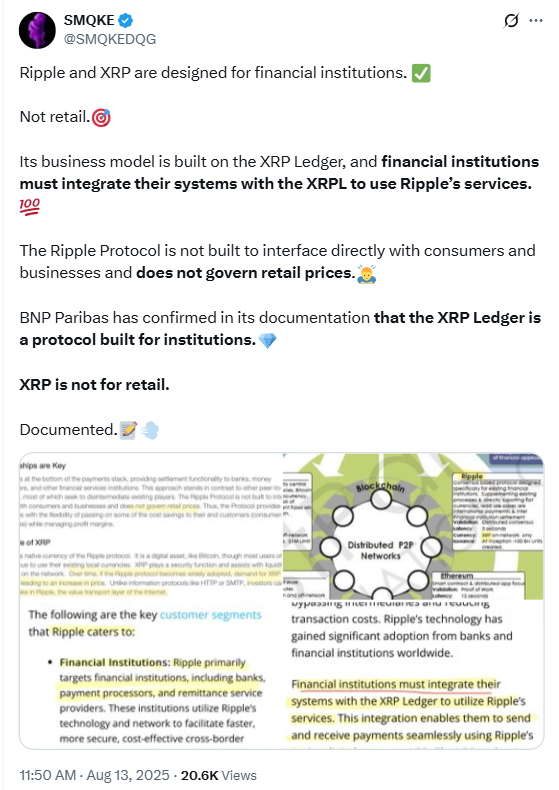
The analyst noted that the business model is built on the XRP Ledger. According to him, financial institutions must integrate their systems with the XRPL to utilize Ripple services.
SMQKE added that the Ripple protocol is not designed to interface directly with consumers and businesses. Against this background, the analyst pointed out that Ripple does not govern retail prices.
SMQKE also posted a BNP Paribas documentation, which stated that the XRPL is a protocol built for institutions.
The Influence of ISO Compliance
Amid these developments, XRP community member, KingXRP on X announced that the U.S reserve is set to implement the ISO 20022 standard for its payment systems very soon.
The community member emphasized that Ripple and XRP are set to play a leading role in ISO 20022 financial messaging networks.
ISO 20022 is a new financial messaging standard replacing SWIFT messages. It acts to bridge this gap by unifying banks, crypto exchanges, and messaging systems into one communication mode.
Ripple’s system, with its focus on secure and fast online transactions, complements the objectives of the ISO 20022 standard.
Several market analysts claim this compatibility makes XRP uniquely placed to thrive among legacy institutions embracing the ISO 20022 standard.
Thus, the implementation of ISO 20022 by the Fed would mean trillions in institutional capital pouring into the XRPL.
In a parallel development, RippleX recently introduced XLS-0089d, a draft standard that structures metadata for tokens issued on the XRPL.
The goal is to make token information more accessible and machine-readable across XRPL applications.