Claudia
 Bunker Mode
 Pearl
Pearl Starknet
 Solana
 NEAR Protocol
 Render
Key Insights:
- Google Cloud is piloting its Universal Ledger blockchain that targets the financial industry.
- The platform supports Python smart contracts and is compliance- and automation-oriented.
- GCUL is permissioned and private, and some people consider it not a true blockchain..
Google Cloud is working on a revised blockchain system that seeks to change payout services by financial companies. The project, or Google Cloud Universal Ledger (GCUL), is at its private testing stage and aims to provide a compliant and programmable ledger system.
Google Cloud Universal Ledger Designed for Financial Services
According to a LinkedIn post by Widmann, GCUL is built as a blockchain network for financial markets and payment systems. The platform supports Python-based smart contracts and provides automation for payment services.
Google Cloud described the blockchain as “performant and credibly neutral,” presenting it as an infrastructure layer for banks, payment providers, and financial firms.
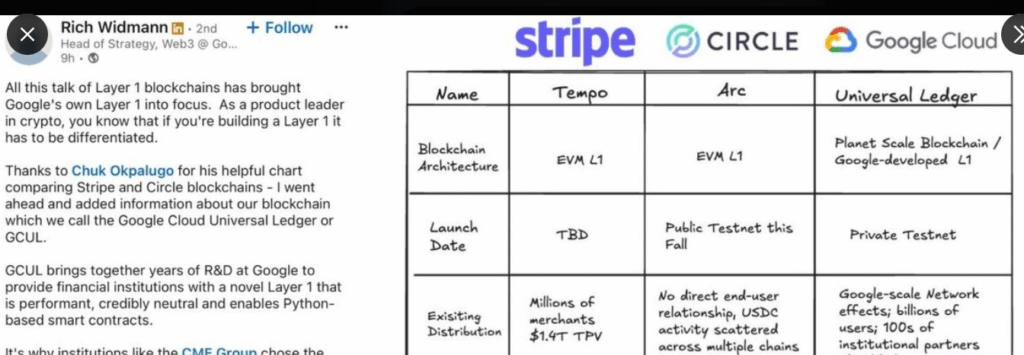
Widmann noted that GCUL will not be tied to a single firm or issuer. He stated that institutions such as Tether or Circle may not rely on each other’s systems, but GCUL is designed as a shared environment accessible to a wide range of entities.
Private and Permissioned Structure Raises Debate
More so, the announcement stated that GCUL is a private and permissioned system built to meet compliance requirements. It is programmable and can be used in cross-border payments and digital asset management by accessing a single API.
The permissioned structure has, however, drawn conflicts among the general crypto community. Critics say that it is misleading to refer to GCUL as a decentralized blockchain since it is private.
Social network comments on X touched on the fact that a blockchain that a single company controls is against the principle of decentralization.
Some on X stated that such a model does not reflect the values of permissionless networks. Others questioned the claim that the ledger is “credibly neutral” when operated under centralized oversight.
Background and Institutional Collaboration
Google Cloud had previously introduced the GCUL project earlier this year. In March, the company revealed that it was working with CME Group to test wholesale payment and asset tokenization solutions using the platform. At that time, CME was already piloting systems on the ledger.
The company added that the blockchain aims to simplify how institutions manage accounts and process cross-border transactions. It intends to integrate multiple currencies and assets into a single system, removing the need for additional infrastructure development.
Features include near-instant transaction settlement, stable fees invoiced monthly, and 24/7 availability for clients.
Industry Response and Future Outlook
Industry participants’ reactions have been divided. Some commented on the project, comparing it to earlier corporate blockchain efforts such as Diem.
Despite the debate, Google Cloud indicated that the ledger will be expanded beyond its current test environment. Widmann said it will eventually be opened to Google’s user base and hundreds of institutional partners.
However, no official timeline has been shared for when the platform will move from private testing to public access.
Cloud technology has become more involved in the blockchain and crypto industry. In a recent report, Worldcoin price benefited from OpenAI’s transition from Microsoft Azure to Google Cloud. The move enhanced AI infrastructure while creating potential synergies with blockchain innovation.
MetaMask Adds Social Login Option
In another twist, MetaMask introduced a new feature in which users can create and manage their wallets with the help of Google and Apple accounts. The social sign-in feature allows you to create a wallet without dealing directly with the traditional 12-word Secret Recovery Phrase.
Instead, the recovery phrase is generated in the background and secured by the user’s password.
MetaMask stated that the approach maintains self-custody since no single entity can access the recovery data. However, the company noted that wallet access cannot be restored if a user loses their password.