 WASTED
 Official Trump
 Chunkee The Manatee
 Bitcoin
 Hyperliquid
 Lucia
 Pudgy Penguins

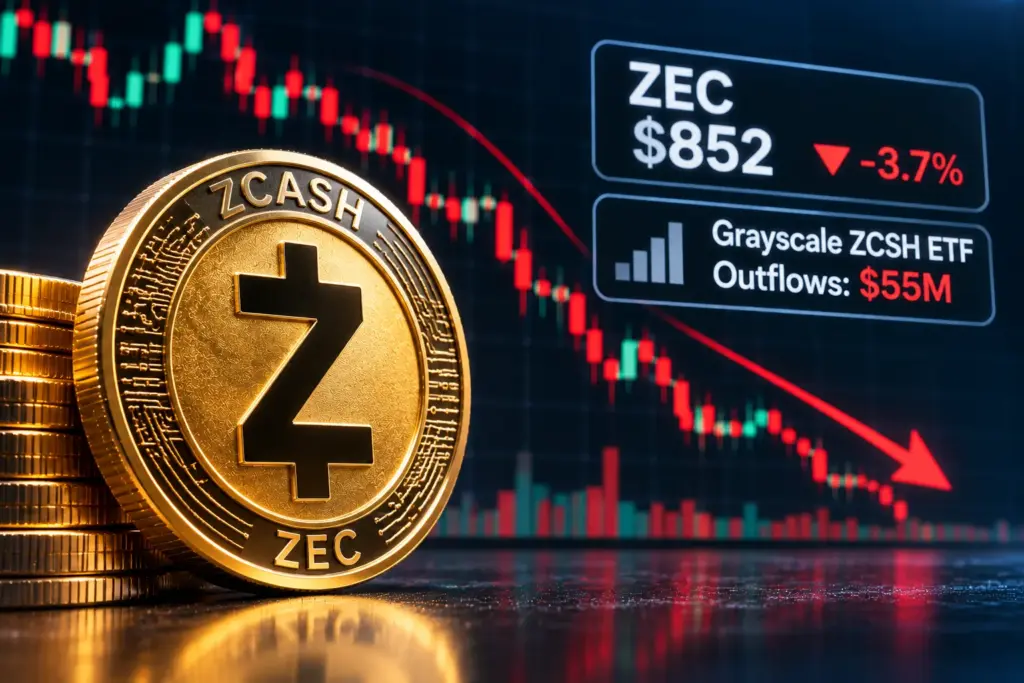
Zcash price extended its decline on Friday, Nov. 20, as cryptocurrency markets faced renewed selling pressure. ZEC traded near $852 during early Friday trading, according to market data cited by Blockchain Reporter.
The decline followed weeks of withdrawals from Grayscale’s Zcash Trust ETF (ZCSH). The fund recorded approximately $54.69 million in outflows over three consecutive weeks through Nov. 18, according to SoSoValue data cited by CoinEdition.
Meanwhile, investors faced uncertainty over U.S. monetary policy and weaker cryptocurrency market sentiment. Technical indicators also pointed to continued pressure, although the next price direction remained uncertain.
Zcash Price Falls as Grayscale ETF Outflows Continue
One reason the ZEC token is falling is that American investors have continued to dump their ETFs. SoSoValue data shows that the Grayscale Zcash ETF (ZCSH) had over $707k outflows on Thursday, bringing the monthly outflows to $55 million.
These funds shed over $46 million in assets in October, erasing the $245 million gains they experienced in September. In total, these funds have had cumulative net inflows of $166 million and now have $474 million in assets.
The ongoing ZEC ETF outflows have coincided with those of other assets. For example, spot Bitcoin ETF outflows have jumped to over $3.4 billion this month. Spot ETH ETFs have shed $980 million this month.
The ongoing performance is happening as the Crypto fear and greed index continues falling. It has dropped to the extreme fear zone of 12. This decline is occurring as investors react to recent macro data showing that the headline Consumer Price Index (CPI) rose 0.4% last month. The American economy also created over 165k jobs last month.
Recent inflation and employment data have strengthened expectations of another Federal Reserve interest rate hike in December. The CME FedWatch tool tracks market expectations for a 25-basis-point increase. Meanwhile, the U.S. 10-year Treasury yield recently climbed above 5%, reflecting concerns about persistent inflation and tighter monetary policy.
The same trend is happening in the stock market, where equities have continued their downward trend. Nvidia stock has entered a bear market and erased over $2 trillion in value over the past few months. The Nasdaq 100 and S&P 500 indices extended their sell-off as well.
Zcash Futures Open Interest Continues to Fall
Meanwhile, Zcash futures open interest has declined this month, dropping to $1.6 billion, its lowest level since September. This represents a 45% decline from its year-to-date high of $2.9 billion, suggesting that traders have reduced their leveraged exposure.
The decline has coincided with increased long liquidations, adding pressure to Zcash price. According to CoinGlass, long positions worth over $17 million were liquidated, compared with $5.25 million during the earlier comparison period. Such liquidations can intensify selling pressure, although falling open interest alone does not confirm further price declines.
Zcash Price Prediction: Technical Analysis
The daily chart shows that the ZEC price has been in a strong downward trend in the past few months. It has slumped from a high of $1,689 in September to its current level of $771. It has already moved to the 61.8% Fibonacci Retracement level. A move below that level will confirm the bearish outlook.
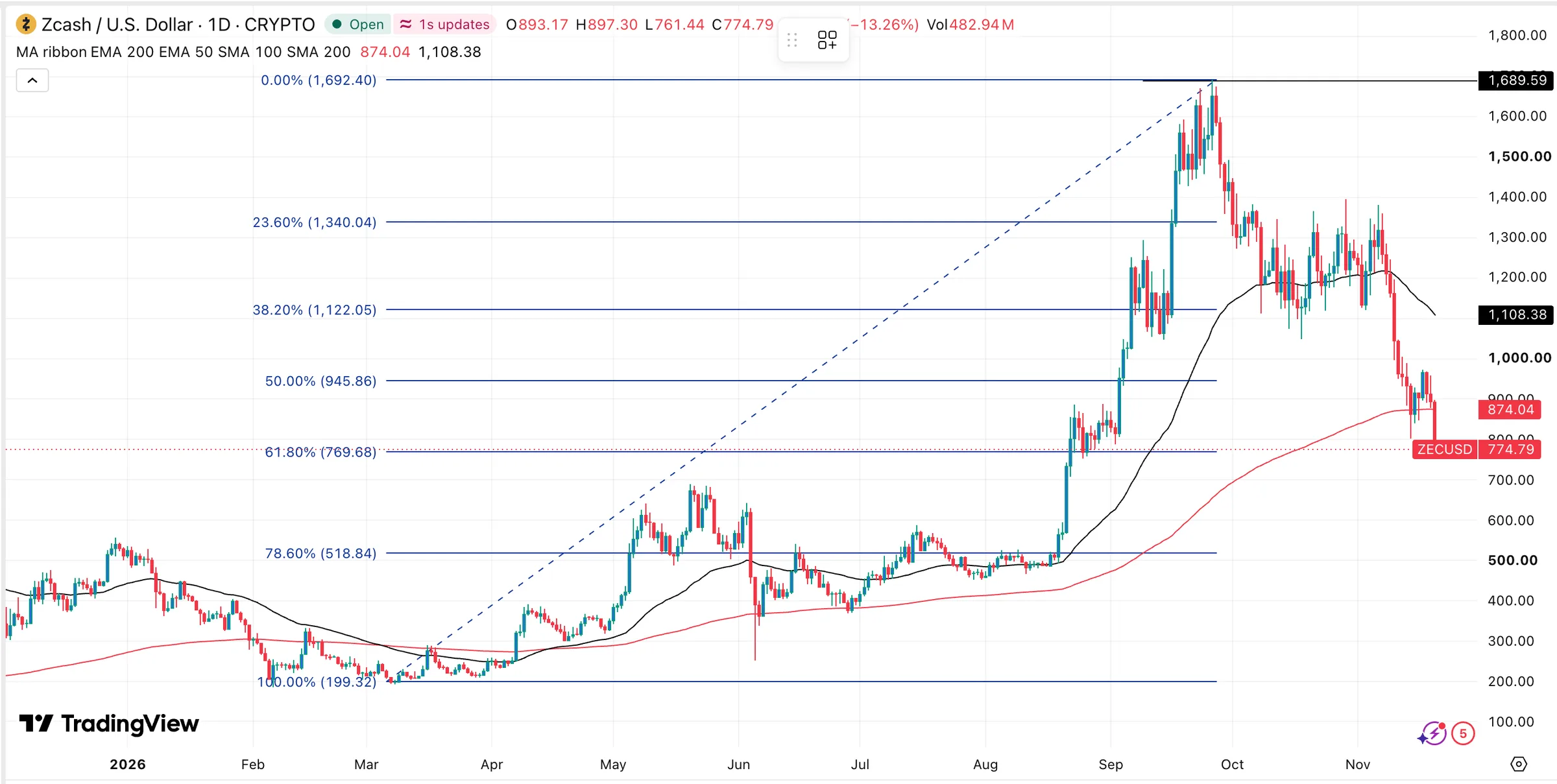
The coin has also slumped below the 50-day and 200-day Exponential Moving Averages (EMA). If the downtrend continues, the coin will enter a death cross, a highly bearish technical signal.
The Relative Strength Index (RSI) and the MACD indicators have also continued falling. Therefore, the token will likely continue falling as sellers target the key support level of $599, which coincides with the 78.6% Fibonacci Retracement level. On the other hand, a move above the crucial resistance level of $900 will invalidate the bearish outlook.
This article provides general financial information, not investment advice. Cryptocurrency prices are volatile, and technical indicators cannot guarantee future returns. Investors should conduct independent research before making financial decisions.