 Celestia
 LayerZero
 Sui
Sui Injective
 Pi Network
 Quantus
 Pudgy Penguins

Key Insights:
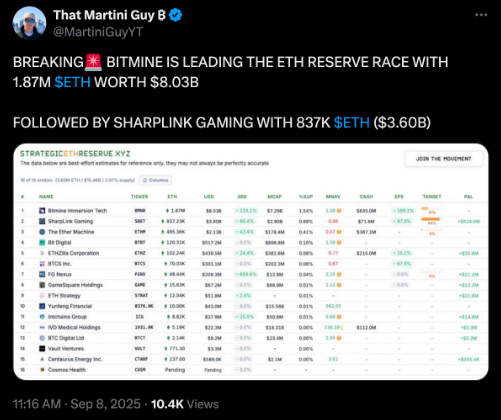
- Bitmine secures 1.87 million ETH, valued at $8.03 billion.
- Sharplink Gaming holds 837,000 ETH, totaling $3.6 billion in reserves.
- Ethereum dominates tokenized assets, leading to the adoption of stablecoins, treasurys, and commodities.
Bitmine is now the biggest corporate Ethereum holder with a total of 1.87 million ETH worth $8.03 Billion. The statistics show that the holdings were 1.54% of the circulating supply of Ethereum.
After that, Sharplink Gaming reveals holdings of 837,230 ETH worth $3.6 Billion. The two companies represent almost 2.3 million ETH, valued at over $11.6 Million.
Bitmine bought about 7.7 billion dollars of ETH between July and August. This fills its coffers quickly and then decelerates in September.
The minor momentum decline is accompanied by market-wide exhaustion and the September Effect. Asset prices generally underperform in September.
The Ether Machine holds 495,360 ETH valued at $2.13 Billion. Bit Digital owns 120,310 ETH, worth around $500 Million. ETHZilla Corporation controls 102,240 ETH, totaling $439 Million. These entities represent major players in Ethereum accumulation.
Ethereum Adoption Expands Beyond Gaming and Mining
Ethereum’s dominance of token assets has emerged as a characteristic of its network in 2025. Ethereum, in general, is the favored blockchain for implementing real-world assets (RWA).
The current estimates put the amount of circulating stablecoins on Ethereum at over $160 Billion. This is more than twice the amount circulating at the beginning of 2024.
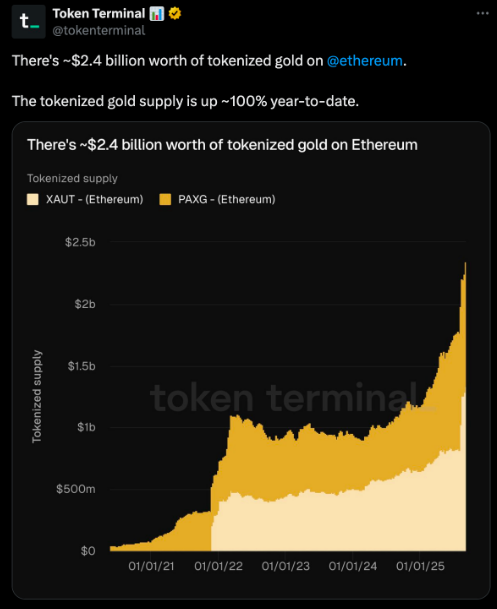
There is now over $2.4 Billion in tokenized gold on Ethereum. This represents over 70% of the tokenized U.S. Treasurys market. There has been a continued gain in momentum since early September, when Fidelity released the Fidelity Digital Interest Token (FDIT).
This is an on-chain Treasury product that raised more than $200 million in days. The hype highlights Ethereum’s shift into institutions’ financial support worldwide.
Market Context: Range-Bound Prices and ETF Outflows
Nevertheless, Ethereum has not been able to rise in the market in recent weeks despite the robust institutional adoption. At the beginning of September, the ETH was trading in a tight range of $4,200 to $4,300.
It followed a surge to above $4,400 in July. When writing, the Ethereum price stood at $4,314, with relatively small gains over 24 hours based on CoinMarketCap data.
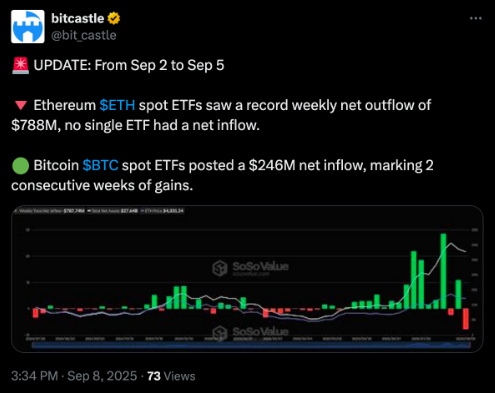
SosoValue data shows five consecutive withdrawals, amounting to $788 million in one week, the largest ever. Meanwhile, Ethereum trading rates declined by 25% of weekly averages, which suggested a deceleration in the trend.
According to Token Terminal, Ethereum network revenues dropped by 45% month-over-month to $14.1 Million. The decrease in revenues weakened the profit margins and lowered the staking rewards. This, analysts caution, may kill the mood should the trend continue.
Several research centers have observed the September Effect as a cause of the stagnation of Ethereum. Korbit Research noted an increase in investor caution, with such companies as Bitmine reducing purchases of reserves.
The basics of Ethereum, such as a shrinking network revenue, have also had a hand in dampening the movement. However, on-chain data indicate that investors are still accumulating ETH, which is expected to reach $5,000 soon.
Binance and Coinbase saw a combined drop of over 2.6 million ETH in reserves from late June to early September. This sharp decline points to reduced sell-side liquidity in the market. This could be a foundation of future stability, although the action of the short-term prices is also restricted.
Disclaimer
This article is for informational purposes only and provides no financial, investment, or other advice. The author or any people mentioned in this article are not responsible for any financial loss that may occur from investing in or trading. Please do your research before making any financial decisions.