Minter
 Pearl
Pearl NEAR Protocol
 Pons
Pons Quack AI
 Quantus
 Sui
Sui

In a post on X on October 3, 2025, @KobeissiLetter disclosed a significant milestone. A record high of $20 Trillion has been reached in foreign holdings of US equities.
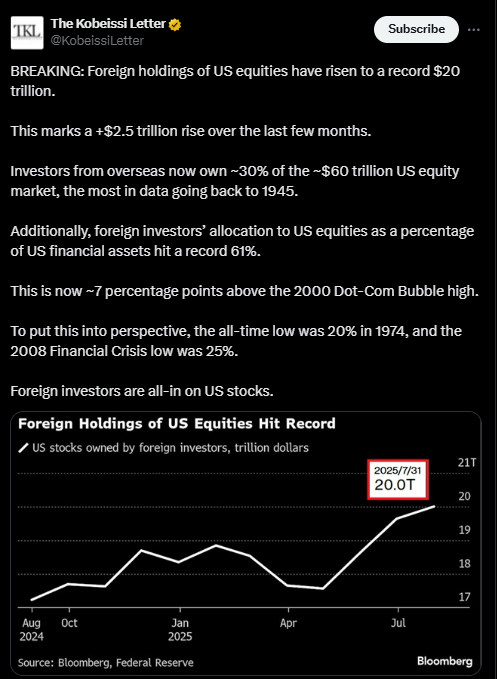
This represents a $2.5 Trillion increase in just a matter of months. As international investors flood the U.S. stock market with cash, the news comes.
A Reuters report confirms this pattern. It demonstrates how the Federal Reserve’s rate cuts are fueling this increase in investment. Let’s examine this trend and its significance.
Foreign Investors Power the U.S. Stock Market Boom
Approximately 30% of the $60 Trillion U.S. equity market is currently owned by foreign investors. Since records started being held in 1945, this is the highest level. Over $30 Trillion in U.S. stocks and bonds are held by foreign investors.
This includes just $8 trillion from investors in Europe. Due to its mighty tech giants, the United States remains a top choice. Global capital is drawn to companies such as Apple and Microsoft. The Federal Reserve’s rate-cutting move increases the allure of investing in the United States.
Hedging against a declining dollar is less expensive when rates are lower. Investors are shielded from currency losses by hedging. According to Reuters, the dollar has lost 10% of its value this year. This promotes increased foreign investment in American markets.
Risks Loom Over U.S. Stock Market Expansion
The @KobeissiLetter post highlights a key statistic. Foreign investors’ allocation to U.S. equities is now 61% of U.S. financial assets. This beats the 2000 Dot-Com Bubble peak by 7 percentage points.
Historically, foreign ownership was as low as 20% in 1974. It rose to 25% during the 2008 Financial Crisis. The current 30% ownership shows a significant shift.
Analysts are warning of risks. A weaker dollar and U.S. policy uncertainty are concerns. Investors are increasing hedges to manage these risks.
This could make markets more fragile. If global conditions change, a sudden pullback might occur. However, the opportunity is clear. The U.S. offers stability and growth. Technological innovation and substantial profits continue to attract funds.
What the Future Could Hold
The increase in foreign investment highlighted both optimism and fragility. While investors showed confidence in the U.S. economy, the concentration of global wealth in American markets introduced new risks.
Reuters noted that the Federal Reserve planned two more rate cuts in 2025, potentially spurring even more foreign inflows. Lower yields globally and dollar weakness could maintain upward pressure on equity valuations. Yet, many traders viewed this as a late-cycle indicator.
Some X users labeled the $20 Trillion milestone a potential “top signal.” Others argued it reflected the global trust in U.S. institutions and innovation. As the S&P 500 continued posting new highs, market sentiment split between faith in corporate resilience and fear of overheating.
Job data painted a mixed picture. Openings approached their lowest level since before the pandemic, suggesting cooling demand. Despite that, corporate earnings stayed strong, and buybacks hit fresh records.
In short, the U.S. equity boom underscored how deeply intertwined global finance had become. The record $20 Trillion in foreign holdings showed how much the U.S. stock market shaped global portfolios — and how vulnerable it could be to shifts in confidence or policy.