Quack AI
 Pons
Pons Lighter
 Sui
Sui NEAR Protocol
 NeoSoul
 Quant
Quant

U.S. Senator Cynthia Lummis shared on X that she’s developing a de minimis tax exemption for Bitcoin. It would apply to small transactions used in everyday purchases. This move follows Block CEO Jack Dorsey’s call to make Bitcoin everyday money.
The proposal could simplify taxes on minor crypto purchases, boosting adoption. It reflects growing support for cryptocurrency in the U.S. amid ongoing debates.
What Is the De Minimis Tax Exemption?
De minimis tax exemptions exempt small transactions from paying taxes. This would be the case for regular Bitcoin purchases, such as purchasing coffee. Currently, every Bitcoin transaction is considered a taxable event by the IRS.
This means that even small gains must be reported. Lummis proposes a $300 yearly threshold as part of her July 2025 Digital Asset Tax Fairness Act.
Small trades would not be subject to capital gains tax as a result. The goal is to lessen users’ paperwork burden. Additionally, it aims to promote the adoption of Bitcoin in everyday life.
The plan expands on the Senate Finance Committee’s discussions. Industry leaders requested such exemptions in 2023. They contended that it is impractical to keep track of every little transaction. Studies from the National Bureau of Economic Research support this.
It was discovered that tax friction reduces the adoption of cryptocurrencies by 15% to 20%. A de minimis rule might reverse this trend. It does, however, raise questions regarding lost tax revenue. The financial impact will need to be studied by the government.
Jack Dorsey, a key advocate for Bitcoin, supports this idea. Recently, he posted on X about needing a de minimis exemption. On the same day, in a post, he also expressed his wish to see Bitcoin as everyday money.
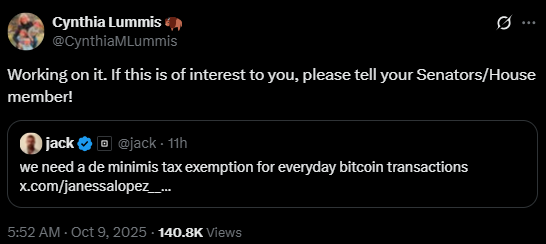
His company, Block, is also launching tools for merchants to accept Bitcoin. This shows a growing push from both lawmakers and businesses. Lummis responded to Dorsey’s post, saying she is working on it. She urged people to contact their representatives to support the plan.
Benefits and Challenges Ahead
Bitcoin may gain popularity as a result of this tax exemption. Without worrying about taxes, people might use it for small payments. It may also benefit small businesses.
On October 9, 2025, Block revealed its new Square Bitcoin wallet, which enables businesses to accept Bitcoin. With more than 4 million Square users, this could lead to widespread adoption of cryptocurrency.
Economic studies predict that adoption will increase by 15–25%. This supports Dorsey’s idea that Bitcoin can serve as a form of daily currency.
Another advantage is privacy. Detailed reporting may not be necessary for small transactions. Users who value anonymity might find this appealing. The IRS may find it difficult to enforce the regulations, though.
Crypto tax compliance is already a problem for them. Oversight has become more challenging due to the agency’s recent personnel losses. Some fear that if this is not closely monitored, it may lead to tax evasion.
The volatility of Bitcoin is another obstacle. Setting a reasonable exemption limit is challenging due to the rapid fluctuations in its price. If the price of Bitcoin rises, a $300 threshold might not be effective. Over time, lawmakers will need to modify the rule. Critics also question the revenue loss.
According to the Congressional Joint Committee on Taxation, Lummis’s overall tax plan might bring in $600 Million between 2025 and 2034. An exemption might cut into this. They’ll have to look for alternative funding sources.