 Pearl
Pearl Bitway
 Pudgy Penguins
 Quantus
 Walrus
 Quant
Quant Artificial Superintelligence Alliance
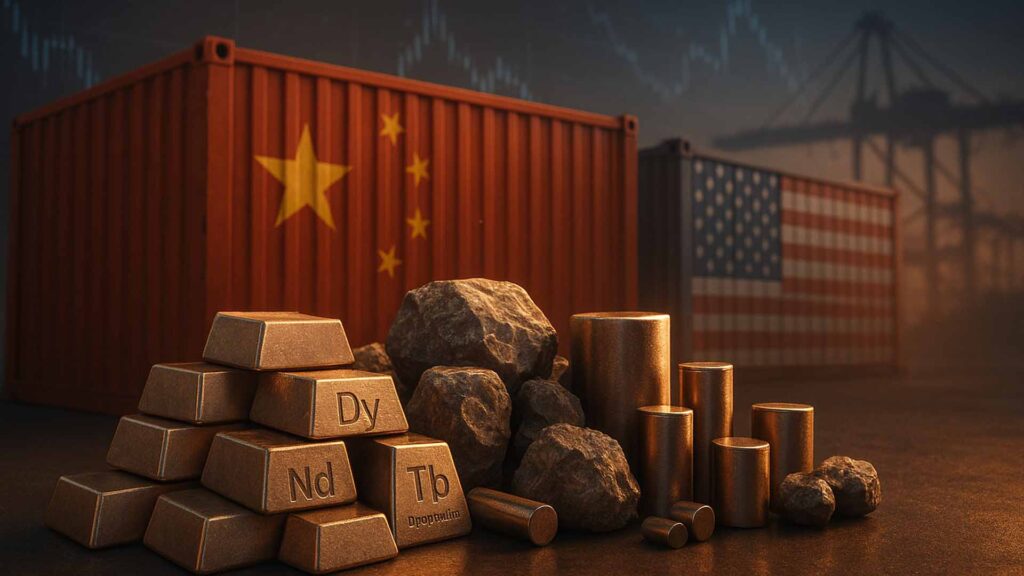
China has officially clarified that its recently announced restrictions on rare earth element exports are not a complete ban. Instead, the government emphasized that applications that comply with regulatory requirements will be accepted.
This declaration coincides with growing global concern over geopolitical tensions and supply chain stability.
China’s Statement: Control, Not Restriction
China’s Ministry of Commerce clarified its rare earth export policy in a public statement on October 12, 2025. According to the ministry, the new regulations are intended to safeguard responsible trade practices and national interests.
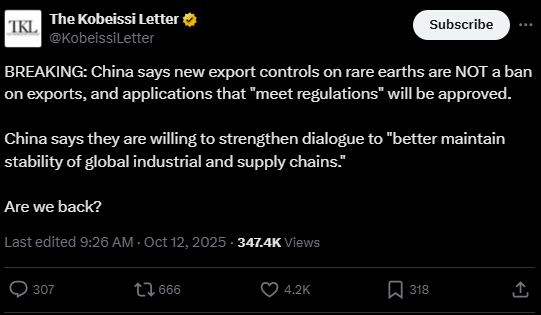
It did stress, though, that these actions do not amount to a complete export restriction. Applications for exports that adhere to the revised rules will still be reviewed and accepted.
China also expressed its willingness to strengthen international dialogue to help maintain the stability of global industrial and supply chains. This clarification was widely viewed as an effort to alleviate concerns about a trade disruption.
Rare earth elements are essential for the production of semiconductors, defense technologies, renewable energy sources, and electric cars. China currently supplies more than 60% of the world’s rare earths. So, its export regulations have a significant impact on the global market.
Tariff Announcement Triggers Crypto Crash
U.S. President Donald Trump announced 100% tariffs on Chinese imports just hours after China’s regulatory announcement. They are focusing on essential software and technology segments. Global financial markets immediately responded to the announcement.
The cryptocurrency sector was severely impacted. Bitcoin fell to about $104,782, a decrease of more than 8%. Solana and Ethereum also experienced sharp drops.
Leveraged cryptocurrency holdings worth over $7 Billion were liquidated within an hour of the tariff announcement. Over 1.6 million traders were impacted by the $19 billion in total liquidations by the end of the day.
The stock market also reacted negatively. Tech and semiconductor stocks led the more than 2% decline in the S&P 500. Investors were concerned that China’s export restrictions might disrupt supply chains. This could increase manufacturing costs when combined with U.S. tariffs.
What the Crypto World Could Expect
The recent crash underscored the vulnerability of cryptocurrency markets to geopolitical shifts. As more statements from world leaders emerge, traders should prepare for further price fluctuations. As traders adopt safer tactics and exchanges tighten risk controls, leverage may stay low.
Stablecoins, as well as well-known cryptocurrencies like Bitcoin and Ethereum, may attract more investors. Speculative tokens may not perform as well as projects with solid foundations and practical applications.
Governments may track cryptocurrency platforms more closely, particularly those with high leverage and significant exposure to risk. Anticipate additional demands for risk management and transparency in decentralized finance (DeFi).
Remarkably, DeFi platforms managed the crash better than CEXs, preserving liquidity and access without interruption. This may increase trust in DeFi protocols and attract more users seeking transparency and autonomy.
China’s Diplomatic Tone Signals De-escalation
China’s diplomatic tone suggests a desire to prevent further escalation amid market turmoil. The nation is open to dialogue and cooperation, the Ministry of Commerce reaffirmed.
It highlighted the importance of maintaining a stable global supply chain, especially for businesses that rely on rare earth elements. This approach, according to financial analysts, might help avert a full-scale trade war.
The Kobeissi Letter, a financial analysis outlet, noted that the likelihood of 100% tariffs going live on November 1 is low. They expect further negotiations and possible policy adjustments.
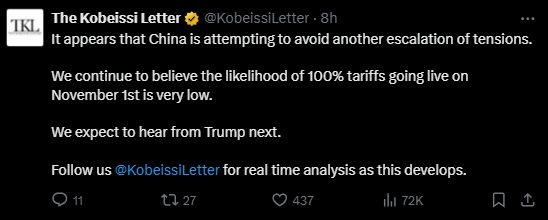
China’s clarification also aligns with its broader strategy of balancing national security with global economic engagement. By regulating exports rather than banning them outright, China maintains control while signaling its commitment to responsible trade.