
 Pearl
Pearl Ondo
Ondo Starknet
 Quantus
 Aerodrome Finance
 Pudgy Penguins
 Akash Network

President Donald Trump surprised Americans on Thanksgiving by saying he may completely cut the federal income tax. He said that the Trump tariffs will bring in huge amounts of money to replace it.
The idea quickly went viral on social media and made headlines around the world. Many people are excited, but experts say the numbers may not add up.
What Trump Actually Said
On Thursday, Trump joined a call with U.S. service members. He suggested that income taxes could be rolled back “over the next couple of years.”
He claimed that Trump tariffs are bringing in “so large” amounts of money. He said the government may no longer need income tax revenue.
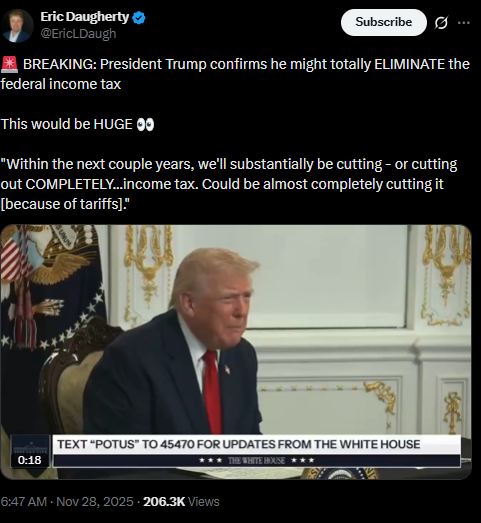
The president stated, “Within the next couple of years, we’ll substantially be cutting – or cutting out COMPLETELY…income tax. Could be almost completely cutting it [because of tariffs].”
Trump has repeated this claim throughout the year on X and Truth Social. He has floated cuts for households earning under $200,000. He has also suggested that some families might not owe federal income tax. He frames this as a major change to help households.
Trump Tariffs as a Revenue Source
Trump returned to office and introduced new tariffs. He set rates between 10% and 50% on imports. He imposed especially high tariffs on Chinese goods. He argues that Trump’s tariffs protect American jobs and encourage shoppers to buy U.S. products.
Trump says tariffs generate billions for the government. He claims they can reduce debt and fund public services. Supporters call them a shield for local factories. Critics warn that they raise prices and strain trade relations.
Supporters argue that tariffs strengthen U.S. industries and reduce the country’s reliance on imports. Critics warn that they act as hidden taxes, raising prices on everyday items such as clothes, phones, and cars.
The $2,000 Tariff Dividend
One of Trump’s most discussed ideas is a yearly “tariff dividend.” He says most households could receive at least $2,000, funded directly from Trump tariffs, with high earners excluded.
Trump argues the dividend would offset higher prices. He says tariffs can deliver direct benefits. He claims families would see real gains.
The idea resurfaced after the Supreme Court heard challenges to the legality of certain tariffs. This could trigger more than $100 billion in refunds.
The Numbers Behind Trump Tariffs
Economists remain sceptical. Last year, tariffs generated approximately $80 billion, while federal income taxes yielded more than $2 trillion. That’s nearly half of all government revenue.
Even with aggressive tariff hikes, studies estimate that collections might reach $300–$ 500 billion, far short of replacing income tax.
The U.S. imported $3.1 trillion worth of goods last year, but income taxes apply to more than $20 trillion in earnings. Experts say this gap makes Trump tariffs an insufficient substitute. They also warn that higher
Big Dreams, Big Questions
Trump’s vision of a tariff-funded government is ambitious but faces steep hurdles. Congress would need to approve any major tax overhaul. Additionally, many Republicans are concerned about the potential for ballooning deficits if income tax revenue is eliminated.
For now, Trump has offered no official plan or detailed numbers. His promise of cutting or eliminating income tax remains more of a campaign-style pledge than a concrete policy.
Whether Trump tariffs can truly replace income tax, or serve as a political rallying cry, remains uncertain. The idea has reignited debate in America. People now question how the country pays for public services.
They also ask who will gain or lose from such a big shift. He claimed that Trump tariffs are bringing in “so large” amounts of money. He said the government may no longer need income tax revenue.