
 Boomer
 Minter
 Pearl
Pearl Pudgy Penguins
 Sui
Sui Covenant x402
 Pump.fun

Key Insights
- Altcoin Season Index stays weak as Bitcoin dominance drives momentum.
- Altcoin market cap retests a crucial ascending trendline from 2023.
- Weekly RSI shows hidden divergence supporting broader market structure stability.
An altcoin season could be ahead as the overall crypto market cap minus Bitcoin returns to a historic rising support area. The support area has been guiding the market since the beginning of 2023.
Weekly candles exhibit a clear pattern that has brought about increased lows over the past year and a half. The trend started to develop in January 2023 as the market overcame a long-lasting decline. Important reactions occurred in June 2023, January 2024, and July 2024, with an increasing low each having a rising diagonal.
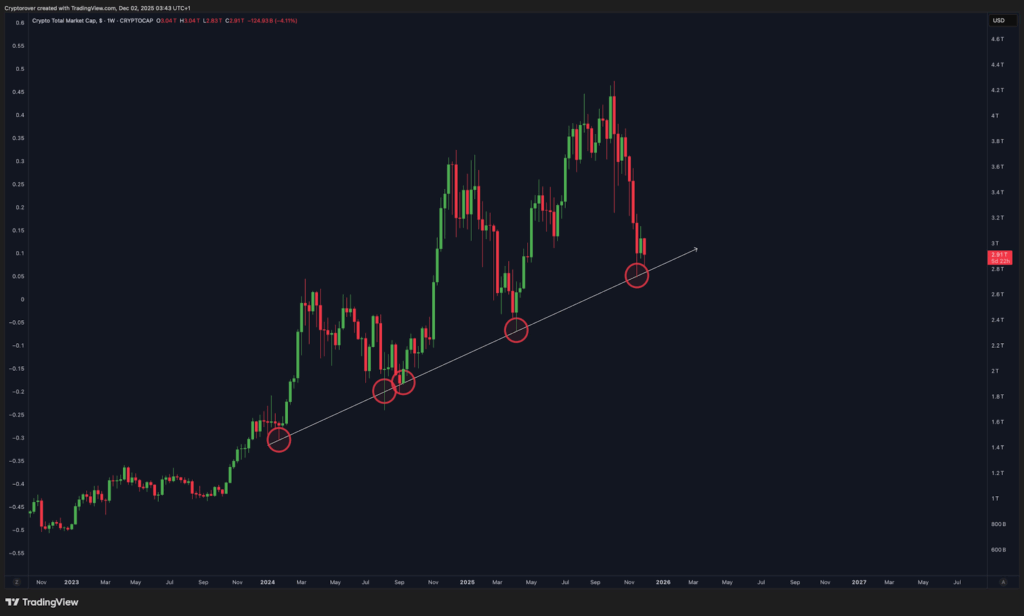
The most recent chart indicates that the market has returned to this trendline as of early December 2025, with a weekly touch, marking the fifth since it was established. All the past experiences led to months-long protests. These were seen in the January 2023 retest, which was followed by a recovery through April. Another similar occurrence was in June 2023, retest by the late-2023 cycle, and the January 2024 touch by a move towards higher mid-year levels.
The current movement indicates that the market is weighing out of the support above the $3.6 trillion zone down to the mark of almost $3 trillion.
RSI Signals Hidden Divergence as Market Holds Higher Lows
Looking at weekly charts, the price has been consolidating higher lows on the rising diagonal. Weekly charts indicate a 1.5-year hidden bullish divergence has been completed on the RSI. The zone is characterized by prices printing higher lows while momentum indicators move lower, typically signaling trend continuation in established uptrends. The trendline of RSI has been dropping steadily since the beginning of 2024. The dislodgment of the two lifetimes is expected to occur around 18 months from now, starting in mid-2023.
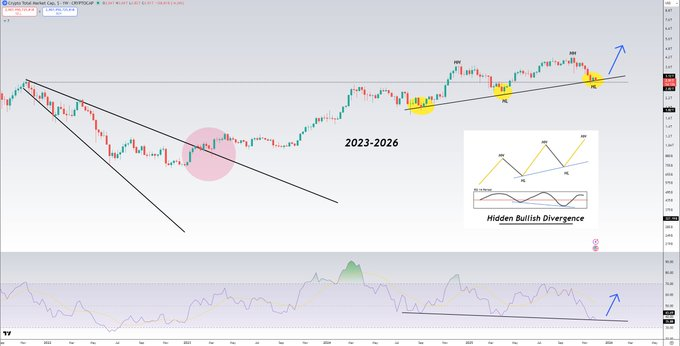
RSI is compressed between 35 and 45 via charts. This suggests that this will take place in the fourth quarter of 2025. The analyst’s layout illustrates a textbook divergence pattern, whereby momentum dwindles during multi-month consolidations without breaching the larger price pattern. The snapshot of the chart shows more highs in market cap between 2023 and mid-2025.
Altcoin Season Index Shows Bull Dormancy
The change in momentum can also be seen through the CoinMarketCap altcoin Season index. The index is 23/100 in the Bitcoin Season category. The trend of the Altcoin Season Index in the 90-day chart exhibits a clear negative trend from mid-September to the end of November, coinciding with a decline in the market cap of altcoins.
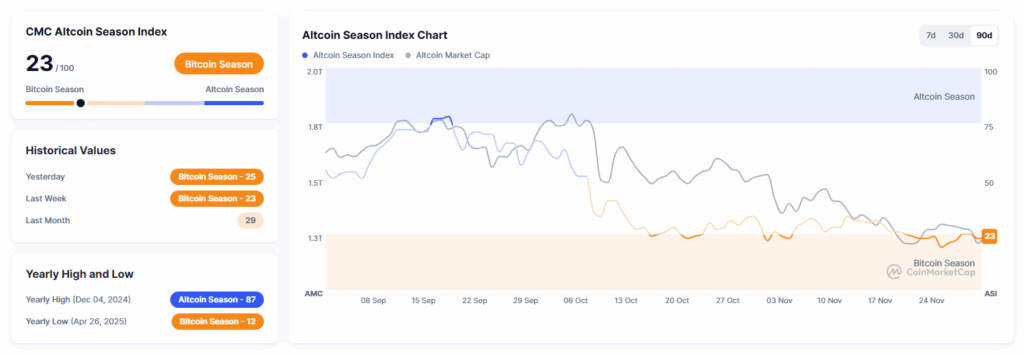
Although the market cap is retesting the long-term trendline, the index remains quiet, indicating that capital rotation into altcoins has yet to begin. The index visual also places the current circumstances near the bottom of its Bitcoin-dominated area.
Altcoin season: Market Breadth Charts Show Mixed Short-Term Performance
Examining additional altcoin data, we observe that the majority of the assets reported marginal gains or losses of between -1% and +1% as of the time of this press release. It is worth noting that MYX gained 2.9%, QNT and ZEC gained approximately 1.2%, and MERL lost 1.5% with SPX losing by a greater margin of -1.2%. The reduced dispersion is a manifestation of the general cooling movement, in line with suppressed altcoin rotation.
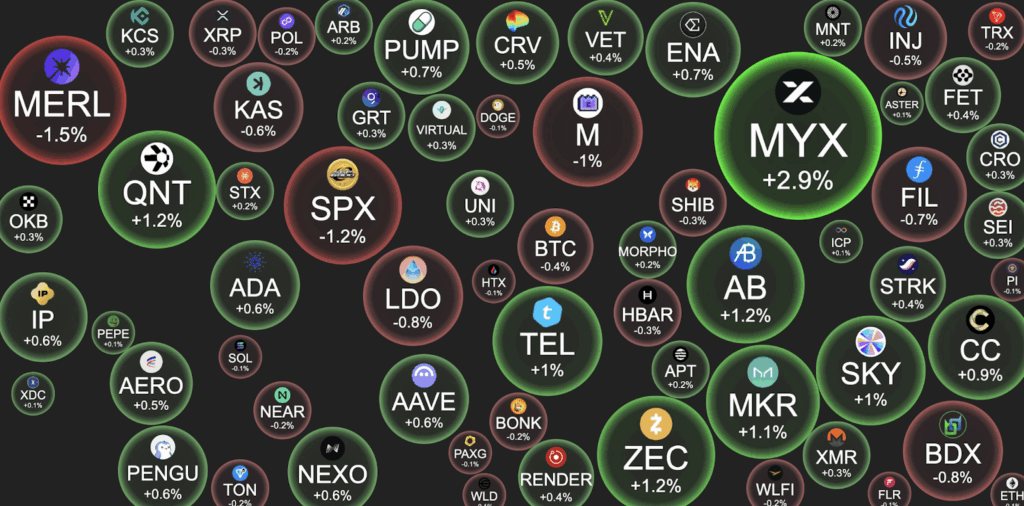
The larger trendline charts and the divergence indicators can provide a contrast to the short-term weakness. Importantly, there are no strong inflows, but the long-term support zone is still intact. The zone has created structural stability as altcoins try the fifth time to break the trendline of the rise since 2023.