 Quack AI
 Bitcoin
 Lighter
 Injective
 Pearl
Pearl Zcash
Zcash Sui
Sui
Arbitrum (ARB) is approaching a technically dangerous area following a prolonged period of decline. Analysts observe a forming bullish divergence in the weekly timeframe as the token grooves around the lower end of a descending wedge pattern.
The structure has steered the overall downward trend at ARB since the beginning of 2024. ARB price is currently at a huge compression, as evident in both price and momentum charts.
A lasting exit from this support zone would result in a more widespread alteration of behavior in the altcoin market. However, this would only be confirmed if Bitcoin returns to power above the $90,000 mark.
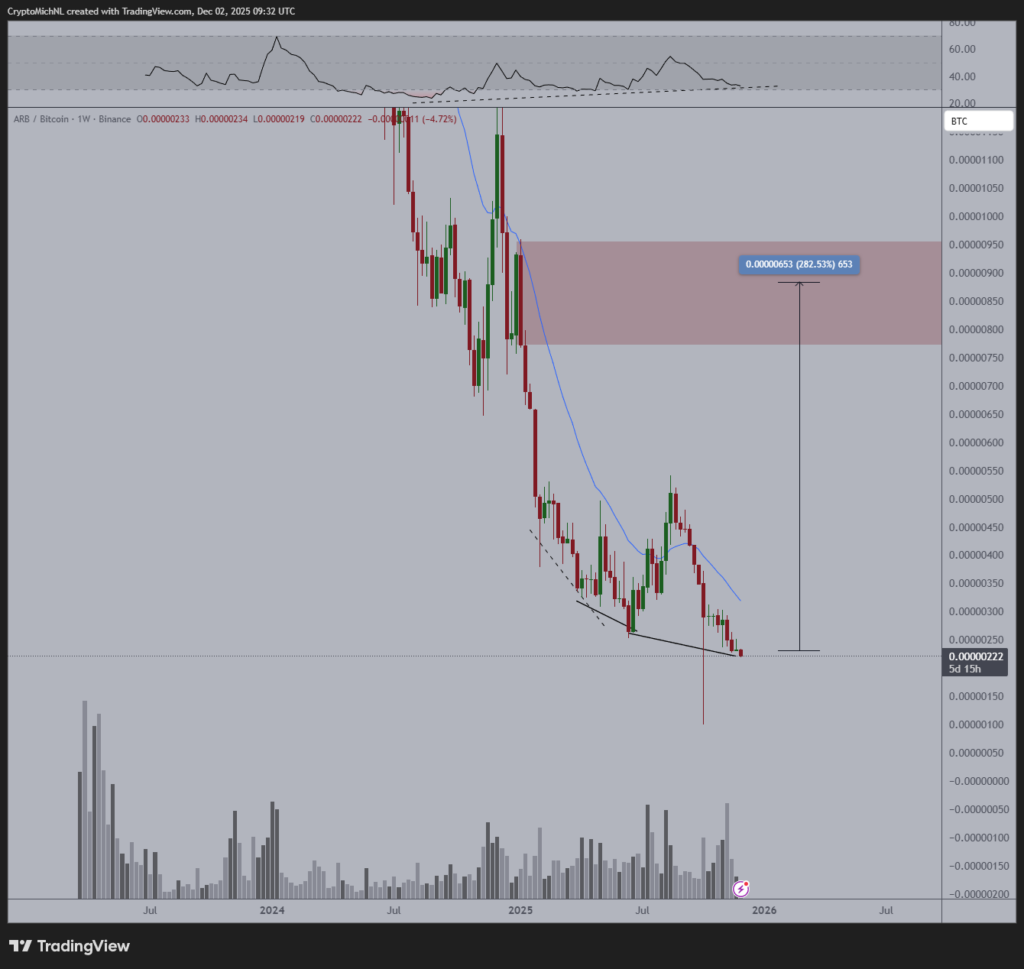
The ARB/BTC weekly chart shows the token trading near 0.0000022 BTC, a level last tested in mid-2023. The price has kept on developing low lows, whereas the RSI on the weekly timeframe has been developing high lows.
This action creates a definite divergence between price momentum and oscillator structure. This deviation has evolved over the course of a few months and is currently approaching an inflection point as the wedge narrows.
Price Action Compresses Inside Multi-Quarter Falling Wedge
More weekly chart data shows ARB price forming a well-defined falling wedge that began to develop after reaching its peak at the end of 2023. The trend has been characterized by several rejections of the downward-trending line.
Significantly, lower peaks were created in February 2024, August 2024, and September 2025. Every rejection has been followed by a re-entry into wedge support, which occurred in June 2024 and April 2025. The move was seen once more at the end of October 2025.
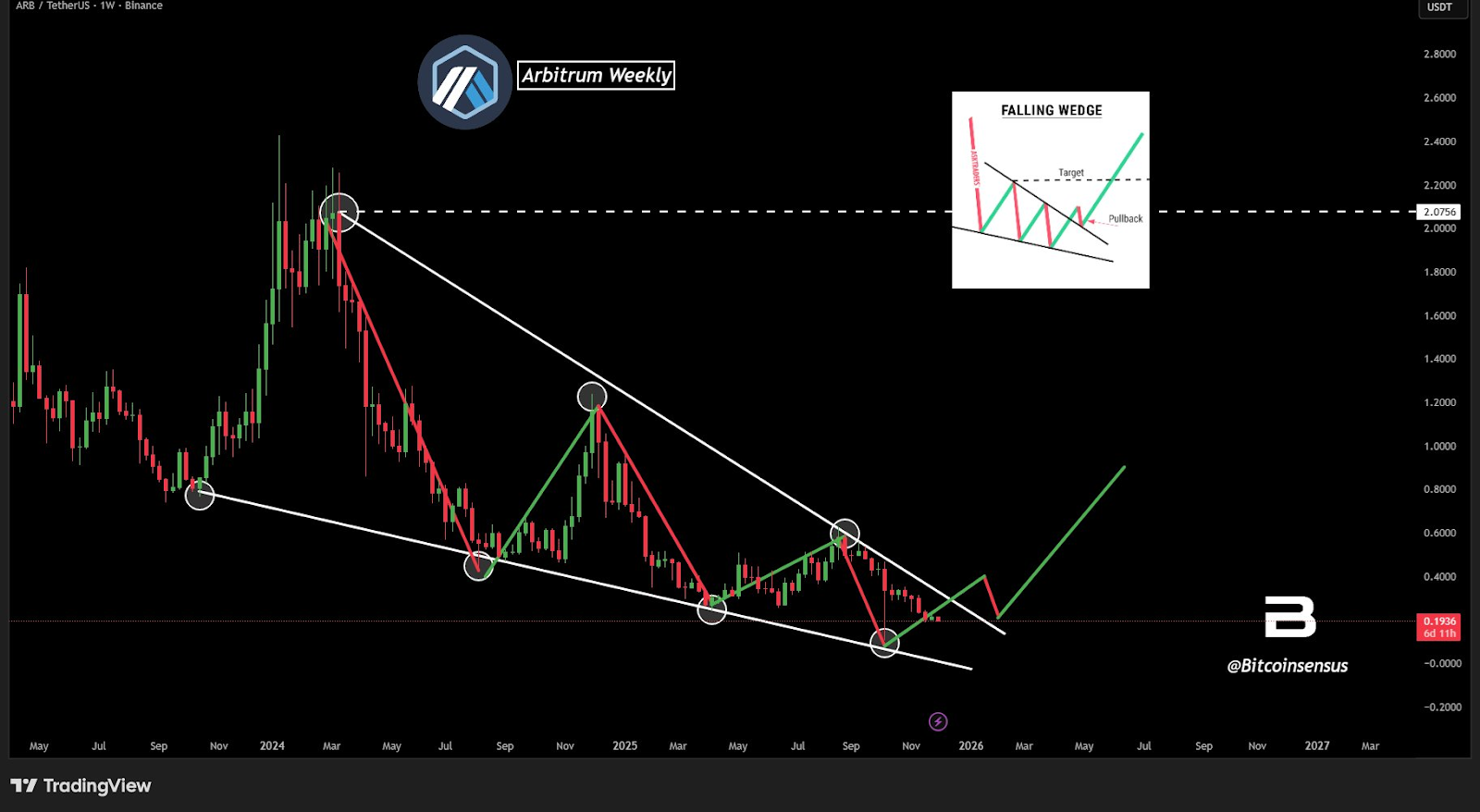
The existing retested price wedge floor is approximately at a price level of $0.19. The bottom boundary serves as a crucial technical point of reference for any future reversal. If the price regains the middle range within the wedge, the technical target provided by the analyst will be $2.07.
That level coincides with the overhead resistance area indicated on the chart, and the first large supply area in terms of time. It goes back to the consolidations in September and November of 2024.
The $2.07 price is not a projection but an estimated price obtained directly from the technical height of the wedge. It resembles the zone that was found in several previous tests, such as the rejection in June 2024 and the pullback in early 2025.
On-Chain Data Points to ARB Price Stability
The backing statistics provided by the ArbitrumDAO revenue chart indicate that the network achieved a Year-to-Date high of $4.5 million in October. This number is a drastic increase when compared to the level between 2.3 million in August and September.
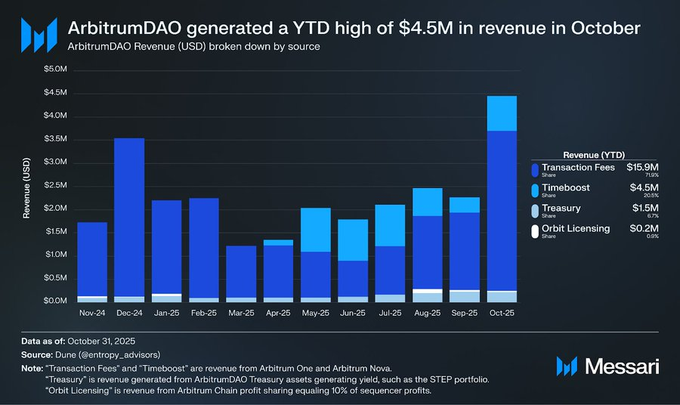
This means that the Arbitrum One and Nova transaction fees still prevail as the primary source of revenue at 15.9 million YTD. This comprises over 70% of all inflows.
Timeboost charges contributed to the company to the tune of $4.5 million in the corresponding period, with the most significant contribution in a few months being made in October.
The treasury yield of Dao and Orbit licensing revenues added not much. The yield reached the YTD totals of 1.5 million and 0.2 million, respectively.
The most notable result is the October figure, which was the best performance of the network since December 2024. This indicates increased activity in the ecosystem and a growing adoption of applications related to tokenization.
Further on-chain statistics provided by Artemis indicate that daily trading on Arbitrum was between 2 and 4 million in September and October 2025. There was a sharp rise at the end of September, exceeding 6 million. The move was followed by a steady range of consolidation up to mid-November.
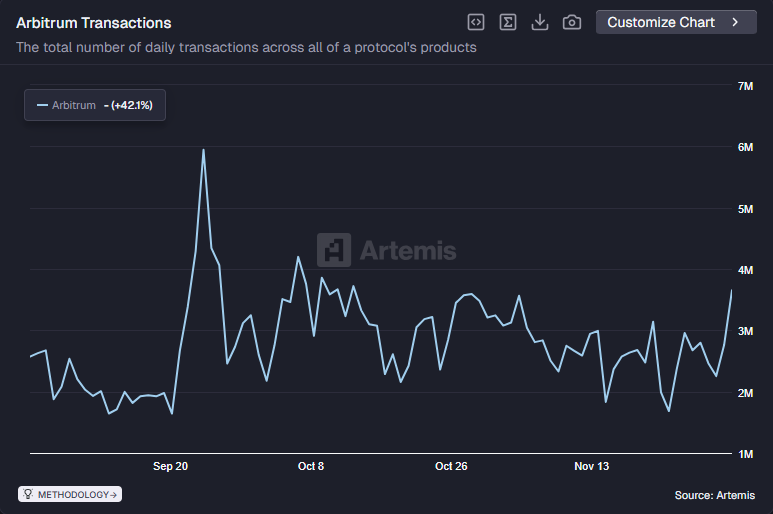
The statistics indicate a 42% increase in transaction levels during early September, despite ARB price continuing to decline. The consistency in the 3-million-transactions level means the fundamental user activity of the protocol has not been harmed by the market volatility.