Wisp
Wisp Bunker Mode
 Crawlerpad
 Zylo Ecosystem
 Identity.md 6900
 Pearl
Pearl Quant
Quant

The Polygon price has crashed to a record low since its all-time high, following the conversion from MATIC to POL in late 2024. POL token dropped to a low of $0.1267, down by ~83% from its highest point this year. So, can its growing stablecoin transactions help boost the POL price?
Polygon Price Drops Amid Stablecoin Growth
The POL price has been in a strong downward trend this year, as competition in the layer-2 industry has increased. Its main competitors are networks like Base and Arbitrum.
Still, there are signs that the Polygon network is doing well in some areas. That may help in improving its performance in the long term.
For example, Polygon is one of the most popular players in the stablecoin industry. Its supply and transaction volume have soared in the past few months.
Data compiled by Artemis shows that the network has a stablecoin supply of $3 billion, making it one of the largest players in the sector. Its stablecoin transaction volume rose by 7% over the last 30 days to approximately $30 billion.
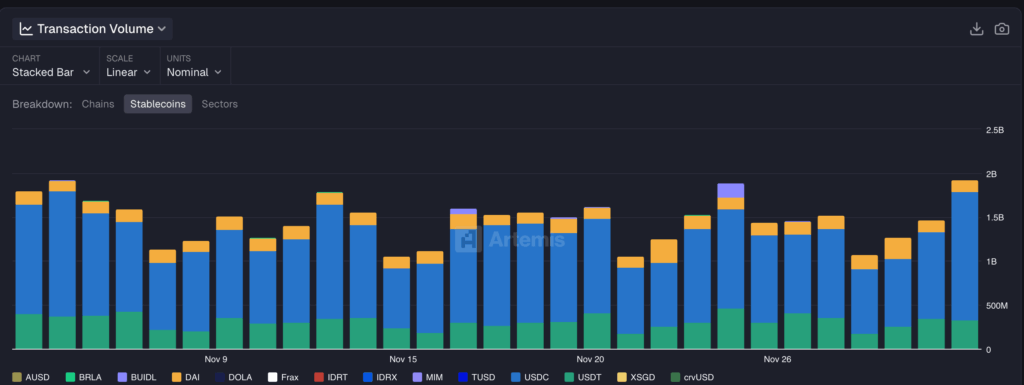
Most importantly, the number of stablecoin addresses has jumped by 24% in the last 30 days to nearly 50 million. Additionally, the number of stablecoin transactions increased by 30% to 178 million during this period, indicating that most transfers are small in size.
Analysts believe that stablecoins will be the most important area in the crypto industry in the future. That’s because demand continues to grow after Donald Trump signed the GENIUS Act into law earlier this year.
Polygon Transactions and Fees are Soaring
Meanwhile, more data compiled by Nansen shows that Polygon has emerged as one of the fastest-growing networks in the crypto industry. Its transactions, fees, and active addresses have all surged in the past few weeks.
Polygon processed 147 million transactions in the last 30 days, representing a 95% increase. This figure made it the seventh-largest chain in the crypto industry, after Solana, BNB Chain, Base, Tron, Somnia, and Aptos.
Ethereum, the largest layer-1 chain in the industry, processed 46 million transactions during the same period.
Transactions soared as the number of active addresses on the network rose by 87% to 12.6 million. Also, its active addresses make it one of the biggest chains, with their number exceeding Base’s 8.5 million and Arbitrum’s 4.1 million.
Most importantly, Polygon is making money, which is used to burn the POL token. It generated nearly $1 million in fees in November and burned all of it.
Most of this fee is coming from its growing market share in the prediction market industry, which has globally become more popular. For example, Polymarket leverages Polygon’s technology, mostly because of the low transaction costs.
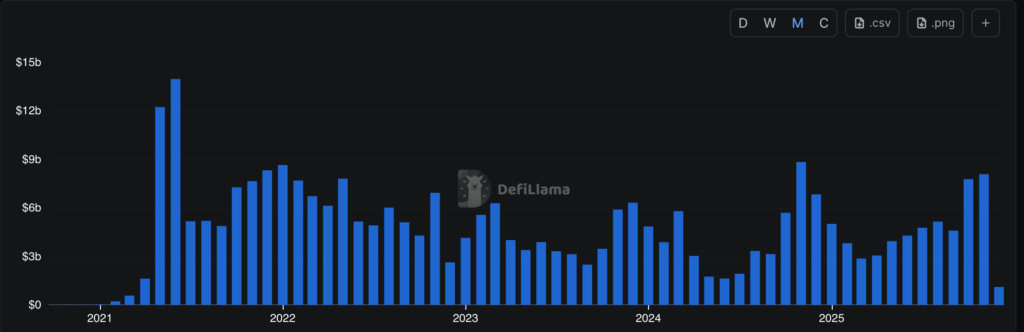
As a result, DeFi Llama data shows that the DEC volume handled by Polymarket rose to $280 million in the last 30 days and $8.2 billion in the last 30 days.
Polygon Price Technical Analysis Points to a Rebound
The daily timeframe chart shows that the POL price has been in a strong downward trend during the past few days. It has dropped from a high of $0.2960 on September 3 to its current value of $0.1268 today.
Besides, the Relative Strength Index (RSI) entered the oversold zone earlier this week, while the MACD indicator is slowly forming a bullish divergence pattern.
It recently moved below the important support level at $0.1520, its lowest level in April this year. On the positive side, the token has formed a falling wedge pattern whose two lines are about to meet. This price action indicates that a rebound is approaching.
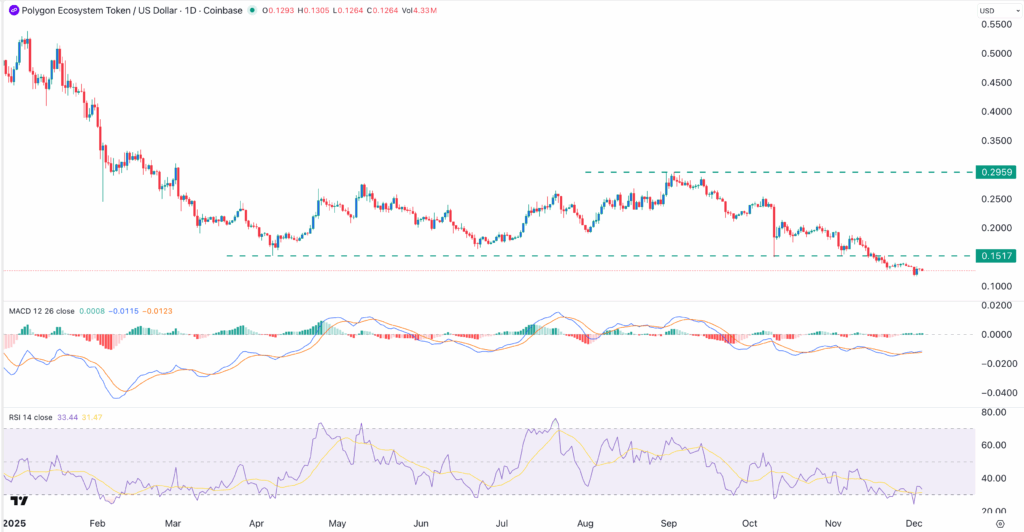
Therefore, the token is likely to rebound as bulls target the psychological level of $0.2500, which is ~95% above the current level.