
 streamoors
 IGNITION
 Injective
 Aerodrome Finance
 ZKsync
 Collector Crypt
 Sui
Sui

Ethereum price held near the $3,100 area as traders assessed fresh upside projections and a short-lived drop in validator participation following a Prysm client bug. Market analysts highlighted key resistance levels and long-term ratio models, while developers addressed the network disruption. The two narratives converged into one broader question: how high the Ethereum price could move while the chain worked to stabilize.
The market reaction stayed measured. Beaconcha.in data showed participation recovering to 97–99%, easing concerns around a potential loss of finality after the Fusaka upgrade. Yet, the episode highlighted structural weaknesses that continued to persist beneath Ethereum’s bullish long-term forecasts.
Analysts Push New ETH Targets Despite Network Turbulence
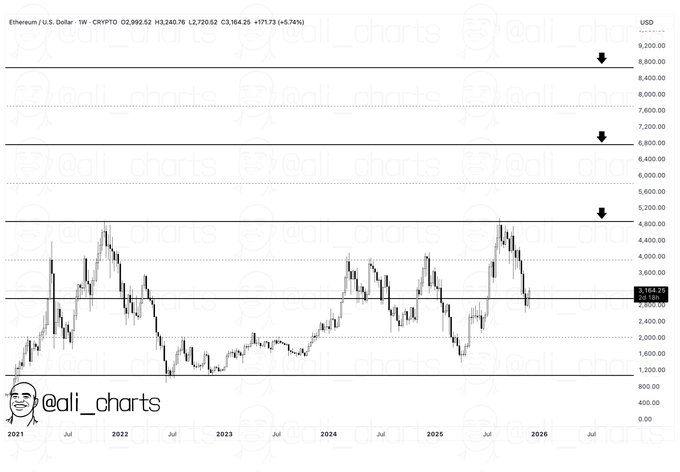
Traders continued to frame the next moves around clear price levels. Ted Pillows said Ethereum needed to reclaim the $3,300–$3,400 region to confirm a short-term bullish move. He added that a rejection there would likely push ETH back toward $3,000. Ali Charts advanced the conversation with broader targets, arguing that Ethereum could reach $6,800 and $8,800 once it broke above $4,800.
Long-term projections gained renewed traction after comments resurfaced from Binance Blockchain Week Dubai. A fan account tracking analyst, Tom Lee, said Lee viewed Ethereum as “grossly undervalued” at around $3,000. His ratio-based models outlined several paths to higher valuations. A return to Ethereum’s eight-year average BTC ratio implied a price near $12,000. Revisiting 2021 levels pointed to roughly $22,000. If ETH ever reached 0.25 BTC, Lee’s model suggested a scenario of around $62,000.
Price analysts treated those scenarios as directional frameworks rather than imminent outcomes, but their inclusion reflected a broader bullish tone. Market participants remained interested in large-scale targets, particularly as Bitcoin forecasts shifted higher.
Prysm Client Bug Briefly Pushes Ethereum Near Finality Risk
Sentiment on the network side grew more cautious. Shortly after the Fusaka upgrade, Ethereum experienced a sharp decline in validator participation when a bug in the Prysm consensus client caused a segment of validators to go offline. Prysm developers said version v7.0.0 generated outdated states when processing older attestations. Terence Tsao, a Prysm core developer, explained that the issue prevented nodes from functioning correctly.

The team recommended launching Prysm with the “–disable-last-epoch-targets” flag as a temporary fix. Participation metrics showed an immediate impact. At epoch 411,448, sync participation fell to 75% and voting participation reached only 74.7%. Voting participation dropping below two-thirds would have removed finality and disrupted normal chain operation.
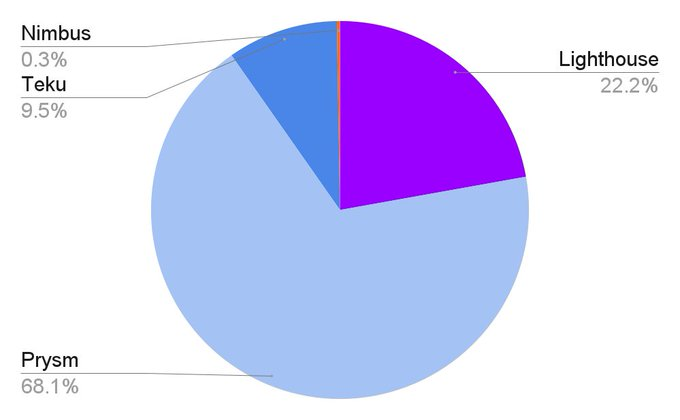
Beaconcha.in data later showed a strong recovery. By epoch 411,712, voting participation returned to nearly 99%, and sync participation reached about 97%. Historical levels had stayed well above 99%, underscoring how noticeable the dip was. Analysts linked the decline to Prysm’s validator share, which stood near 22.71% before dropping to 18% after the incident.
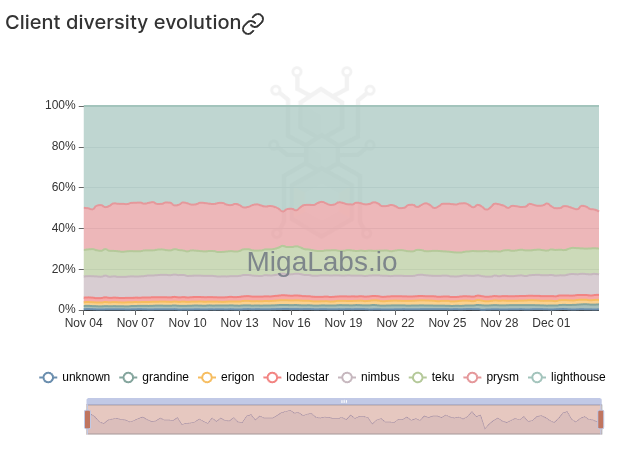
The Ethereum Foundation and Offchain Labs did not provide comment by publication time. Community educators focused instead on structural risks. Anthony Sassano said that “if Lighthouse had had the bug instead, then the network would’ve lost finalization.” Lighthouse currently accounts for over 52% of consensus nodes, according to MigaLabs.
Client Diversity Concerns Return to Spotlight
Ethereum researchers have long argued that no single consensus client should exceed 33% of the network to prevent chain-wide failures from isolated bugs. The latest readings showed that Lighthouse and Prysm together remained well above that threshold.
Historical data reinforced the issue. In September 2021, Prysm accounted for more than two-thirds of Ethereum’s consensus nodes. A similar client bug at that time could have caused far broader disruption. Levels have improved since then, but current shares still left the network exposed. The May 2023 finality loss event served as a further reminder of how quickly validator alignment issues can escalate.
The Fusaka upgrade aimed to improve efficiency and push Ethereum closer to an “instant feel” user experience. The Prysm incident contrasted sharply with those ambitions. Still, developers noted that the network produced blocks normally throughout the disruption, even if those blocks were at risk of not being finalized.
ETH Price Holds Steady as Traders Weigh Risk and Reward
Market reaction stayed disciplined. Ethereum hovered around $3,100 while traders weighed short-term resistance, long-term ratio models, and the network’s rapid recovery. The sharp bounce in participation metrics alleviated immediate concerns about broader instability.
The price debate returned to core technical markers. Traders needed confirmation above $3,300–$3,400 to anchor the next push. Larger structural targets remained tied to ratio dynamics and Bitcoin strength, with various analysts mapping ETH’s possible path to $6,800, $8,800, $12,000, and beyond.
Ethereum’s outlook balanced two competing narratives: ambitious upside cases and renewed questions over network resilience. For now, traders watched both charts and validator metrics with equal attention.