streamoors
 Altai the Tiger
 Sword Inu
 IGNITION
 no crying in the casino
 Quantus
 Pearl
Pearl

Europe’s crypto news is changing fast. The Markets in Crypto-Assets (MiCA) framework is now fully in force. It became effective on December 30, 2024. Lithuania is leading the way in strict enforcement. The Bank of Lithuania has set a clear deadline.
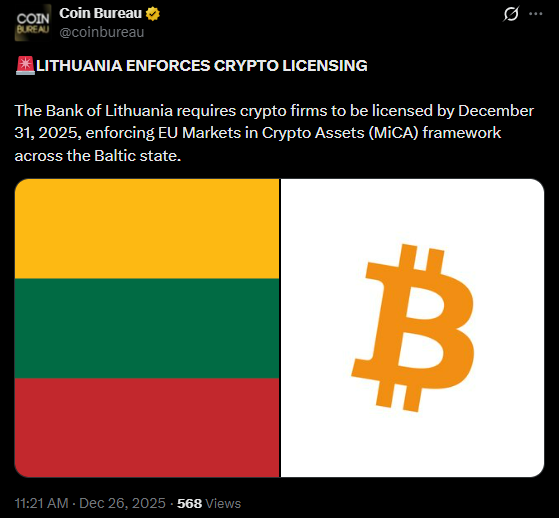
Crypto firms must secure MiCA licenses by December 31, 2025. If they fail, they must stop operations. This marks a turning point for the digital asset industry. The move reflects Europe’s commitment to consumer protection and market stability.
Crypto News: Lithuania Leads with Tight Deadline
The latest crypto news highlights Lithuania’s tough stance. The Bank of Lithuania announced that crypto-asset service providers (CASPs) must obtain full MiCA authorization by December 31, 2025.
From January 1, 2026, penalties will apply. These include fines, website blocking, and even prison terms of up to four years for illegal operations.
Lithuania allowed a 12‑month grandfathering period, following guidance from the European Securities and Markets Authority (ESMA). The country was once a crypto-friendly hub.
Since 2018, it has issued more than 400 virtual asset service provider licenses. Now, the focus has shifted. Transparency, anti-money laundering, and risk management are the priorities.
Industry reports show the impact. Over 100 local firms could be affected. In 2025, new registrations dropped by 15% compared to the previous year. Crypto news sources say enforcement aims to remove non-compliant firms.
The goal is a safer environment for investors. Critics warn that innovation may suffer. Smaller firms may relocate outside the EU. The central bank has issued repeated warnings. Firms are rushing to submit applications before the deadline.
Patchwork of Deadlines Across EU Nations
Crypto news also shows a mixed picture across Europe. Transitional periods vary by country. ESMA’s list confirms that member states chose different timelines.
Some countries opted for short six‑month windows. These include the Netherlands, Finland, Latvia, Hungary, Poland, and Slovenia. Their deadlines have already passed or are ending soon. Firms in those nations must comply or exit.
Other countries, such as Germany, Ireland, Greece, Austria, and Slovakia, followed Lithuania’s 12‑month model. Their deadlines also end in late December 2025.
Major hubs like France, Malta, Spain, Italy, and Bulgaria gave firms more time. They extended to a maximum of 18 months. Their deadlines run until July 1, 2026.
This variation comes from Article 143(3) of MiCA. It allows states to shorten periods if their earlier rules were weaker. Analysts warn of regulatory arbitrage. Firms may move to countries with longer windows. This creates challenges for cross-border operations.
Global Implications of MiCA Enforcement
Crypto news points to wider effects. Europe is becoming a regulated powerhouse in digital assets. MiCA rules cover stablecoins, exchanges, and custodians. The framework aims to protect consumers from fraud and volatility.
The transition is not smooth. Stricter countries like Lithuania may see temporary market fragmentation. Unlicensed firms will halt operations, but compliant firms will gain an edge. They can attract institutional investors. Market stability is expected to grow.
Still, concerns remain. Some firms are considering relocation to non-EU countries such as Switzerland or the UK. Innovation could shift outside Europe.
The coming months will be critical. Regulators and providers must work together. The resilience of the sector will be tested. Europe’s approach may set a global standard.
This crypto news story shows MiCA’s transformative impact. Lithuania’s strict enforcement highlights the balance between protection and progress. Deadlines across Europe create pressure, but also present opportunities. The digital economy is entering a new era.