Bitcoin
 NEAR Protocol
 Pudgy Penguins
 Puffer
 ZKsync
 Bitway
 Pearl
Pearl

The Solana Foundation has introduced new requirements for its Delegation Program to improve decentralization and ensure fairness. The new requirements are expected to take effect on May 1st, 2026.
According to the update, the new standards are meant to enable fair transaction handling and ensure a more robust validator set.
Solana New Validator Requirement Seeks to Remove Censorship and Decentralization
As part of the new requirements, participants in the Solana Foundation Delegation Program (SFDP) must move faster in scheduling and transaction processing. They must complete scheduling using first-in, first-out (FIFO) or fee-based prioritization within a 50-millisecond (ms) window.
This, along with the requirement to release shreds every 50ms or as soon as an erasure batch is full, appears calculated to prevent transaction delays on Solana. This is further emphasized by the instruction not to delay transactions from the transaction processing unit (TPU) for more than 50ms.
Interestingly, SFDP validators are also now required not to censor any transaction received from the TPU.
Meanwhile, the Solana Foundation also introduced new requirements to discourage centralization. There is now a limit on the number of validators that can operate within an ASN. Validators must now operate on an ASN that has less than 25% of the total network stake.
ASN, which refers to the Autonomous System Number, is a unique identifier for an Autonomous System, which is a network of servers that are considered connected based on publicly available data. The network enables decentralization by ensuring no ASN has more than 33.3% of the active stake.
The decentralization efforts also extend to data centers, with operators now required to use a data center that does not have more than 15% of the overall network stake.
This is not the first time that Solana has introduced new requirements to enable decentralization. In 2025, the Solana Foundation announced a policy to remove three long-term validators from the SFDP for every new validator joining the program. This appears focused on boosting independent external staking by validators instead of having them rely on the foundation.
Active Validator Count Reduces on Solana
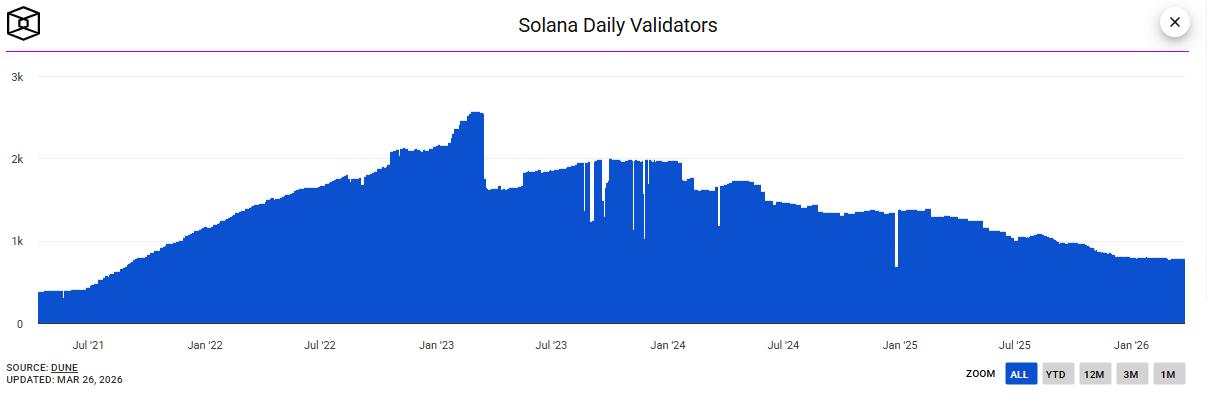
Meanwhile, the move to tighten validator operations comes as Solana sees a rapid decline in its validator count. The number of validators has been reducing since 2023. Data shows that the number of daily Solana validators has dropped from 2,560 in 2023 to around 770 in March 2026.
Stakeholders on the network have attributed the decline to the high cost of operating a node on Solana, which is forcing many small-time validators to shut down. Interestingly, data from Solanacompass shows that the network has 5050 nodes.
However, Solana’s Nakamoto Coefficient of 20 puts it in the moderate category for decentralization, indicating that at least 20 large validators working together would need to control 33.3% of the network stake.
With the new validator requirements, there are further concerns that more small validators may be forced to drop out. While this could raise further concerns about its decentralization, the 5% drop in SOL value over the last 24 hours is likely to be more pressing for investors. The token is down to $87 and has now lost 30.72% of its value since the start of the year.