Quack AI
 NEAR Protocol
 Monero
 Lighter
 Ethena
 Pons
Pons Sui
Sui

Ethereum news shifted toward artificial intelligence after Vitalik Buterin shared a series of posts discussing local AI systems, privacy infrastructure, and decentralized computing.
The Ethereum co-founder connected recent advances in local large language models with Ethereum’s broader privacy roadmap and secure blockchain access.
Ethereum News: DeepSeek V4 Runs Locally Within 90 GB of VRAM
Buterin reported that DeepSeek V4 now has a 2-bit quantized version that can run locally within roughly 90 GB of VRAM.
In his own testing, the build reached around 35 tokens per second on Apple hardware and about 7 tokens per second on AMD hardware.
The gap between the two hardware results fed directly into the point Buterin wanted to make. He argued that genuine decentralized AI should support more than one hardware manufacturer rather than depending on a single chip ecosystem or cloud provider.
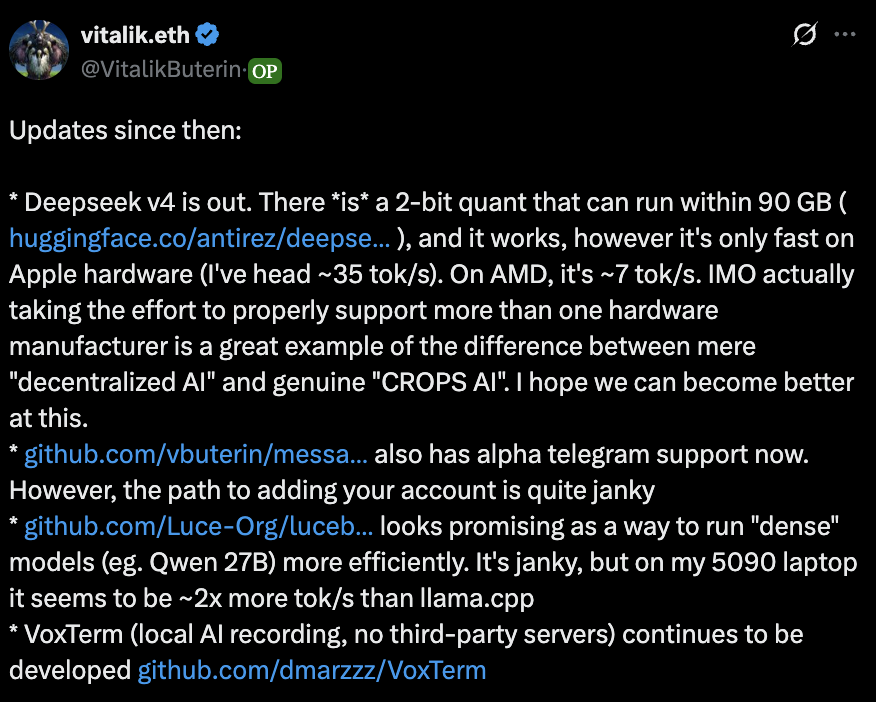
Vitalik Buterin used the term CROPS AI to describe systems that work across multiple hardware platforms, drawing a line between that goal and what he called mere decentralized AI that still leans on centralized infrastructure.
Buterin also flagged several other local AI tools he has been testing. The list included VoxTerm for local AI recording without third-party servers, a messaging daemon with alpha Telegram support, and Lucebox Hub as a way to run dense models more efficiently.
He reported that Lucebox Hub ran roughly twice as fast as llama.cpp for dense models on his 5090 laptop. His own self-hosted setup runs open-weight models locally with sandbox protections.
Linking Local AI to Ethereum Privacy Infrastructure
The most discussed part of the thread tied local AI directly to Ethereum privacy infrastructure.
Buterin described a clear overlap between what he called a CROPS Ethereum access layer and CROPS AI, with the same building blocks serving both.
He pointed to a zero-knowledge method for making paid calls to large remote language models as a shared component.
The same mechanism that allows private paid LLM calls would also solve the problem of private RPC reads on Ethereum, where a wallet queries the chain without revealing the specifics of what it is reading to its RPC provider.
The connection lets one piece of cryptographic work serve both the AI and the blockchain access problem at once.
The access-layer ideas in the thread included private Ethereum RPC reads, zero-knowledge-based remote LLM payments, and local AI systems that store prompts and wallet data on user devices rather than cloud servers.
The set of ideas runs alongside the broader Ethereum privacy roadmap Buterin has documented over the past year, which covers wallet, protocol, and cryptographic layers.
Ethereum-Tuned AI Models for Smart Contract Security
A second strand of the AI news from Vitalik Buterin centered on Ethereum-specific AI models.
He argued that the Ethereum ecosystem should build fine-tuned AI systems specialized for smart contract auditing, transaction verification, Solidity security analysis, and protocol code review.
Buterin pointed to Leanstral as an example of what a specialized model can do. The model fits within 70 GB or less and can hold its own against much larger 1-trillion-parameter models when written in Lean.
He tied the result to his recent work on formal verification, arguing that specialized models are a major help for writing more secure code.
The case rests on the view that AI-assisted verification will become central as AI-powered exploit discovery grows more advanced.
Buterin reacted to one widely discussed example in which AI generated more than 700,000 lines of Ethereum-related code within two weeks.
He acknowledged the speed gains while stressing that much of the productivity should go toward security and verification rather than simply shipping code faster.
Security Risks and the Self-Sovereign AI Stack
The security risks associated with AI agents were a recurring theme across recent posts.
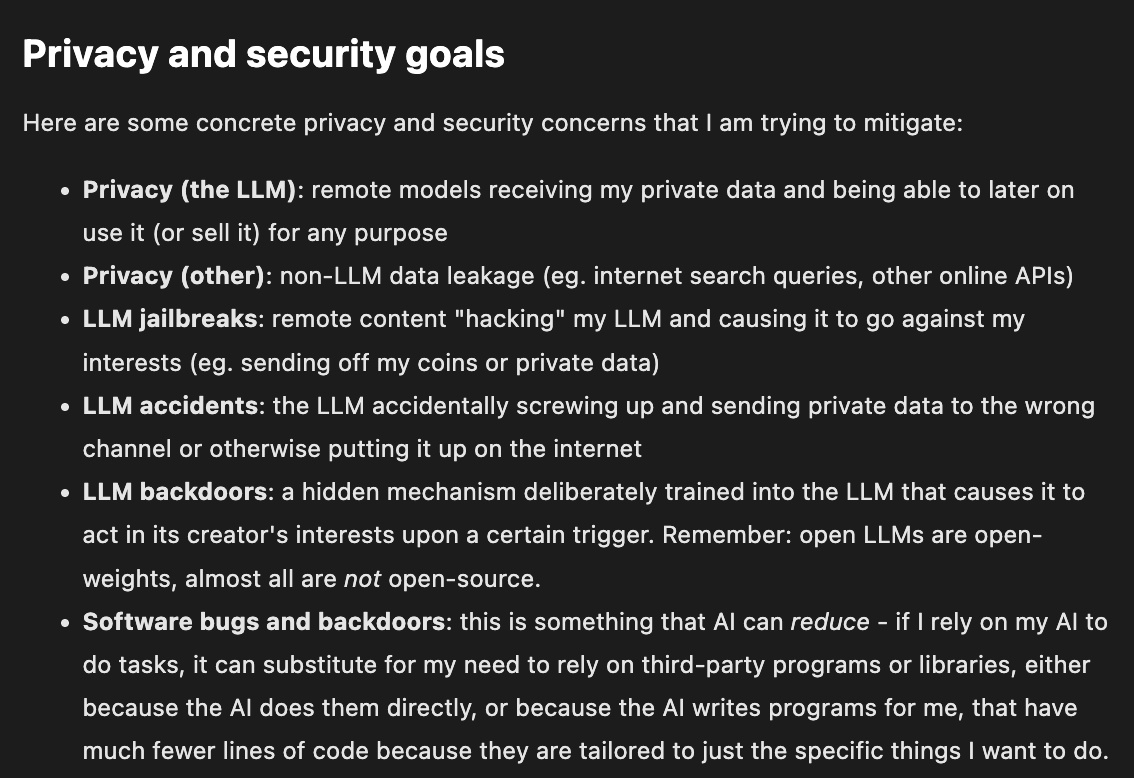
Vitalik Buterin warned that many AI agent plugins and external tools may contain malicious instructions, which is why he prefers local, sandboxed systems over cloud-based agents.
Buterin has spoken in earlier discussions this year about largely moving away from cloud AI services. He now runs open-weight models locally on his own hardware with sandbox protections, with his setup reportedly including Qwen models running on an NVIDIA 5090 laptop.
The overall theme across the posts is that Buterin sees AI becoming deeply integrated with Ethereum, not only for developer productivity but for privacy-preserving infrastructure, decentralized identity, autonomous agents that use crypto payments, and secure smart contract development.