
 Pearl
 Bitcoin
 Hyperliquid
 Pudgy Penguins
 Venice Token
 Canton
 Aave


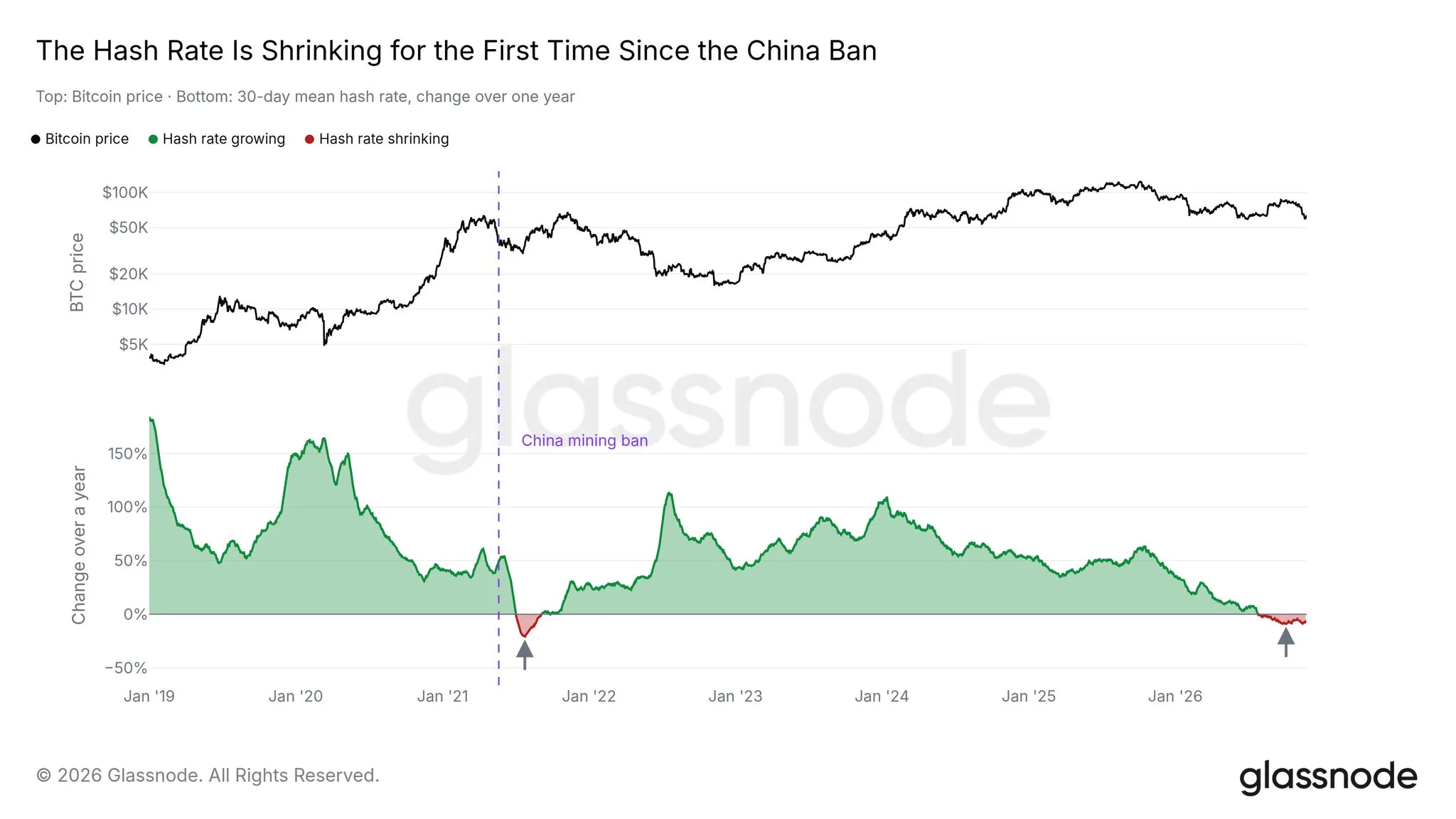
Bitcoin mining hashrate fell 8% year over year on Nov. 24, according to blockchain analytics firm Glassnode. The contraction marked the network’s first annual decline since China’s 2021 mining crackdown.
Glassnode attributed the decline to miners shutting down equipment amid falling Bitcoin prices and record-low hashprice.
Meanwhile, several publicly listed mining companies continued redirecting infrastructure toward artificial intelligence (AI) computing. However, other operators expanded their Bitcoin mining capacity despite declining revenue per unit of computing power.
Hashrate Decline Linked to Miners Powering Down Due to Bitcoin Price
According to Glassnode analysts, the decline in hashrate is due to Bitcoin miners shutting down their machines. They noted that Bitcoin price struggles have led to a decline in profitability.
With Bitcoin falling below $60,000, the hash price is now at an all-time low, leaving miners in a tough financial position. Data from Hashrate Index show that the hash price is currently at $28.07 per petahash per second per day (PH/s/d).
While hash price is falling, Bitcoin mining difficulty is set to rise by around 9% on Thursday. This could put miners under significant pressure again and worsen an already bad financial situation.
Mining difficulty has been fluctuating this year depending on whether miners power up or shut down their machines. Prices have mostly influenced this, with a recent surge in difficulty following Bitcoin’s rapid jump above $80,000.
Bitcoin is currently trading around $59,800 after falling 7% in the past seven days. The flagship asset has now seen its heaviest realized losses since the FTX crash, according to Glassnode.
CryptoQuant data also confirm this, showing that long-term holders sold at a 33% loss. This has not happened since June, and analysts believe it could be mutual that a bottom is near.
Still, the demand needed to ensure recovery remains absent. Spot Bitcoin ETFs continue to see net outflows, and US investors are not buying the dip. Coinbase has traded below offshore exchanges for 80 consecutive days.
Pivot to AI Impacting Bitcoin Mining
Meanwhile, the mass pivot to AI by Bitcoin miners might also be a factor driving the lower hashrate. With Bitcoin price struggles and demand for AI computing rising, more Bitcoin miners have now focused their attention on AI.
Major Bitcoin miners such as TeraWulf, Core Scientific, and IREN together cut their hashrate by 49% in Q3 to focus on AI. Some, like Core Scientific, are even planning to stop mining entirely.
Interestingly, the impact of the AI pivot is not limited to miners. Even the Bitcoin mining hardware market now has less competition, with Bitmain now accounting for 82% of the sector.
Canaan, which also sells Bitcoin miners, has seen its sales decline significantly as it has shifted its focus to energy projects and to manufacturing mining rigs for its own use. Bitdeer is also doing the same.
This article serves informational purposes only and does not constitute financial or investment advice. Readers should conduct independent research before making investment decisions.