astronaut
 Pearl
Pearl NEAR Protocol
 Walrus
 Zylo Ecosystem
 Bitcoin
 Hyperliquid
Ripple partnered with Stripe-owned Privy on Oct. 13 to expand wallet infrastructure on the XRP Ledger (XRPL). The agreement will help developers integrate XRP, Ripple USD (RLUSD), and other blockchain assets into financial applications.
Privy announced the partnership as part of its expansion into stablecoin payments and automated transactions. The companies also outlined plans to support artificial intelligence (AI) agents through programmable wallets.
The announcement came as XRP recovered from recent selling pressure. Historical market data showed the token trading near $1.37 on Oct. 13, below resistance around $1.40.
Ripple News: Privy Adds Programmable XRP Ledger Wallets
Privy will give developers tools to create and manage XRPL wallets directly within their applications. Developers will also be able to sign transactions through Privy’s infrastructure rather than build separate wallet systems. The arrangement targets fintech businesses, payment providers, and developers creating digital asset services.
Embedded wallets operate inside an application, reducing the need for customers to connect an external wallet. Users will not need to handle private keys during routine onboarding or payments. However, Privy will allow customers to export private keys and seed phrases, preserving the option to move their wallets elsewhere.
Stripe acquired Privy in 2025, although the wallet provider continues to operate separately. The new partnership adds XRPL support to Privy’s developer offering.
Ripple News: Partnership Integrates XRP and RLUSD Payments
The wallet infrastructure will support XRP, Ripple’s RLUSD stablecoin, and other assets issued on XRPL. Developers can use the tools to incorporate transfers and transaction signing into financial applications.
Payment companies can also build stablecoin services without asking customers to manage wallet credentials manually.
XRPL handles digital asset transfers and exchanges through its decentralized blockchain network. Privy reported that the ledger has surpassed eight million funded accounts and processed more than $1 trillion in transferred value over its history.
The integration will also support applications involving tokenized assets available on XRPL. Developers will determine which supported assets their services accept.
AI Agent Transactions and Wallet Controls
Ripple and Privy also plan to support agentic commerce through programmable wallets. Developers can provide server-side wallets that allow software agents to hold funds and initiate transactions. The companies identified x402 payments as one use case for automated purchases of online services.
Ripple reported that XRPL has processed 13 million agent payments, representing approximately 25% of network activity. That figure came from Ripple’s announcement and does not establish the value of those payments. Privy’s new integration does not, by itself, show how many additional transactions the network will process.
Privy plans to introduce policy controls and fee sponsorship as the integration develops. Policy controls would let developers set conditions for wallet transactions. Fee sponsorship would allow applications to cover network costs for their users.
XRP Price Prediction: Resistance at $1.40 Comes First
XRP traded above $1.36 at the time of writing after recovering from support near $1.30. The daily chart placed the 200-day exponential moving average around $1.38 and the 50-day average near $1.40. A sustained move above those barriers could bring the $1.55 resistance area into view.
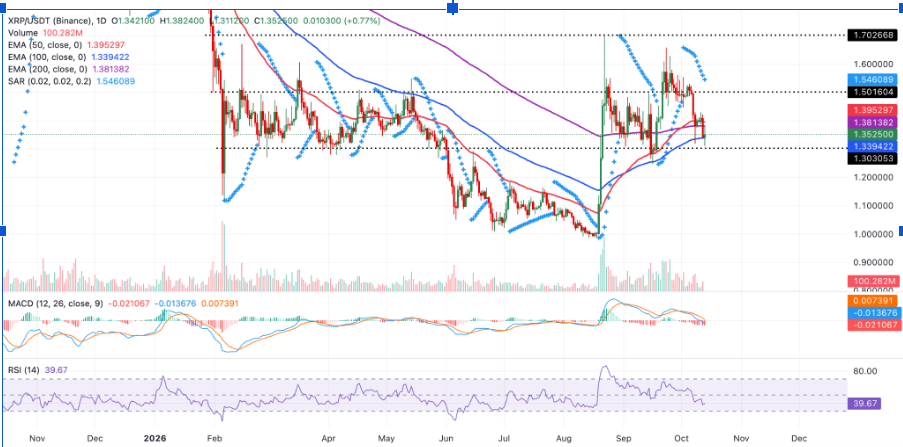
The 100-day average near $1.34 offers closer support. A drop below that level would draw renewed attention to $1.30. Meanwhile, the relative strength index hovered near 40, while the MACD remained below zero. Both readings indicated that selling pressure had not fully eased.
Analyst ChartNerd separately outlined an eight-and-a-half-year cup-and-handle formation. The chart identified $3.60 as a major resistance level and set $8 as a possible target following a confirmed breakout.
This article is for informational purposes only and does not constitute financial or investment advice.