
 Pearl
 Pudgy Penguins
 Pepe
 Collector Crypt
 Quant
 Grass
 Worldcoin

Neocloud stocks faced renewed pressure on October 20 after South Korean AI infrastructure provider Elice plunged during its market debut. The decline added to concerns surrounding CoreWeave, Nebius and IREN.
Elice raised approximately $151 million in its initial public offering, but its shares fell by about one-third. The disappointing debut followed the cancellation of Firmus’ Australian IPO and investor resistance to Nscale’s proposed valuation.
Meanwhile, Gartner warned that trillions in planned AI infrastructure investment could face impairment risks over the coming years.
Neocloud Stocks Fell After Elise IPO Flopped
A key reason behind the sell-off was the latest IPO of Elice Inc. a top South Korean neocloud company. The firm launched its IPO today, Oct. 20, after going public. It raised $151 million in its IPO, with its retail tranche being highly oversubscribed.
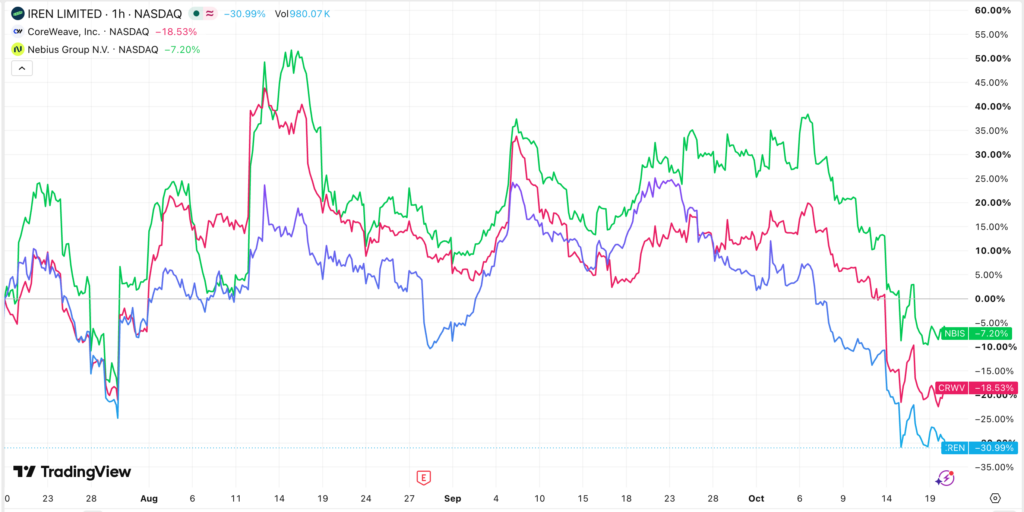
CRWV, Nebius, and IREN stocks have slumped this year | Source: TradingView
Elice stock dropped by 33%, a sign that investors are pushing back against the high valuations that neoclouds are asking as they go public.
The drop comes a few weeks after Firmus, an Australian company, pulled its IPO as investors criticized its high valuation. Its management then decided to launch a private offering, which will be followed by another IPO in New York.
Investors are also pushing back against Nscale, a British company that is planning to go public at a $33 billion valuation. Media reports suggest that its investors are privately seeking for the company to lower the valuation target to about $16 billion.
The ongoing pushback is happening as publicly traded neocloud companies struggle. CoreWeave, which is backed by Nvidia, went public last year and then climbed to $186 a few months later. Since then, it has dropped to $63, erasing billions of dollars in value.
Nebius, which emerged from Russia’s Yandex, soared to $300 in June and then dropped to $174, while IREN has tumbled to $27.7 from a high of $76. The same has happened among Bitcoin mining companies that have pivoted to the AI data center industry like Riot Platforms, HIVE Digital, and MARA Holdings.
Depreciation and Rising Competition
There are several reasons why these neocloud companies have slumped this year. One of them is a recent report by Gartner, which warned that these companies will need to announce impairments worth billions of dollars in the coming years.
The report cited the fact that AI data center owners will need to generate $8.5 trillion in revenue by the end of 2030. Gartner expects these companies to make no more than $3.6 billion in revenue in this period. It also noted that neocloud companies will be among the most affected because hyperscalers have diverse offerings.
CoreWeave, Nebius, and IREN are also announcing huge depreciation, a trend that may continue over time. In its last earnings report, CoreWeave said that its revenue was $2.5 billion against a depreciation of $752 million. Nebius, on the other hand, made $582 million in revenue, while its depreciation was $259 million; IREN’s revenue was $137 million against depreciation of $66 million.
Additionally, competition in the industry is rising. For example, Nscale received a $45 billion deal from Anthropic recently. It is also in talks with Anthropic for a similar deal. In addition to this, most Bitcoin mining companies have moved to the industry. RUM Group, formerly known as Rumble, has also entered the industry and received a $13 billion deal with Anthropic.
There are also concerns that the AI bubble will burst soon. Ray Dalio has warned that the bubble will burst as soon as this year because of the rising interest rates. Michael Burry, who predicted the housing bubble, has also warned that the bubble will burst. Such a move would also affect these neocloud companies.
This article is for informational purposes only and does not constitute financial or investment advice. Technology and AI infrastructure stocks can experience substantial volatility and capital losses. Investors should conduct independent research and consult a qualified financial adviser before making investment decisions.