 Irys
 Universal High Income
 Bitcoin
 Pudgy Penguins
 Pearl
 Venice Token
 Starknet

Ethereum developers postponed the Glamsterdam upgrade on the Hoodi testnet on October 22, citing smart-contract compatibility concerns. The decision canceled the October 26 activation and left the mainnet deployment without a confirmed date.
The Ethereum Foundation said developers would investigate EIP-8037’s interaction with existing smart contracts. Security firm ChainSecurity separately identified risks involving revised gas-accounting rules and transaction failures.
Glamsterdam Delay Caused by Security Issues
According to Ethereum Core developer Christine Kim, the decision to cancel the upgrade is due to security issues in Glamsterdam. She stated in a post on X (formerly Twitter) that blockchain security firm Chain Security identified the issues.
The issue in question is gas accounting risks in two of the Ethereum improvement proposals that form part of the upgrade. EIP-8037 for Ethereum’s state-creation, and EIP-8038, which reprices state access, both have fundamental flaws.
The firm noted that Glamsterdam could change how the network reacts to failed calls due to low gas. Instead of such calls simply retrying after gas refills and repricing, they could now fail permanently.
It said: “Contracts often catch failed external calls so they can record a failure, continue a batch, or choose a fallback. But if a call fails because it was given too little gas, continuing can turn a retryable operation into a permanent failure.”
Meanwhile, Chain Security noted that it has found 13 real-world examples of the security impact and is already in discussions with affected projects. It noted that the Ethereum Foundation is still determining how many contracts were affected and by how much.
Ethereum Glamsterdam Upgrade Future Remains Undecided
With the decision to pause the Hoodi upgrade, Glamsterdam’s future remains cloudy. The Ethereum Foundation’s announcement stated that the delay will allow developers to investigate how EIP-8037 interacts with mainnet smart contracts.
The scheduled activations on the execution and consensus layers have been removed, as has the gas limit schedule that would have raised Hoodi’s gas limit to 200 million at the epoch.
Given that no new date has been selected for the upgrade, it is unclear whether the Glamsterdam update will still take place this year. Early December was the tentative date for the mainnet upgrade, but this depended on the Hoodi upgrade going smoothly.
Glamsterdam is expected to expand Ethereum’s capacity to support more transactions. The upgrade will change how the network executes transactions and significantly increase block gas limits.
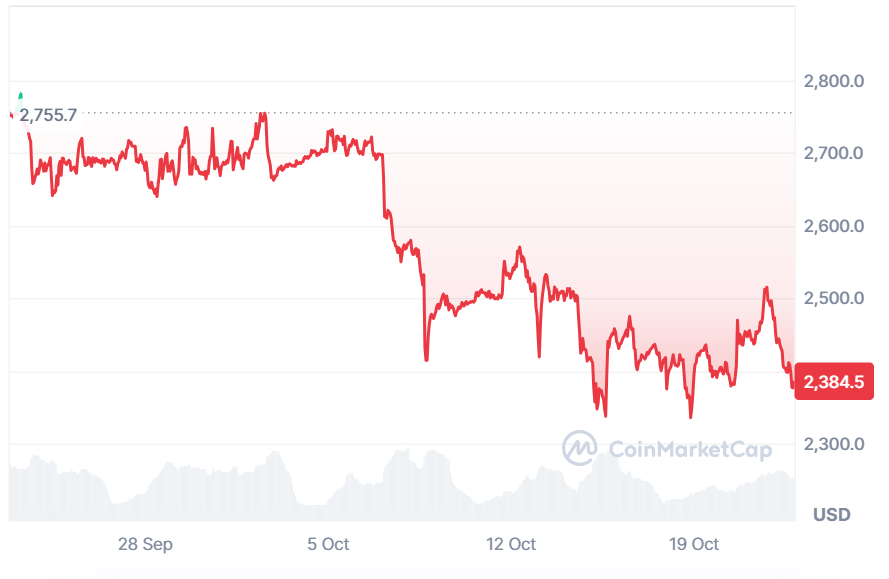
Following the setback, Ethereum ETH is down almost 5% in the past 24 hours. The token, which had crossed $2,500 the day before, is now down to $2,382.
However, the decline in ETH value might not be due to the Glamsterdam delay alone. The broader crypto market also declined significantly, with Bitcoin falling to $81,000. Crypto market cap is now at $2.7 trillion after a 4% drop.
This article is for informational purposes only and does not constitute financial advice. Cryptocurrencies carry substantial volatility and potential capital losses. Readers should conduct independent research before making investment decisions.