
 Super Pepe
 Super Inu
 Hyperliquid
 Pudgy Penguins
 Lisk
 Solana
 Lighter

Tether news highlighted rising reserves after the stablecoin issuer reported $1.5 billion in third-quarter operating profit. The company disclosed $191.45 billion in assets against $183.50 billion in liabilities.
Its Oct. 30 announcement showed excess reserves reaching $7.95 billion as of Sept. 30. However, rising investment valuations contributed to the improvement.
Tether Earns $4.5B in the First Nine Months of 2026
Third-quarter earnings brought Tether‘s nine-month net operating profit to $4.5 billion. Income from U.S. Treasury bills and reverse repurchase agreements accounted for most of that amount. The company continued to collect returns from its reserve investments as the amount of USDT in circulation changed little.
USDT issuance remained around $184 billion during the first nine months of the year. By September 30, Tether had recorded $183.47 billion in liabilities linked to issued digital tokens. Those tokens made up nearly all its liabilities, and the company classifies them as obligations that holders can redeem on demand under the relevant terms.
Excess Reserves Grow by Nearly $3.8B in Three Months
Tether ended June with $187.75 billion in assets and $183.64 billion in liabilities. That left a reserve cushion of $4.11 billion. Over the following three months, assets grew by about $3.7 billion, while liabilities fell slightly.
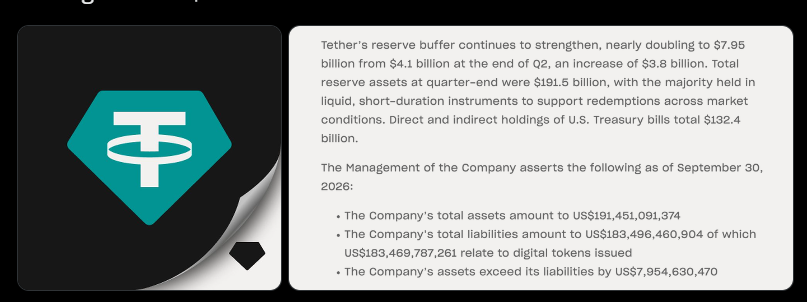
Tether News | Source: X
The gap between the two reached $7.95 billion at the end of September, an increase of roughly 94%.
The larger buffer gave Tether about $104.34 in assets for every $100 in reported liabilities. Excess reserves represented 4.34% of liabilities, compared with 2.24% in June. The figures measure how much the company’s assets exceed the value of its obligations at the reporting date.
CEO Paolo Ardoino said the reserve strategy aims to maintain liquidity for redemptions during market stress. He also discussed plans to fund infrastructure over time.
U.S. Treasury Bills Remain Tether’s Largest Reserve Holding
At the end of September, Tether directly held $122.84 billion in U.S. Treasury bills. Those bills had a weighted average maturity of less than 90 days. The company reported $132.4 billion in direct and indirect Treasury bill exposure, making U.S. government debt the largest part of its reserves.
The portfolio also contained $9.52 billion in overnight reverse repurchase agreements and $7.18 billion in term reverse repos. Together with bank deposits and other short-term holdings, Tether’s cash, cash equivalents, and short-term deposits reached $139.58 billion. That represented about 72.9% of its total assets held in reserve.
Tether uses these shorter-term investments to earn income while keeping a large portion of its reserves in instruments that mature relatively quickly. Treasury bills and reverse repos generated most of the company’s operating earnings during the first three quarters.
Gold and Bitcoin Holdings Reach $27.45B
Tether’s reserves included $19.08 billion in physical gold and $8.37 billion in Bitcoin. Combined, those holdings reached $27.45 billion, compared with $24.64 billion at the end of June. Gold and Bitcoin made up about 14.3% of total reserves in September.
The company valued both assets at market prices on September 30, using $83,621.23 per Bitcoin. Its gold holdings consisted of physical bars that meet London Bullion Market Association standards. Changes in gold and Bitcoin prices can therefore change the reported value of those reserves.
Tether news reported $14.18 billion in secured loans, $6 billion in other investments, $4.18 billion in public equities and $63.9 million in corporate bonds. The company said its secured loans carry collateral above the amount borrowed and include procedures to maintain that coverage.
Separately, Tether equity reconciliation recorded a $1.66 billion financial result for the first nine months, a measure distinct from the $4.5 billion in net operating profit.