
 Pudgy Penguins
 Injective
 Official Trump
 Collector Crypt
 Ethereum
 Pearl
 Solana

Nvidia stock extended its recent decline on Nov. 4, even as major U.S. indexes rallied following the midterm elections. Shares closed at $200.13, down 3.17%, after briefly falling below the $200 support level.
The decline reduced Nvidia’s market capitalization to approximately $4.83 trillion, compared with its earlier peak near $5.76 trillion. Meanwhile, the Dow Jones Industrial Average jumped 3%, highlighting the divergence between semiconductor stocks and the broader market.
Although Nvidia faces further downside risks, its upcoming earnings report could provide another test of investor confidence.
Nvidia Stock Dropped After the Midterm Elections
NVDA stock has been in a strong sell-off, a trend that continued after the midterm elections. This sell-off coincided with the drops in other AI companies, including many that Nvidia has invested in.
For example, Marvell Technology stock has slumped by over 50% from the year-to-date high, a sell-off that continued after it decided to merge with Lumentum in a $115 billion deal. Neoclouds like CoreWeave, IREN, and Nebius that it has invested in also plunged.
Cumulatively, companies in the AI space have lost over $1 trillion in value in the past few weeks, with Nvidia and Micron leading the charge.
These stocks tumbled after the midterm elections in which Democrats won the House of Representatives and the Senate. They won across the country, including in states that Democrats have not won in decades, like Texas and Kansas.
A key concern is that Democrats will put the brakes in the ongoing data center rollouts across the country. That’s because many of their voters are opposing these large projects, pointing to the rising utility costs. Trump, on the other hand, has supported the data center industry, which has helped push the stock market to record highs.
Another reason is that a Democratic majority will force Trump from approving Nvidia chips to China. The administration has already agreed to sell H200 chips to several Chinese companies like ByteDance and Alibaba.
Potential Catalysts for NVDA Stock
On the positive side, there are several potential catalysts that will drive Nvidia shares higher. First, despite the noise, chances are that Democrats will not succeed in stopping data centers in the country.
Second, despite the noise, there is evidence that Nvidia’s business is thriving. In its last earnings report, the company said that its business generated over $104 billion in revenue, a big increase from what it made a year earlier.
Jensen Huang also estimated that the 2027 annual revenue will be up by 70% from what it made this year. Historically, Huang tends to be highly conservative, meaning that the real figure will be higher than that.
Third, and most importantly, there are signs that Nvidia is a highly undervalued company. It has a forward price-to-earnings ratio of 22, much lower than the five-year average of 42. These numbers mean that the stock may see some gains among dip-buyers.
Nvidia has other catalysts, including its large stakes in companies like Anthropic and OpenAI that are set to go public soon. The IPO will give it a chance to monetize its stake.
Nvidia Stock Technical Analysis
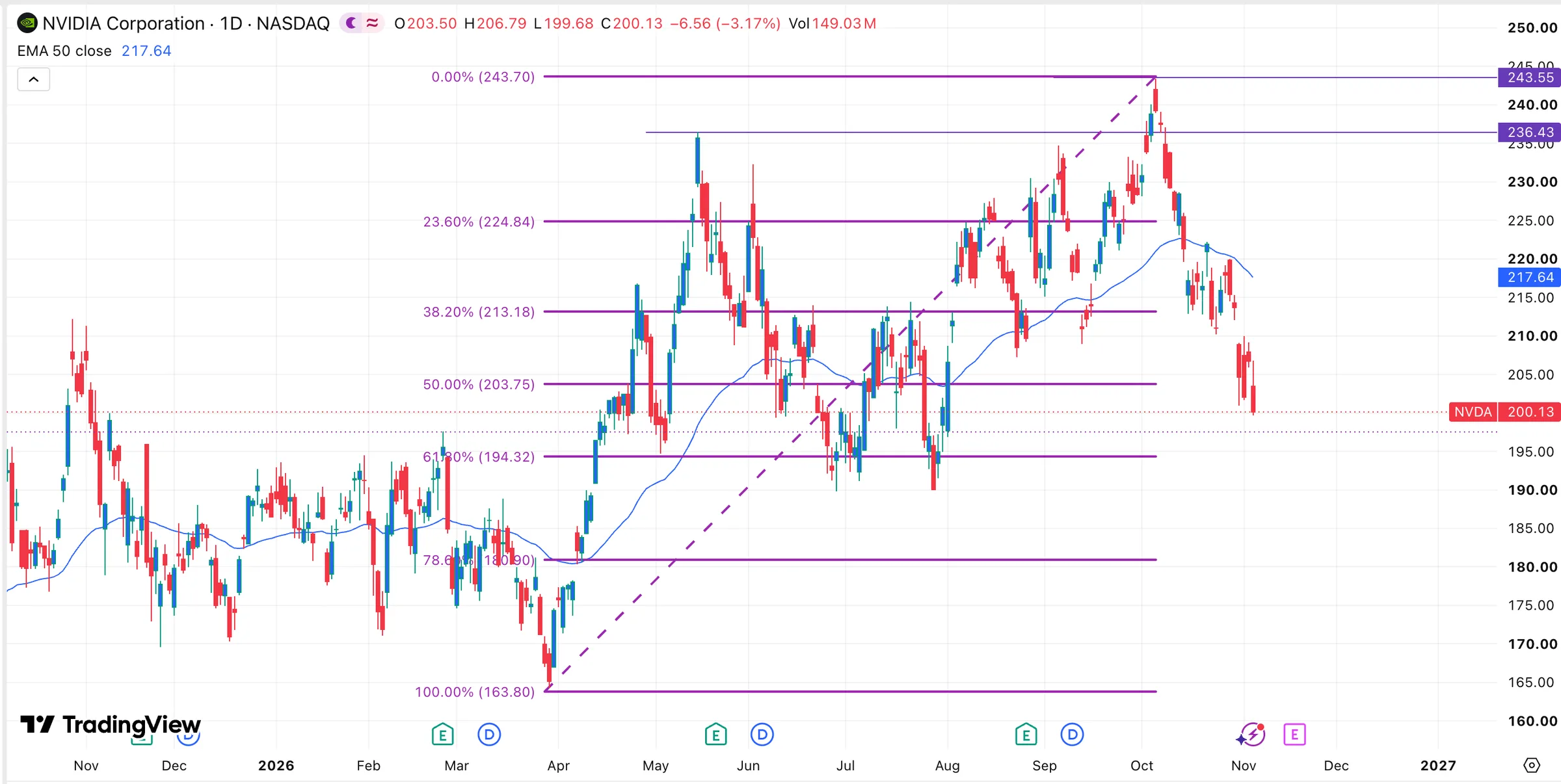
On the charts, we see that the NVDA stock is plummeting, moving from a high of $243 to below $200 today. It has already slumped below the 50% Fibonacci Retracement level and is now targeting the decisive 61.8% retracement point.
The stock has also slipped below the 200-day moving average. Also, all oscillators like the Relative Strength Index (RSI) and the MACD have pointed downwards.
Therefore, the stock will likely continue to push downwards in the coming days. If this happens, it may drop to the 61.8% retracement level of $194 and then resume the downward trend.
This article provides market analysis, not investment advice. Stock prices can fluctuate, and technical projections do not guarantee future returns.