
 Bitcoin
 EVAA Protocol
 Ethereum
 Monero
 Aave
 Pearl
 Hyperliquid


Ethereum price prediction remained under pressure on Nov. 19 as ETH traded near $1,800. Large market participants continued selling, while smaller traders showed buying activity during the downturn.
Meanwhile, Binance’s seven-day average Ethereum reserves reached their lowest level since November 2020. U.S. spot Ethereum exchange-traded funds (ETFs) also recorded a third consecutive session of net withdrawals.
Technical analysts identified $1,710 as an important downside level. A sustained breakdown could expose ETH to further losses toward $1,500.
Large Ethereum Holders Sell While Retail Buyers Step In
Ethereum traded at $1,804 on Thursday, down 0.55% over 24 hours and 12% across seven days. The network’s token has struggled to recover after successive lower highs and lower lows since early October. Market capitalization stood at $220 billion, with daily volume reaching $10.7 billion.
The recent $1,734 low remains a nearby support reference, while $1,817 marks an initial level for any sustained rebound.
Alphractal analyst Joao Wedson reported selling by participants handling transactions between $100,000 and $10 million across several exchanges. Smaller participants continued purchasing during the same period.
Wedson also identified a concentration of potential liquidations around $1,200 on Hyperliquid. However, those positions can change before ETH crypto approaches that level.
Binance ETH Reserves Hit Lowest Since November 2020
CryptoQuant contributor CryptoOnchain reported that Binance’s seven-day average ETH reserves fell to 2.97 million through November 17. The reading marked their lowest level since November 2, 2020. Binance’s reserves dropped 11.3% over 30 days as Ethereum’s price declined 18.7% during the same period.
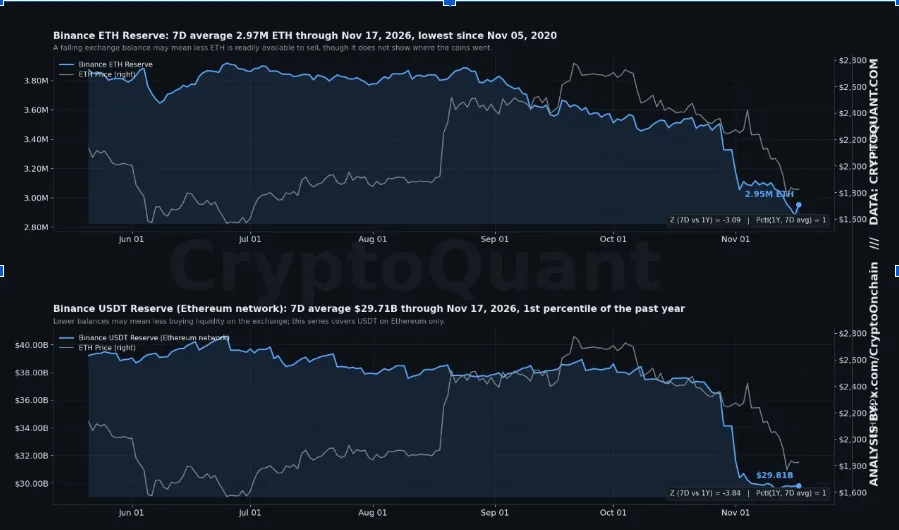
The decline was more concentrated at Binance than at other major exchanges. Combined exchange reserves fell 2.1% to 14.54 million ETH, while Coinbase holdings remained near 3.13 million. Binance’s seven-day average USDT reserves on Ethereum also reached $29.71 billion. Across monitored exchanges, USDT balances on Ethereum stood at $41.35 billion, down 11.5%.
CryptoOnchain said ETH might be moving into private wallets or staking, although available data did not confirm its destination. Binance’s estimated leverage ratio reached 0.84, while exchange-wide Ethereum open interest dropped 18.2% to $9.53 billion.
Lower reserves can lift the ratio without participants adding positions. The analyst’s composite reading remained neutral at 0.23.
Ethereum Price Prediction Focuses on This Support
ETH/USDT one-hour chart shows a symmetrical triangle forming after Ethereum’s recent decline. The pattern connects lower highs with higher lows, reflecting a narrowing price range.
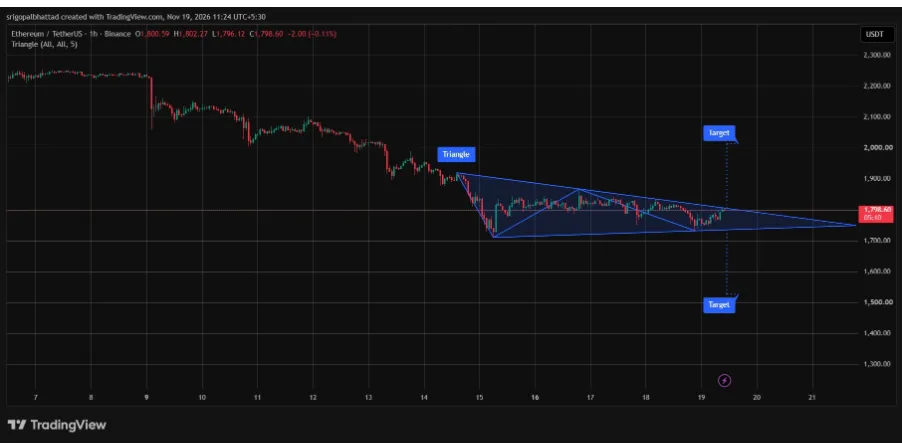
The analyst identified $1,850 to $1,900 as the area ETH must clear for a possible move toward $2,050. A break beneath $1,710 could instead open a path toward $1,500.
Ethereum price prediction does not confirm either outcome. Separately, the daily lower Bollinger Band sat near $1,663, while the 20-day moving average stood around $2,067.63.
ETF Withdrawals Accompany ETH Price Prediction
US spot Ethereum ETFs posted $39.8 million in net withdrawals on November 18, according to Farside Investors. That marked a third consecutive negative session, with five-session outflows totaling $145.5 million. BlackRock’s ETHA accounted for $17.4 million, while its staked Ethereum product recorded another $5.4 million. Grayscale’s two products accounted for the remaining $17 million.
CoinShares also disclosed the sale of its $16.6 million Ethereum treasury position as part of a broader share repurchase plan. Meanwhile, Federal Reserve meeting minutes released Wednesday showed policymakers discussing the prospect of further monetary tightening under their economic forecasts.
On a two-week chart, analyst Crypto Patel marked $1,000 to $1,500 as a historical accumulation region. Patel identified $1,000 as longer-term support and outlined a possible cycle peak in 2027 or 2028.
This article provides market information and analysis, not investment advice. Cryptocurrency prices remain volatile, and technical forecasts do not guarantee future performance.