Quantus
 Starknet
 Pearl
Pearl Celestia
 Injective
 Sui
Sui NEAR Protocol

Key Insights:
- Bitcoin’s accumulation trend shows weakening demand from institutional investors.
- Reduced network activity and fewer active addresses point to declining market interest.
- Long-term holders are increasing positions, while short-term traders reduce exposure.
Despite market fluctuations, Bitcoin‘s (BTC) price has shown resilience, recovering from recent dips. The price fell as low as $93,500 to start the week off on a bad note, which alarmed dealers.
However, the bulls quickly regained control, defending that level and propelling the price upward. By mid-week, Bitcoin surged past the $96,000 mark and reached $97,000 before settling at $98,771. It was an impressive 1.58% increase in the last 24 hours and a 1.75% rise over the past week.
While these short-term gains are promising, the underlying market dynamics indicate that BTC may be at a crossroads. Institutional sentiment and key indicators indicated potential risks ahead.
Bitcoin Accumulation Trend Score Decline: A Warning Sign Amid Price Recovery
Despite BTC’s recent price recovery, a deeper analysis of its Accumulation Trend Score (ATS) painted a more cautionary picture. The ATS has shown a noticeable downward trend from late 2024 through February 2025. It usually tracks Bitcoin price movements alongside its accumulation activity.
The ATS fluctuates with price shifts but has been consistently lower recently. This decline suggested that BTC price was holding steady. However, large holders or institutional players may not be as eager to accumulate at current levels.
This stagnation or potential distribution in accumulation could signal a decrease in confidence among the biggest players in the market. Such behavior typically hinted at a lack of new demand from institutional investors.
This raises questions about the sustainability of Bitcoin’s price recovery. The absence of active accumulation is a worrying sign for those hoping for a continuation of bullish momentum.
Network Activity and Bitcoin Adoption Slows
Bitcoin’s network activity provides further insight into the current market sentiment. Data from IntoTheBlock revealed that the number of active addresses has decreased significantly in recent weeks.
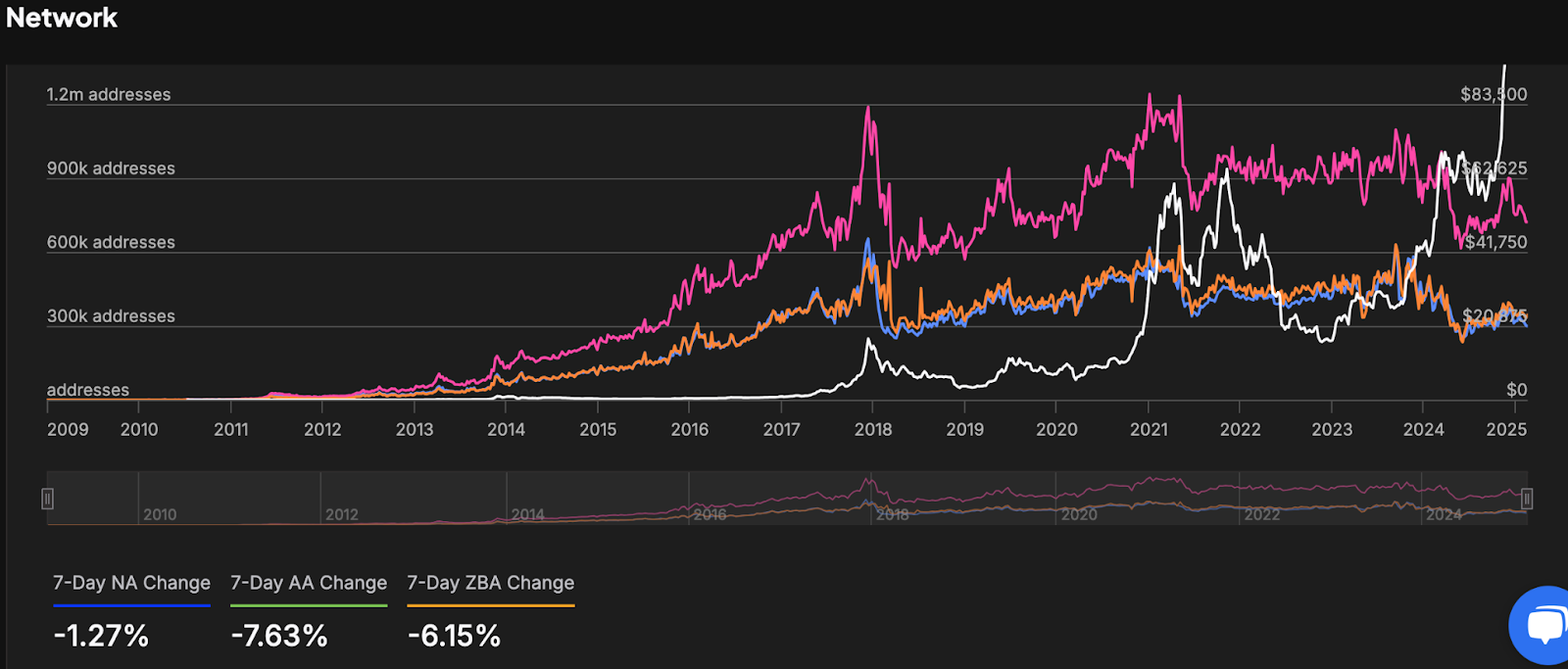
Over the past seven days, the number of new active addresses has dropped by 1.27%. At the same time, the total number of active addresses fell by 7.63%. This could indicate a reduction in the appeal of Bitcoin among new and existing users alike.
The lack of fresh engagement may be tied to the recent price instability. This could indicate that market players are awaiting more definite indications of the direction of prices.
Another noteworthy metric is the number of zero-balance addresses, which has decreased by 6.15%. This suggested that some holders abandon their wallets or redistribute their holdings. That was likely due to a lack of new investment interest.
Long-Term Holders Show Confidence, Traders Flee
BTC ownership breakdown offers additional context on the market’s current health. IntoTheBlock data indicated that long-term holders had increased their positions by 0.81% in the last 30 days.
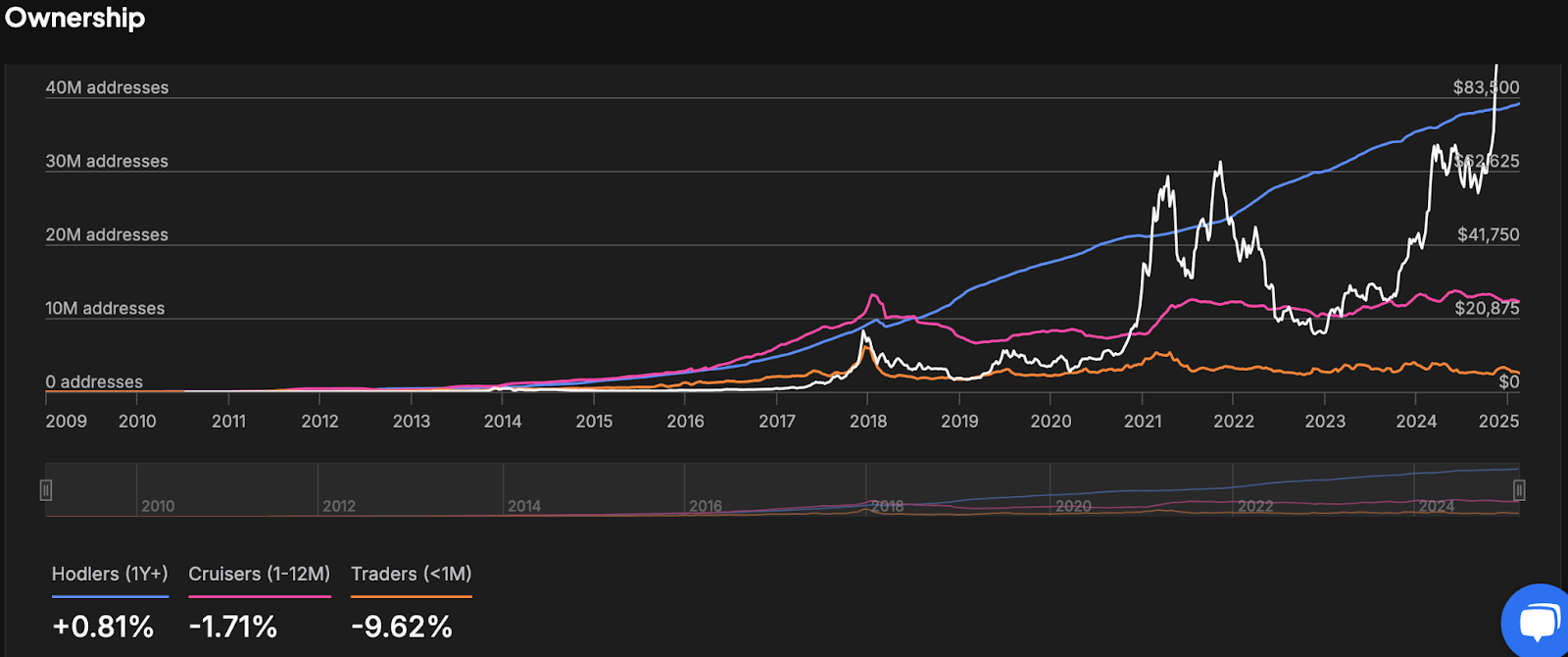
This could be seen as a sign of continued faith in the long-term value proposition of Bitcoin as a store of value. On the other hand, short- and medium-term holders have reduced their positions significantly.
Moving ahead, the number of traders (holders with less than one month of Bitcoin ownership) declined by 9.62%. This drop among traders might be due to several factors, including a cooling-off period after speculative trading.
Institutional investors may be shifting away from Bitcoin as a short-term profit vehicle. They may be in favor of long-term positions or diversifying into other assets.
JPMorgan’s Downside Risk Outlook
In related news, JPMorgan issued an alert in a recently published document. This pointed to possible weaknesses in both BTC and cryptocurrency market values. The financial services giant points to weak demand from institutional investors as a key factor behind this risk.
Further, the futures market of CME Bitcoin demonstrates weakness since its prices are below current market rates. Based on diminished demand among futures contract traders, Bitcoin price prediction for shorter timeframes remains uncertain.
The author discusses momentum decay as an issue that affects both BTC and ETH. Momentum-driven funds tend to decrease their investment in both assets.
This strengthens the downward price pressure. The absence of driving forces that stimulate market sentiment threatens Bitcoin prices.
Disclaimer
In this article, the views and opinions stated by the author or any people named are for informational purposes only, and they don’t establish the investment, financial, or any other advice. Trading or investing in cryptocurrency assets comes with a risk of financial loss.