Bitcoin
 Starknet
 Pearl
Pearl ZKsync
 NEAR Protocol
 Quantus
 Zerebro
Astar Network has already implemented its ASTR token into Chainlink CCIP and SuperchainERC20 standard. This allows safe and smooth cross-chain transfers.
The Astar Evolution Phase 1.5 upgrade removes wrapped tokens and liquidity pools. It replaces them with easy two-click transfers through the Astar Portal for a streamlined experience.
ASTR Becomes a Cross-Chain Token with Unified Standards
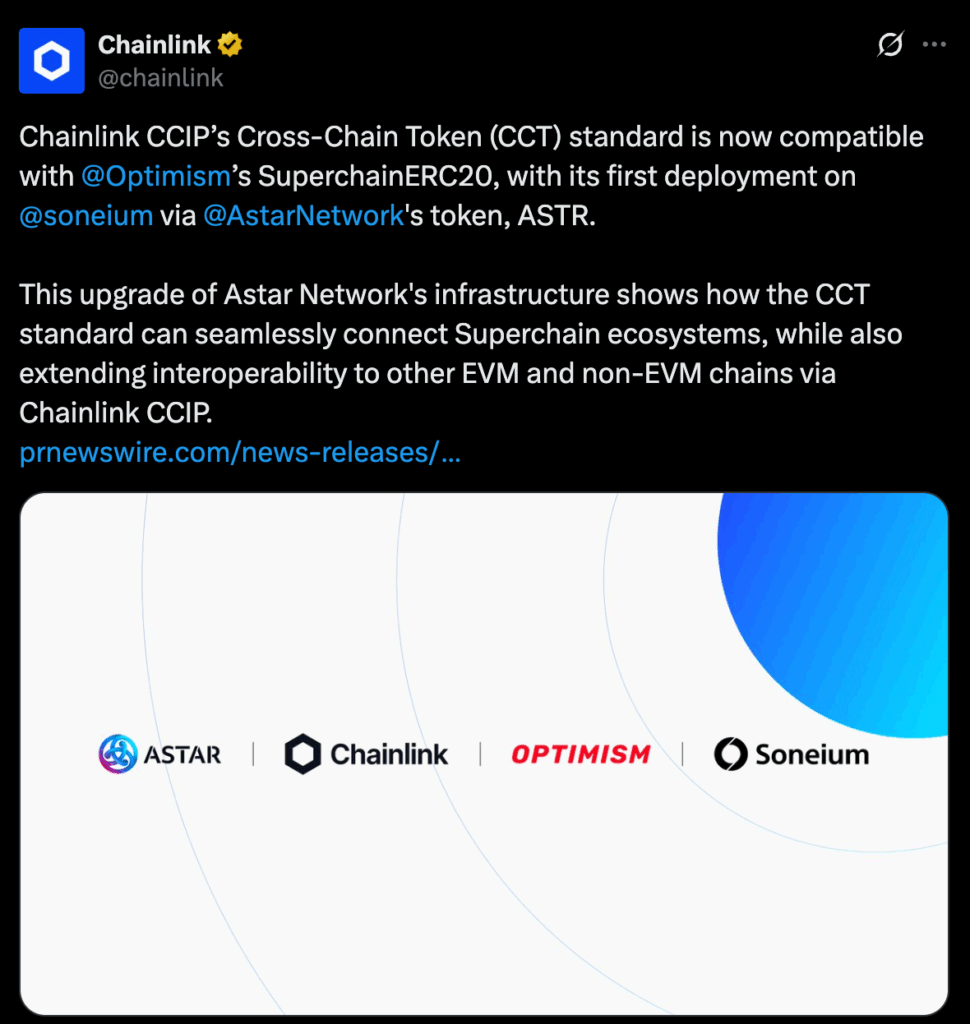
Astar Network introduced the SuperchainERC20 standard to enhance cross-chain compatibility with its ASTR token. The CCIP protocol by Chainlink enables secure token transfers. It connects Polkadot-based Astar with Ethereum-based networks.
The integration allows ASTR tokens to move natively across Astar. They can also transfer within Sony’s Soneium chain and Optimism Superchain networks.
In this new architecture, burn-and-mint replaces the liquidity pools. The supply is preserved through the burning of ASTR tokens on the source chain and minting on the destination. This minimizes the risks associated with wrapped assets and fractured liquidity across platforms.
Chainlink decentralized oracles can verify source-chain transactions and then securely relay them to the destination network. Such a design avoids single points of failure and has every step verified independently. The developers enjoy having a standard that is scalable and interoperable.
Soneium Becomes First Superchain Destination for ASTR
The upgrade made ASTR the first Cross-Chain Token (CCT) to be functional on the Soneium Mainnet developed by Sony. The OP Stack-based Soneium chain offers low-fees and high-speed transactions designed with consumer and entertainment applications in mind.
It serves as a live test bed to implement ASTR cross-chain capabilities. The Soneium deployment is enabled by ERC-7802 functions such as CrosschainMint and CrosschainBurn.
These functions make the cross-chain token behaviour standardised and easier to interoperate with other dApps that are compatible with Superchain. This makes the token logic across chains consistent without any asset wrapping.
The engineering team at Astar Network adopted the UUPS proxy upgrade pattern of OpenZeppelin to provide flexibility to contracts. Also, access control ensures that only Chainlink-approved bridge contracts can mint or burn. Security was certified by independent audit by Cyfrin.
ASTR Token Expands Cross-Chain Capabilities with Chainlink CCIP
The ASTR token extends beyond governance and staking. It enables broader applications in DeFi, gaming, and creative sectors.
Chainlink CCIP enables developers to add cross-chain capabilities to dApps in a composable token model. This method reduces the expense and intricacy of creating cross-chain frameworks.
The execution enables applications to gain access to consolidated liquidity between Superchain and Polkadot-connected ecosystems.
Projects no longer have to lock tokens or keep several wrapped versions across networks. Consequently, developers will be able to build apps that bridge across several ecosystems on a single token.
Superchains enhance interoperability, allowing ASTR tokens to move seamlessly. They can reach OP Mainnet, Base, and World Chain without fragmentation.
When destination networks have attained Stage 1 status, inter-chain transfers will require just two clicks. This infrastructure offers a scalable Web3 growth.
Tokenomics Shift Supports Interoperability Rollout
Alongside the technical upgrades, Astar lowered the base staking reward of the ASTR token in April by half, to 10%. This reduced the inflation rate in a year by 4.86% to 4.32%, and the emissions were cut by around 11%.
The tokenomics update helps facilitate the aim of sustaining the supply when it becomes a multi-chain token. Variable-rate emissions are also being considered in other networks, such as Solana.
The relocation of Astar is a part of a wider movement towards the equilibrium between supply-side mechanics and utility-based demand. This synchronization of infrastructure improvements and tokenomics is important to facilitate sustainable adoption.