streamoors
 Altai the Tiger
 Sword Inu
 IGNITION
 no crying in the casino
 Quantus
 Pearl
Pearl

Key Insights:
- Jerome Powell signals Fed’s shift on crypto oversight and regulation.
- Senate advances stablecoin bill as Fed reconsiders crypto policies.
- Bitcoin shows strength in Wyckoff accumulation, nearing markup phase.
Federal Reserve Chair Jerome Powell stated that crypto assets, including Bitcoin and stablecoins, have grown more mainstream and mature. This prompted the central bank to reassess past regulatory guidance.
Powell’s remarks came during a June 25 testimony before the Senate Banking Committee. Senator Cynthia Lummis questioned him about the Federal Reserve’s 2023 policy under Section 9(13).

This policy was issued in January 2023. It has outlined how the Fed would supervise “novel activities” involving distributed ledger technology, stablecoins, and other crypto-related initiatives.
The statement emphasized that activities involving public or decentralized blockchain networks were likely inconsistent with safe and sound banking practices. Powell acknowledged that the crypto sector had advanced since that guidance was issued.
He noted that regulatory bodies are now re-evaluating prior decisions made during what he described as crypto’s earlier development phase. The central bank chief stated that the 2023 policy under Section 9(13) was part of a wider regulatory structure.
It was not aimed solely at digital assets. However, he confirmed that crypto still plays a role within that structure. Senator Lummis, involved in crypto legislation, sought clarity on the Fed’s intentions. She asked if the earlier stance would be revised or withdrawn.
Stablecoin Oversight Gains Momentum
As federal regulators weigh adjustments, legislative activity around stablecoins has also accelerated. The U.S. Senate passed the GENIUS Act just days before Powell’s testimony. It is a bill aiming to establish a regulatory structure for issuing and trading stablecoins.
The bill garnered bipartisan support and could move to the White House for signing later this summer, pending House approval. In parallel, House lawmakers continue to deliberate over the CLARITY Act. This addresses broader crypto market structures.
The Federal Reserve has issued new guidance, marking a shift in tone. It will no longer consider “reputational risk” when supervising banks. Previously, this was a rationale to restrict institutions exploring crypto-related activities.
Powell emphasized that banks should have the freedom to choose their clients. He said they can engage in various business activities, including crypto.
These activities must align with safety and soundness guidelines. The aim is to ensure responsible innovation within the banking sector. His comments signal a possible recalibration of regulatory posture in light of evolving market dynamics.
Bitcoin Accumulation Phase Nears End
With this reversed regulation, analysts are still monitoring the technical system of Bitcoin. On July 25, an analyst, MartyParty, noticed that Bitcoin has been hitting the Wyckoff accumulation schematic since late 2024. At that time, it reached $108,280.
The Wyckoff method lists five essential steps to explain the behavior of accumulation and distribution during the market cycles. MartyParty said that Bitcoin is fulfilling this structure following an early decline around the $106,400 Automatic Reaction trendline.
It subsequently attempted another tireless takeoff on January 20 at $109,354. After these movements, Bitcoin entered an accumulation stage that began in February. The crypto lingered until it reached the spring level in early April.
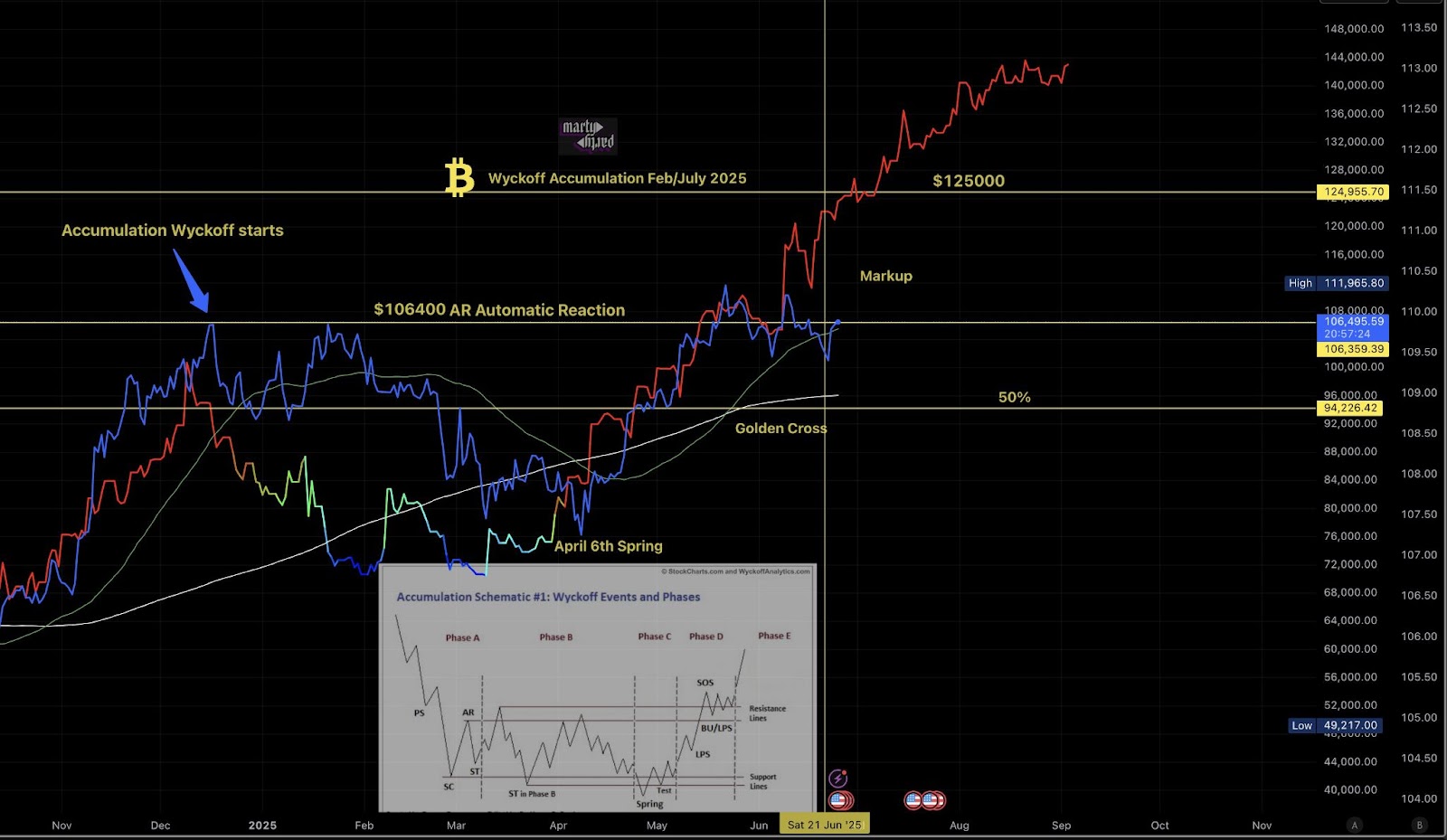
The prices then declined to $74,441. This coincides with the third stage of the Wyckoff model. By late April, the asset began to recover. It retraced to $93,450 by May 6, forming a final support level.
Then, on May 22, it hit a new all-time high of $112,000. This marked the beginning of Phase D in the schematic. Nevertheless, there has been resistance at the vertical trendline of the $106,400 mark.
Also, Bitcoin has not been able to sustain itself above this level. Nonetheless, MartyParty opined that the end of the accumulation phase is upon us.
He indicated that the asset is poised to enter the “markup” phase, the final segment of the schematic. He also linked this potential move to increasing global liquidity, which could fuel a further rally.
According to his projections, Bitcoin’s next target is a 17% rise to $125,000. Should momentum persist, his attached chart suggested a possible surge to approximately $144,000.
Disclaimer
This article is for informational purposes only and provides no financial, investment, or other advice. The author or any people mentioned in this article are not responsible for any financial loss that may occur from investing in or trading. Please do your research before making any financial decisions.