Zylo Ecosystem
 astronaut
 Pearl
Pearl Walrus
 Starknet
 Pudgy Penguins
 Bitcoin
Key Insights:
- Nvidia stock retreated after OpenAI selected it for its custom AI chips.
- Nvidia is facing substantial competition pressure, including from China.
- Technical analysis points to more NVDA stock gains despite these challenges.
Nvidia stock price slipped by 60 basis points in the premarket session as concerns about competition in the industry remained. Precisely, traders reacted to a report that OpenAI would start creating AI chips using Broadcom.
Nvidia Stock Dips After New Broadcom News
OpenAI is the most valuable artificial intelligence startup. It will begin mass‑producing custom chips for AI applications. The project partners with Broadcom. It is a tech giant valued at over $1.44 Trillion.
The new chip will begin shipping next year. It signals a strategic shift for some companies toward making custom semiconductors. This reduces reliance on Nvidia, which currently dominates the industry.
OpenAI is the latest large company to embrace the custom of creating its own chips. For example, Apple ended its partnership with Intel. It now uses custom chips on most of its devices, like the iPhone and the MacBook.
Companies like Microsoft and Amazon are all building their own chips, mostly by collaborating with Marvell Technologies and Taiwan Semiconductor. Broadcom believes the new shift could be a game-changer for the company. It recently hinted at a new customer committing over $10 billion in orders.
Still, it is unclear whether the new developments will hurt Nvidia, as it has a long track record of beating competitors. For example, despite its massive investments, AMD has a small market share in the AI data center industry.
Most notably, Nvidia is significantly ahead of any other company in the chip industry. This means that most of the competition will be playing catch-up.
Its other advantage against other companies is the Compute Unified Device Architecture (CUDA). This software enables companies to harness the power of its chips in high-performance industries like AI and gaming. CUDA has a large market share and has proven hard to replicate.
Most importantly, whether OpenAI is a big Nvidia customer is still unclear. Instead, most of its customers, accounting for over 50% of revenue, are hyperscalers like Microsoft, Amazon, Google, and Meta Platforms.
China Demand Still Rising
The other competition for Nvidia is coming from China. It’s a country determined to win the AI and technology race against the United States.
Several companies have invested billions of dollars in building GPUs and CPUs that will compete with Nvidia in the long term. Some of the most notable ones are Huawei, Alibaba, and Cambricon.
Despite their progress, most Chinese companies are still dependent on Nvidia for their intensive workloads, as we reported this week. Meanwhile, analysts are highly optimistic about Nvidia’s business even after it warned that its business was slowing.
The average estimate is that its quarterly revenue will grow by 55% in the next two quarters. This brings its annual revenue to $206 billion.
It will then make $273 billion in revenue in the coming year. Some analysts see it crossing the $500 billion milestone in the next few years. The move would make it the most profitable company globally because of its superior profit margins.
NVDA Stock Price Analysis
The daily timeframe chart shows that the NVDA stock price continues to move horizontally. Since July this year, it has remained inside the support and resistance levels at $170 and $184.
The ongoing consolidation could be part of forming the bullish flag pattern. This usually leads to a strong bullish breakout.
Nvidia stock price remains above the 50-day and 100-day Exponential Moving Averages (EMAs). It is also above the Major S/R pivot point of the Murrey Math Lines.
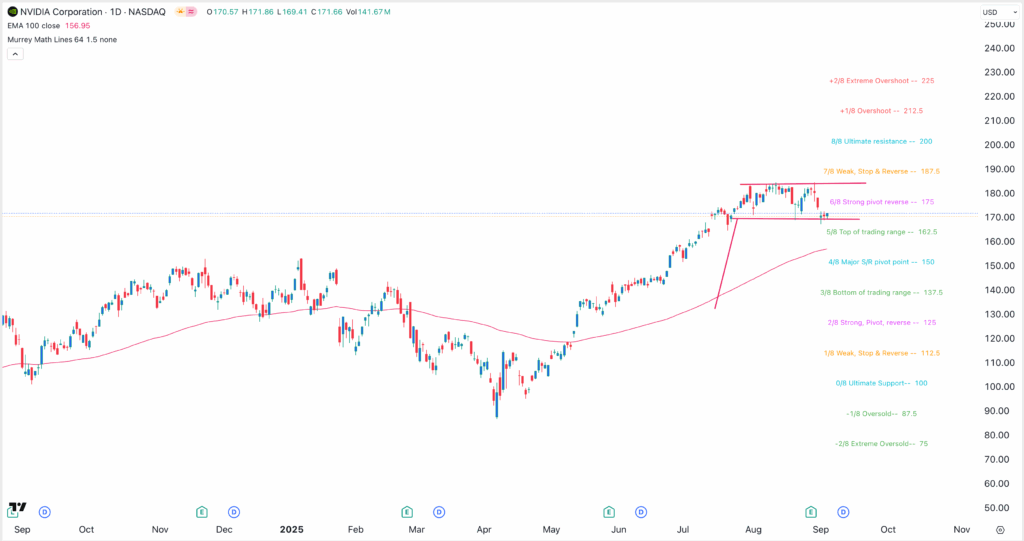
Therefore, the most likely Nvidia stock price forecast is bullish. With this, the next key level to watch is the all-time high of $184.
A move above that resistance level could signal further gains. It may reach the psychological level of $200. An extreme overshoot could push it to $225.
Disclaimer
This article is for informational purposes only and provides no financial, investment, or other advice. The author or any people mentioned in this article are not responsible for any financial loss that may occur from investing in or trading. Please do your research before making any financial decisions.