streamoors
 IGNITION
 no crying in the casino
 Sword Inu
 Altai the Tiger
 NEAR Protocol
 Quantus

Key Insights:
- Ethereum’s stablecoin supply has soared to $165 billion, adding $5 billion in just a week.
- The network now commands a 57% market share, far surpassing Tron and Solana.
- Institutional adoption continues rising, with Fidelity leading the way into tokenized finance.
Ethereum, the top smart contract platform in the world, has reached a new milestone in 2025.
The total stablecoin supply on the network has gone to an unprecedented value of $165 billion, having increased by almost $5 billion in just one week.
That is the equivalent of nearly $1 billion per day flowing into Ethereum-based stablecoins such as USDT and USDC.
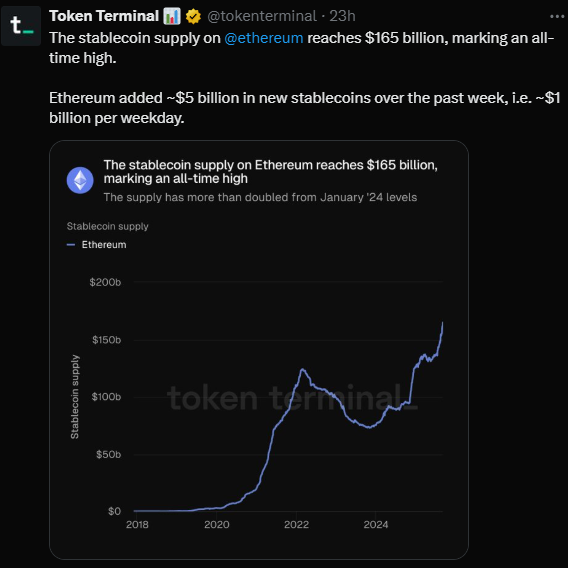
This exponential expansion indicates that Ethereum remains the leader in the critical area of crypto, stablecoins.
The number of stablecoins on Ethereum has doubled since January 2024, solidifying the network as the financial foundation of the digital asset ecosystem.
As per the Token Terminal, Ethereum now holds 57% of the world’s supply of stablecoins, further strengthening its status as the default blockchain for dollar-pegged assets.
Comparatively, its closest competitor is Tron, which captures only 27%, and Solana is even further behind at less than 4%.
How Ethereum Stablecoin Growth Enhances Market Efficiency
Stablecoins have become the blood of crypto markets. They serve as on-chain dollar proxies, the backbone of decentralized exchanges (DEXs) and even cross-border payments.
The high dominance here demonstrates the strength of Ethereum in terms of security, strong liquidity, and institutional reliability.
The stablecoin minting saw a 6.7% week-on-week growth in the ecosystem, with the USDC and USDT contributing a lot.
Notably, Ethereum is not merely winning due to hype but has come to be used as a settlement layer for the choice between crypto-native and institutional-grade stablecoin transactions.
Nevertheless, this development is paradoxical.
Although the use of stablecoins is booming, a good portion of the volume of transactions has moved out of the Ethereum mainnet to layer-2s, such as Arbitrum, Optimism, and Base.
Almost one out of every 10 stablecoin transactions is already present on these cheaper scaling chains, reducing congestion but lowering the fees collected by Ethereum itself.
Market Dominance and Industry Competition
Beyond stablecoins, Ethereum has quietly emerged as the place of tokenized real-world assets.
The supply of tokenized gold on-chain has doubled year-to-year, reaching 2.4 billion.
With Polygon added, the network commands a staggering 77% dominance in commodity tokenization, rising to almost 97%.
This is not just a wave in commodities. Old financial giants are also coming in.
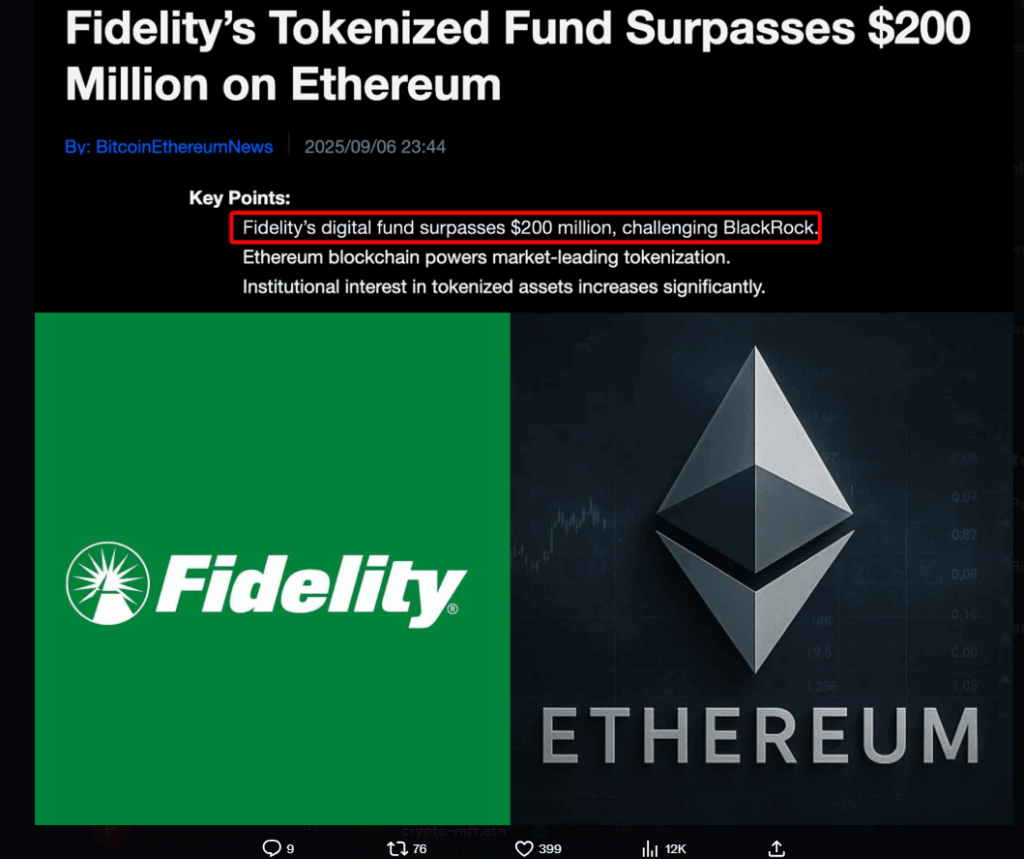
For example, Fidelity announced its Digital Interest Token (FDIT) on Ethereum in September, drawing over 200 million assets in weeks.
These actions underscore the rising adoption of Ethereum as a securitized finance product on Wall Street.
Even U.S Treasuries, which have long been regarded as the backbone of global finance, are finding their way onto Ethereum.
The treasury products that have been tokenized have already reached billions of dollars in value and provide investors with easy, blockchain-based access to government securities without intermediaries.
Is Ethereum Price Set for a $5k Breakout?
Amidst sustained ETF inflows and increased transactional volume on Layer 2 solutions, ETH has faced a significant retracement in the past two weeks.
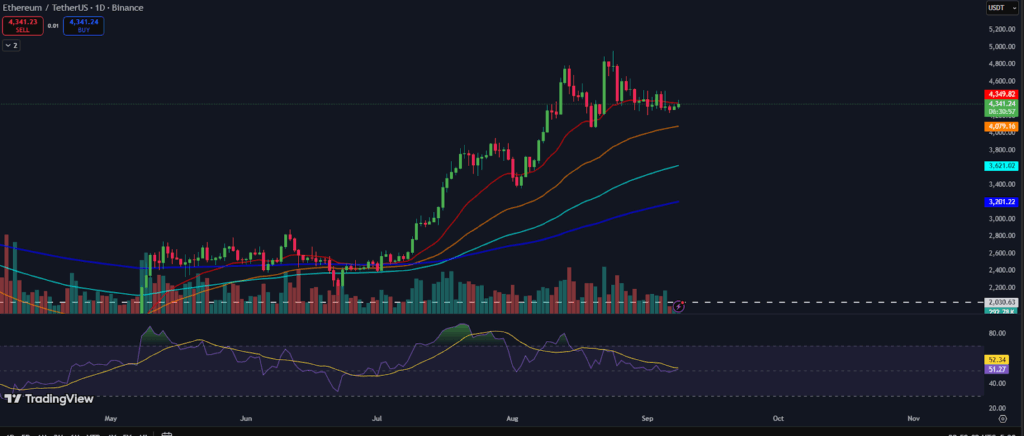
While the bullish sentiment is still on the cards, the Ethereum price holds the 20-day EMA support of $4300 and eyes a rebound. Notably, ETH coin trades in a major uptrend and continued to plot higher highs and higher lows on the larger timeframes.
Once Ethereum price moves past the $5k psychological hurdle, a fresh leg of bullishness will push ETH toward $5800 and $6000 ahead. While a break below $4000 could fuel bearish pressure, a drop toward $3600 could be seen ahead.