astronaut
 Pearl
Pearl NEAR Protocol
 Starknet
 Zcash
Zcash Pudgy Penguins
 Ethena
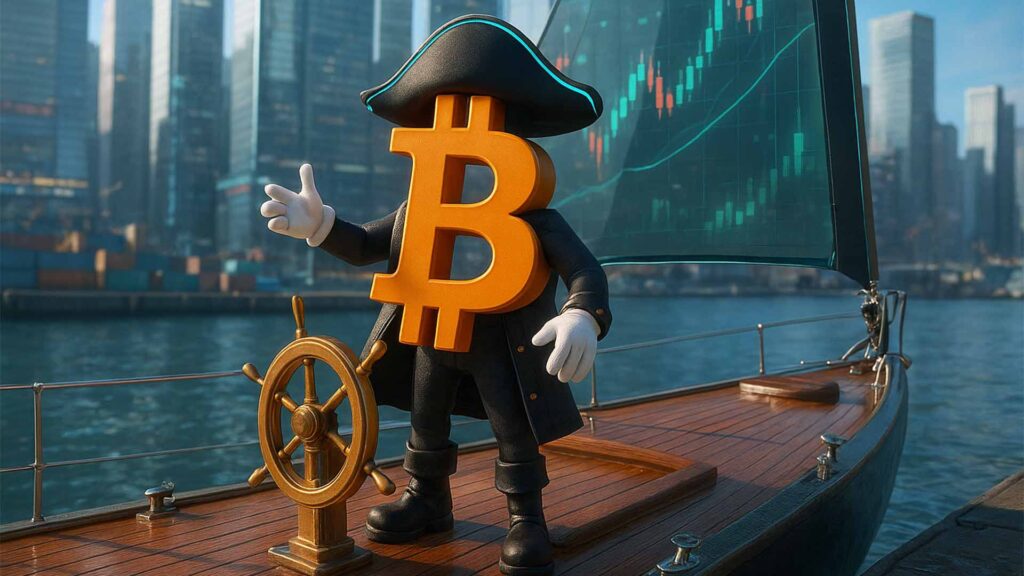
CryptoQuant founder Ki Young Ju has called Bitcoin USD “pirate fintech” after Jack Dorsey said “Bitcoin is not crypto.”
Their comments have drawn attention to Bitcoin’s identity and how it differs from other digital assets.
Market participants are now discussing what this could mean for investors and the wider market.
Jack Dorsey and Ki Young Ju’s Take on Bitcoin USD as Technology
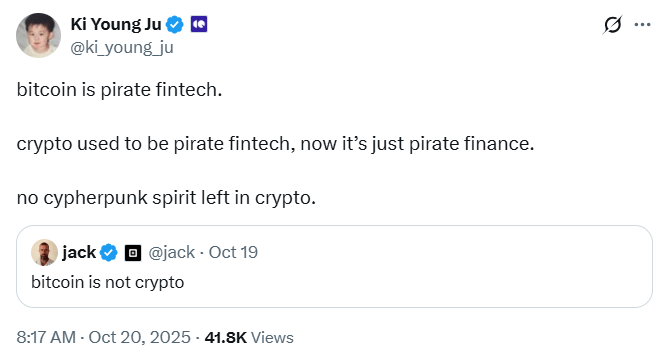
A new discussion has started on social media after Jack Dorsey, founder of Twitter and Square Inc., said, Bitcoin is not crypto.
His post quickly spread across the Bitcoin community. Soon after, Ki Young Ju, founder of analytics firm CryptoQuant, replied by calling Bitcoin a pirate fintech.
Ju added that Bitcoin used to be what he called pirate fintech, but that most of the current crypto industry has turned into pirate finance.
He said the cypherpunk spirit that once guided early crypto users has faded.
Ju’s remark points to a belief that Bitcoin remains close to its original idea of freedom and self-control.
Moreover, newer crypto projects have become more focused on profits and speculation.
Both Dorsey and Ju have long supported Bitcoin’s role as a technology for open and secure finance. Dorsey’s company, Block, has invested heavily in Bitcoin projects.
His view separates Bitcoin USD from the broader crypto space, which he believes has lost focus on decentralization.
Ju’s statement builds on that view, describing Bitcoin as a financial tool created by independent thinkers outside traditional banking systems.
Their exchange has reignited an old debate about what Bitcoin truly represents. To some, it is digital gold and a hedge against inflation.
Still, to others, it remains a technology experiment that seeks to fix problems in the global financial system.
Bitcoin USD Supply and Gold Demand
Alongside this debate, another discussion has compared Bitcoin’s supply with gold’s.
Hunter Horsley, CEO of Bitwise Asset Management, shared recent data showing that in 2024, around 3,660 tons of gold were mined and 1,370 tons were recycled.
That is roughly $680 billion in new gold that buyers had to absorb to keep prices steady.
In his post on X, Horsley explained that Bitcoin’s new supply is much smaller. About 164,000 new Bitcoin units are mined each year, equal to around $24 billion at current prices.
Because this number is lower, Bitcoin might not need as many new buyers as gold to maintain its value.
He said this makes Bitcoin a strong candidate to become a better store of value than gold.
Additionally, Bitcoin’s fixed supply and predictable issuance have always been part of its design.
Many investors see that as a strength, especially during times of inflation or market uncertainty.
Market analysts have also noted that Bitcoin’s current price patterns look similar to past bull cycles in 2017 and 2021.
Some say the market has entered another growth phase after retesting its long-term support level.
They believe institutional investors continue to buy during these quiet periods, adding to market stability.
Market Outlook Ahead of Trade Talks and Rate Cuts
Broader economic events are also shaping Bitcoin’s outlook. As of writing, Bitcoin price was trading at $110,747.78, up 2.38% in the past 24 hours.
Progress in trade discussions between the United States and China has helped calm investors.
President Trump’s recent comments about finding common ground with China have added to a sense of optimism ahead of his meeting with President Xi Jinping.
Meanwhile, a major investor was reported to have opened $255 million in long positions on Bitcoin and Ethereum before the summit.
This move signals growing confidence that better trade relations could lift markets.
At the same time, expectations that the U.S. Federal Reserve could cut interest rates later in October have increased liquidity hopes.
Historically, lower interest rates often encourage investment in assets like Bitcoin USD. Investors believe that the market is gearing for a new high if all of these factors align.