astronaut
 Pearl
Pearl NEAR Protocol
 Walrus
 Zylo Ecosystem
 Bitcoin
 Hyperliquid

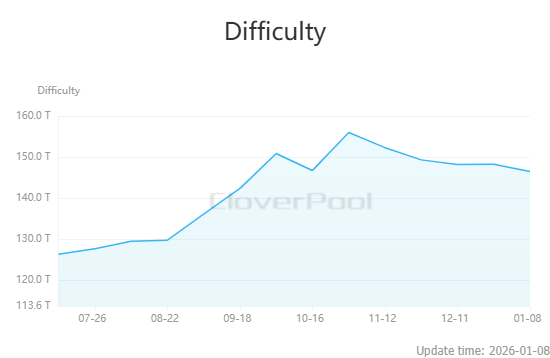
Bitcoin mining difficulty has fallen by 1.20% to 146.7T in the first change of the year. This continues the trend of declining mining difficulty, which began in late 2025.
Mining difficulty, which adjusts every 2,016 blocks, approximately every two weeks, determines how complex it is to mine Bitcoin.
Since hitting an all-time high of 155.9T in October, the difficulty has been steadily falling. However, it rose slightly to 148.1T to 148.2T on Christmas Day.
Drop in Mining Difficulty Follows Consecutive Months of Declining Hashrate
The drop in Bitcoin mining difficulty is a result of Bitcoin’s hashrate declining further. Hashrate reportedly declined for the second consecutive month in December, according to J.P. Morgan. It represents the amount of computing power on the Bitcoin network,
The investment bank noted in its report that there was a 3% drop in average hashrate in December to 1,045 EH/s. This generally indicates that some miners are shutting down their machines from the Bitcoin network.
This is not entirely surprising, given how miners are struggling to remain profitable. This has been a challenge since the 2024 halving event. However, the hashprice has fallen more substantially in the past few months.
According to the Hashrate Index, hashprice is now at $38.83, which is near the all-time low. It has been in the $40 range since mid-November, with no sign of any positive change on the horizon.
JP Morgan analysts also reported a 7% decline in average daily rewards revenue between November and December. The $38,700 per EH/s in revenue represents a 32% decline from last year’s level and is the lowest on record. Gross profits also dropped 9% to $17,100 per EH/s.
For many miners, the revenue struggles have already led to a shift towards hosting HPCs for artificial intelligence firms. Still, the decline in mining difficulty might be a positive development. This would imply that mining could become slightly easier.
Interestingly, the Bitcoin network is on track for another decline in mining difficulty in the next two weeks. According to the Cloverpool data, the next difficulty is estimated to be a 0.35% decline to 145.95T.
Bitcoin Slips Below $90,000 Again
Bitcoin falls back under $90,000 and delays relief for miners. Rising mining difficulty adds further pressure on their operations. The flagship asset had climbed as high as $94,000 a few days ago after the US’s successful operation in Venezuela.
However, it has now dropped 2.31% in the last 24 hours to $89,000. This showed that the recent uptrend might be temporary. Data from CryptoQuant also confirms this, with Bitcoin MVRV flashing bearish.
CryptoZeno noted that the MVRV Ratio is trending lower. It signals cooling momentum in the market. Traders show weakening conviction despite the high price. They noted that the market appears more poised to experience corrections and consolidation than a price rise at the moment.