astronaut
 Pearl
Pearl Zcash
Zcash Walrus
 NEAR Protocol
 Starknet
 Pudgy Penguins

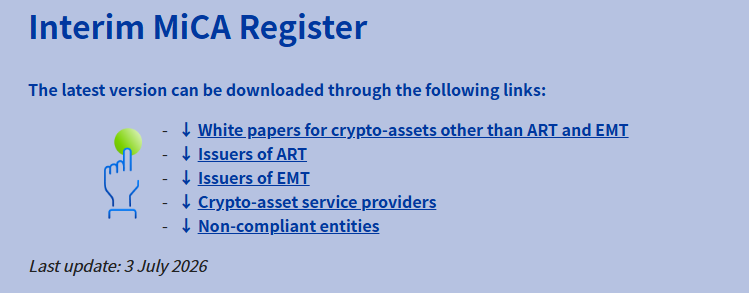
ESMA added 37 crypto-asset service providers to its interim MiCA register after the EU transition period closed. The crypto news lifted the total number of authorized crypto firms to 280 across the European Union. Standard Chartered, FalconX, Sygnum Europe, Ronin EM, and CACEIS appeared among the new names. The update shows how firms moved to secure approval before stricter EU rules took full effect. The update also gives compliance teams a fresh benchmark for screening partners under the new licensing regime across Europe this month.
Crypto News: ESMA Register Expands After MiCA Deadline
The European Securities and Markets Authority published the first register update after the July 1 deadline. The register had listed 243 firms on June 26. The latest update added 37 names in about one week.
The change followed the end of the MiCA transitional period across the bloc. Crypto firms that already served EU users had used that grace period to seek full approval. After the deadline, firms without valid authorization had to stop onboarding new clients. They also had to begin winding down regulated activity in the EU.
Standard Chartered and FalconX Join Licensed Firms
Standard Chartered received MiCA authorization from Luxembourg’s financial regulator, the CSSF, on June 25. The bank also secured an Electronic Money Institution license. That approval allows the bank to operate across EU member states under a single passporting structure.
FalconX also entered the ESMA register after gaining approval from Malta’s financial regulator, the MFSA. The institutional crypto trading firm secured its license before the July 1 cutoff. Its addition places another large market participant inside the EU rulebook.
Other new firms include Sygnum Europe, Ronin EM, and CACEIS. CACEIS serves as the asset servicing arm of Credit Agricole and Santander. Their entry shows that banks, trading firms, custody providers, and service platforms continue to seek regulated access.
MiCA Creates One Rulebook for EU Crypto Firms
MiCA gives the European Union a common framework for crypto-asset service providers. The rules cover trading platforms, custody firms, crypto issuers, and portfolio managers. Licensed firms can use one authorization to serve clients across the 27 EU countries.
That passporting model reduces the need for separate approvals in each member state. A firm licensed in Luxembourg or Malta can expand across the bloc once it meets MiCA standards. This structure gives approved firms a clear legal route into the EU market.
The rules also change how firms manage client access after the transition period. Providers without authorization cannot continue normal expansion across Europe. They must stop adding new clients while they close or reduce restricted services.
EU Crypto Market Gets Clearer Licensing Map
The larger ESMA register gives investors and companies a clearer view of approved crypto providers. Market participants can check which firms hold authorization before choosing trading, custody, or service partners. That public list may support stronger due diligence across the sector.
The number of authorized firms rose quickly near the deadline because firms faced a clear regulatory cutoff. The jump from 243 to 280 shows that several applications reached approval during the final week. It also shows that national regulators continued processing requests before and after July 1.
MiCA now places licensed firms under a common compliance structure. Approved companies can serve a market of about 450 million EU consumers. Firms that missed the deadline face a harder path because they cannot rely on the old grace period.
The next updates to the ESMA register will show how many more firms complete the licensing process. For now, the addition of 37 firms confirms that large financial groups and crypto-native companies want regulated EU access.