Pearl
Pearl Zylo Ecosystem
 Bitway
 Derive
 Walrus
 Quantus
 Pudgy Penguins
America’s crypto regulations stand on the edge as the US Senate will consider a cloture motion on September 15 for the Clarity Act. US Senator Cynthia Lummis has warned that it could be a now-or-never situation before the next major opportunity arrives in 2030. Crypto market enthusiasts would be watching these developments carefully this week.
Clarity Act: September 15 Deadline Appears Before US Senate
The CLARITY Act, which would be a major milestone in America’s crypto regulations, has not yet reached final passage. This crypto legislation faces a major hurdle in the U.S. Senate. Back in July 2025, by a 294–134 vote. Furthermore, the Senate Banking Committee later advanced its version on May 14, 2026, by a 15–9 vote.
However, the next major step is the Senate floor. Here, lawmakers are scheduled to consider a motion to invoke cloture on September 15, 2026. Note that the cloture vote is not the same as final passage. The Senate generally requires 60 votes to overcome the procedural hurdle and advance the legislation.
Even if the Senate passes its version, the bill would not necessarily become law immediately, analyst Crypto Patel reported. He said this because the Senate version differs from the text approved by the House.
Now, the September 15 vote is very important as the Senate returns from its August recess on September 14. So, the cloture vote happens the next day amid a tight calendar ahead of the November midterm elections.
US Senator Cynthia Lummis Says It’s Now Or Over Amid Just 25% Odds of Passing
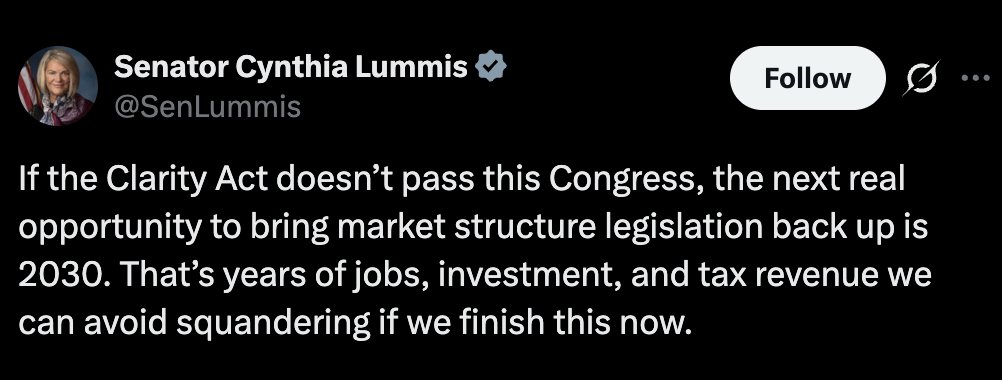
U.S. Senator Cynthia Lummis warned that if the CLARITY Act fails to pass during the current Congress, the next significant opportunity to advance crypto market structure legislation may not come until 2030.
Lummis said passing the legislation now could help prevent years of lost jobs, investment and tax revenue.
Analysts at TD Cowen noted that there’s a 25% chance the CLARITY Act will become law within the next few months.
Recent estimates have varied significantly, with some placing the odds between 10% and 25%. Prediction markets have also recently implied probabilities of roughly 20%, depending on the platform and specific contract.
Major Obstacles Ahead for Clarity Act
Some of the biggest obstacles that the CLARITY Act faces are that both parties – Republicans and Democrats – have yet to agree on stablecoin rewards. There’s a debate over how crypto companies and traditional banking systems operate differently.
Furthermore, the Democrats have raised objections to the crypto interests shown by the Trump administration. They have proposed strong ethics restrictions as part of the political debate surrounding the bill.
Moreover, another point of debate is the treatment of decentralized protocols and developers. Lawmakers face a balancing act between avoiding excessive regulation that could hinder permissionless innovation. They also need to ensure adequate consumer protection and safeguards against illicit finance.
Critics argue that the bill needs stronger safeguards against money laundering, sanctions evasion, and other forms of illicit activity. The Senate Banking Committee’s Democratic minority has specifically raised concerns about potential vulnerabilities related to illicit finance.
What Happens to the Crypto Market?
A failure to pass the CLARITY Act could lead to different outcomes for the crypto market in both the short and long term. In the short term, crypto sentiment could turn bearish, as per analyst Patel.
He expects it could trigger events such as deleveraging, long liquidations, altcoin weakness, and short-term risk-off positioning.
In the long term, failure to pass the legislation would not necessarily undermine the broader crypto market. The SEC and CFTC could continue developing regulatory frameworks.
This article is for informational purposes only and does not constitute financial advice. Cryptocurrency markets can experience sharp price movements.