Wisp
Wisp Identity.md 6900
 Bunker Mode
 Crawlerpad
 Claudia
 Pearl
Pearl NEAR Protocol

Bitcoin price remained under pressure on Sept. 16 after the U.S. Senate failed to advance the CLARITY Act. BTC traded near $75,700-$76,000, while Ethereum, Solana and XRP recorded larger declines.
BitMEX co-founder Arthur Hayes said the regulatory setback does not change Bitcoin’s long-term case. He argued that macroeconomic conditions matter more to BTC than the proposed U.S. market-structure legislation.
Bitcoin Doesn’t Need The Clarity Act, Says Arthur Hayes
During his recent podcast interview with the Altcoin Daily, Hayes said that the Clarity Act is absolutely insignificant for Bitcoin. He added that the only MOAT under the Clarity Act is limited to the US markets, to attract VC funds. Instead, he noted that the Act would be terrible for the US crypto industry, as it would limit creativity and innovation in this space.
“I think the Clarity Act is a terrible thing for US crypto for actual creativity, building useful things that have product-market fit. Bitcoin didn’t need the Clarity Act from 2009 until the present; it doesn’t need it for the future,” noted Hayes.
Instead, Hayes believes that the Bitcoin price is largely correlated with macro factors such as US Treasuries and Japanese bonds. Slamming the US government, Hayes added that it is biased towards US-based AI companies and is working with banks to arrange for capital to bail them.
He said there’s no such interest in the show for investments, even in top crypto companies like Coinbase. In this sense, Bitcoin and the crypto companies are relatively quite independent.
Bitcoin Price Can See New All-Time High In 2026
During his interview with The Rollup last week on September 8, Hayes noted that he sees Bitcoin price reaching a new all-time high before the year-end. Hayes said structural factors supporting monetary easing could eventually lead to large-scale money printing. However, he believes that the U.S. political cycle could influence the pace of policy implementation.
According to him, the Bitcoin price rally could see a sharp surge, followed by consolidation and a correction before another upward move. In his last interview with Altcoin Daily, Hayes said he barely uses technical analysis for Bitcoin and instead follows equity market analyst Milton Berg.
As per him, the Bitcoin price action has increasingly followed the U.S. stock market. He added that if the U.S. equity market weakens, investors holding similar assets on margin could face margin calls. This could push them to sell liquid assets, with Bitcoin potentially among the first.
Following the failure of the Clarity Act, Bitcoin price lost the $76,000 support. The decline has broken the local support that had been holding Bitcoin’s recent market structure. Attention is now shifting toward the $60,000–$70,000 range, a major demand zone for BTC.
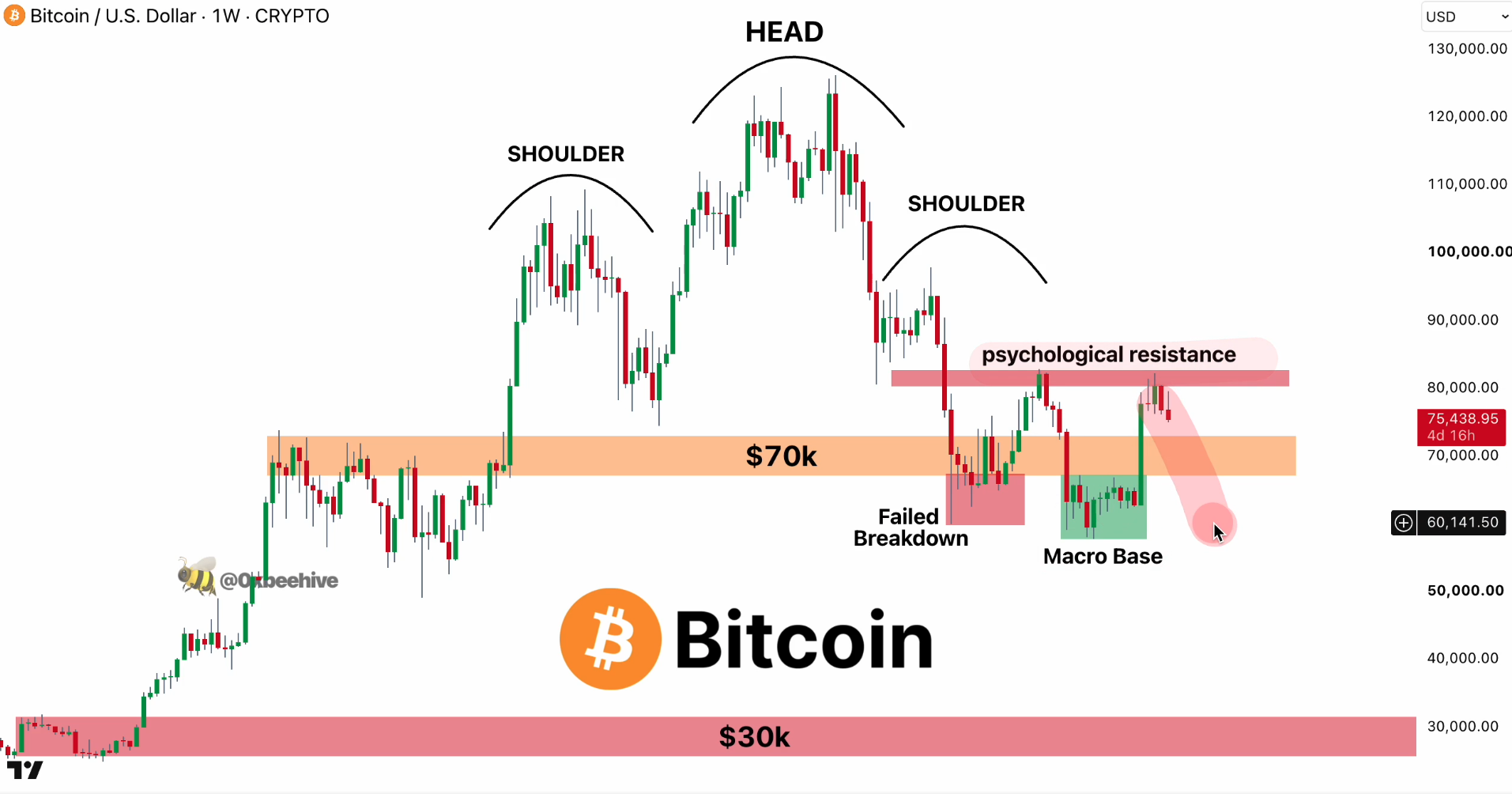
Analyst Beehive further noted that if buyers defend this zone again, the current decline could develop into a larger liquidity sweep. However, a break below the broader macro base would strengthen the bearish scenario.
Clarity Act Fails to Secure 60 Votes
The CLARITY Act failed to advance in the U.S. Senate after a procedural vote ended 49-50. It fell short of the 60 votes required for the crypto legislation to move forward. Four Republicans joined Democrats in voting against the measure, Reuters reported.
Coinbase CEO Brian Armstrong called the Senate setback a “disappointment”. However, he said that the regulatory clarity would still come through the US SEC and the CFTC, which are working to bring clearer rules.
This article is for informational purposes only and does not constitute financial or investment advice. Cryptocurrency investments involve risk, while political and macroeconomic developments can cause sharp market volatility.